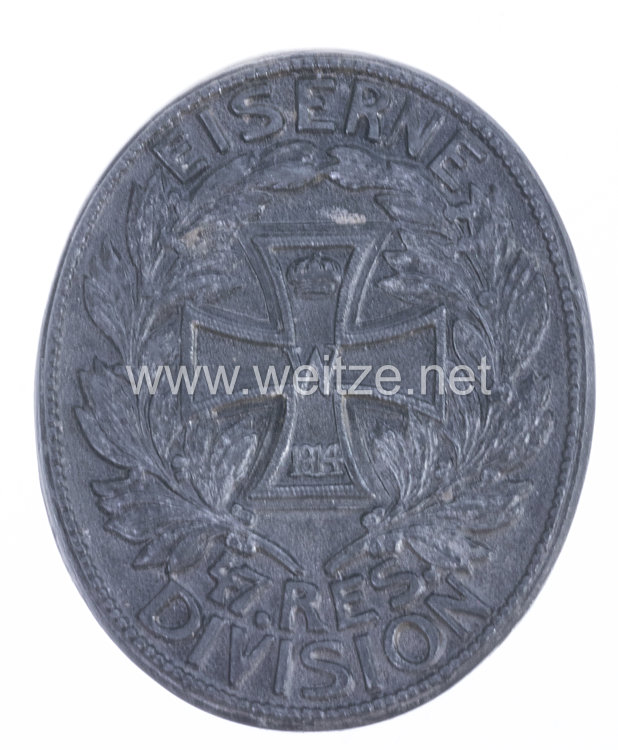
“Iron 47th Reserve Division” Portable Badge of Honor

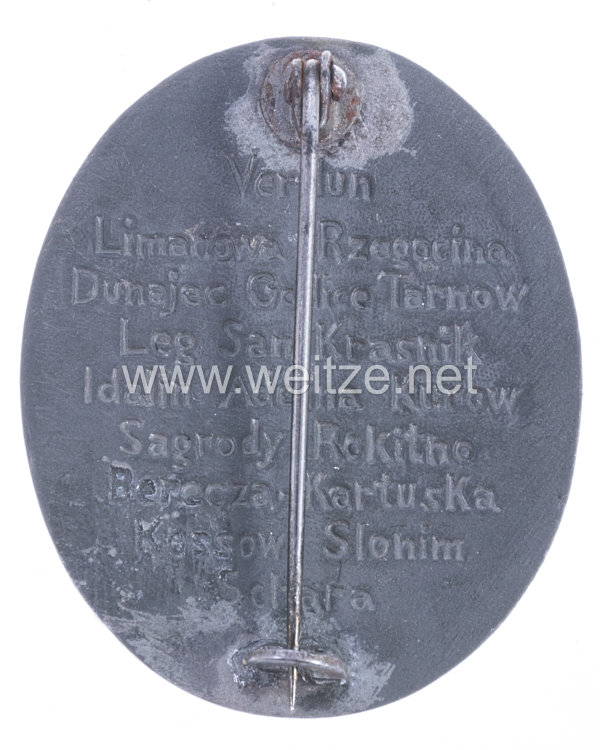
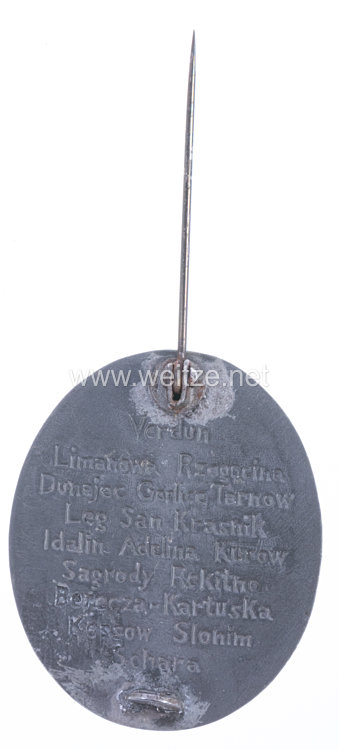
Pin-back badge, toned fine zinc, reverse with battle names: “Verdun, Limanowa...”. Catch repaired. Condition 2.
335494
100,00

“Iron 47th Reserve Division” Portable Badge of Honor

The portable badge of honor of the 47th Reserve Division represents a fascinating aspect of German military history during World War I. This type of badge belonged to the numerous unit insignia and commemorative badges created during and after the war to memorialize shared wartime experiences and strengthen esprit de corps.

The 47th Reserve Division was established at the beginning of World War I in August 1914 and belonged to the Guards Corps. It was composed primarily of reservists from Military District III (Brandenburg). The division fought on various fronts and participated in some of the war's most significant battles, as evidenced by the battle names Verdun and Limanowa inscribed on the reverse of the badge.

The Battle of Limanowa took place in December 1914 in Galicia (now Poland) and was part of the Winter Battle in the Carpathians. German and Austro-Hungarian forces achieved an important victory against the Russian Army, preventing a threatened invasion of Silesia. The 47th Reserve Division's participation in this battle demonstrates its early deployment on the Eastern Front.

Verdun, on the other hand, represents one of the most costly and symbolic battles of World War I. The Battle of Verdun raged from February to December 1916 and became emblematic of industrialized trench warfare. The 47th Reserve Division's participation there testifies to its involvement in this central event of the war on the Western Front.

This pin-back badge was manufactured from fine zinc and toned, a typical production method for military items of this period. The use of zinc instead of more precious metals was partly due to the wartime economy, but also deliberately chosen to symbolize the “iron” nature of war and Prussian virtues. The term “iron” in the badge's title emphasizes this symbolic meaning, referring to steadfastness and valor.

Such divisional badges of honor were typically commissioned by veterans' associations after the war or in its late phase. They served multiple purposes: they were recognition symbols for former comrades, mementos of shared dangers, and expressions of connection to one's military unit. The tradition of these badges dates back to the veterans' associations of the 19th century.

The reverse engraving with battle names was a characteristic feature of many such badges of honor. It documented the unit's combat history and served as permanent testimony to military achievements. Besides Verdun and Limanowa, other battles were likely listed, as suggested by the ellipsis “...”

The note about the repaired clasp indicates that this piece was actually worn and not merely kept as a collector's item. This gives the badge special historical authenticity, as it was apparently important enough to a veteran to have it repaired so he could continue wearing it.

In the context of German military history, these badges of honor also represent the processing of wartime experiences during the Weimar Republic. Veterans' organizations played an important social and political role in the interwar period. Wearing such badges at veterans' gatherings, on memorial days, or at official occasions was widespread.

Today, such divisional badges of honor are important military-historical documents. They provide researchers and collectors with insights into organizational history, the combat history of individual units, and the commemorative culture of the war generation. Each badge tells the story of a military unit and its members, preserving memories of sacrifice and service during one of history's most devastating conflicts.