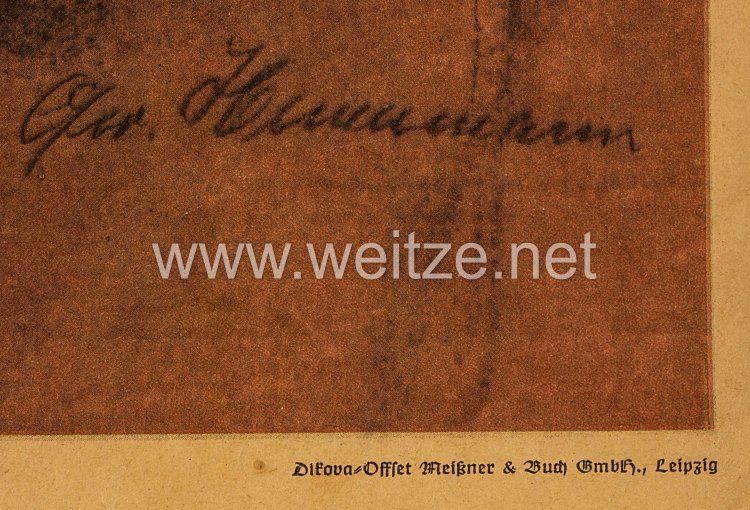
Willrich Color Poster from the Series “Vorkämpfer des Heeres” - Master Sergeant Georg Heinzmann - Knight's Cross Recipient
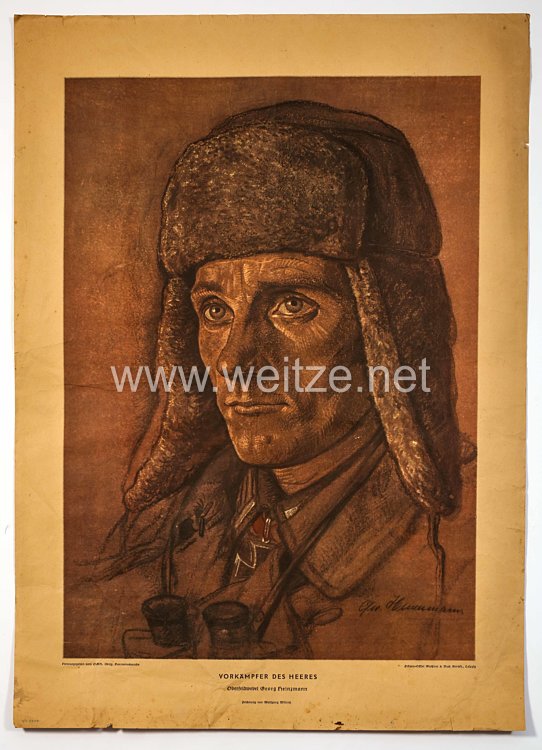
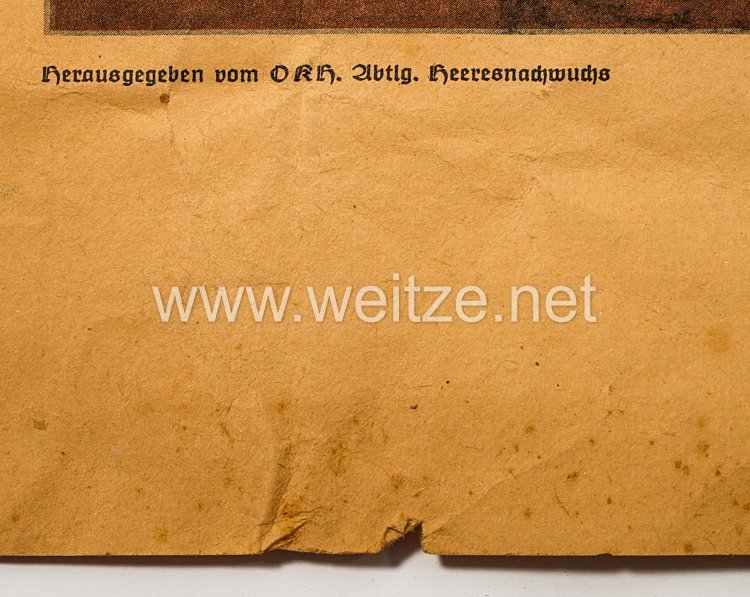
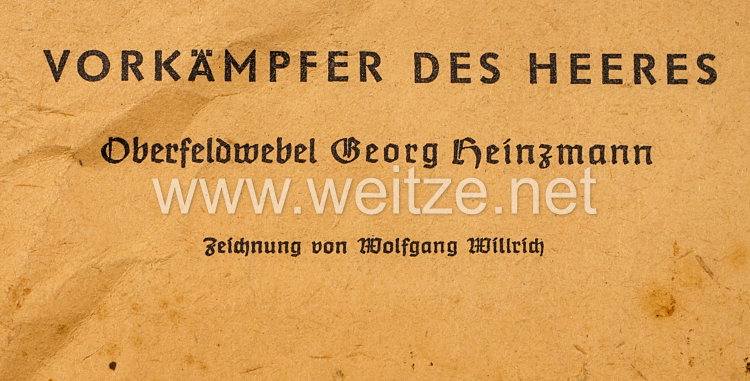
The present poster from the series “Vorkämpfer des Heeres” (Champions of the Army) depicts Oberfeldwebel Georg Heinzmann, a Knight's Cross recipient of the Wehrmacht, and was designed by artist Wolfgang Willrich. This propaganda poster series was published by the Oberkommando des Heeres (OKH), Army Recruitment Department, during World War II and served primarily to recruit and motivate young men for military service.
Wolfgang Willrich (1897-1948) was a German graphic artist and painter who worked as an official propaganda artist during the Nazi era. After his art studies, he specialized in portraiture and became known for his idealized depictions of soldiers and “Nordic racial types.” His works were extensively used by the Nazi regime for propaganda and recruitment purposes. Willrich created numerous portraits of Knight's Cross recipients and other decorated soldiers who were presented as role models for German youth.
The poster series “Vorkämpfer des Heeres” was part of a comprehensive propaganda campaign that focused on heroic soldiers. These colored posters in the 42 x 59 cm format were displayed in barracks, recruitment offices, schools, and other public institutions. They typically showed portraits of decorated soldiers of various ranks and branches of service, often with their medals and decorations, particularly the Knight's Cross of the Iron Cross.
The Knight's Cross of the Iron Cross was one of the highest military decorations of the Third Reich, instituted on September 1, 1939, by Adolf Hitler. It was awarded for exceptional bravery in combat or outstanding military leadership. The depiction of Knight's Cross recipients in propaganda served to stylize these soldiers as national heroes and motivate young men to enlist for military service.
The Army Recruitment Department of the OKH was responsible for recruiting and training new soldiers. From 1942 onwards, as the course of the war increasingly deteriorated for Germany and losses on the Eastern Front rose dramatically, this department intensified its propaganda efforts. The poster series was part of this increased recruitment campaign designed to meet the Wehrmacht's constant need for replacements.
The artistic design of Willrich's posters followed a consistent pattern: the portraits showed soldiers mostly in half-profile or frontal view, in impeccable uniform with clearly visible decorations. The style was realistic but idealized, with facial features often emphasized to convey determination, courage, and “Nordic” racial characteristics. The coloring was bold and designed to attract attention.
The condition of the present poster with creases and small tears is typical for used examples. These posters were not designed as collector's items but as consumable material for daily propaganda work. They were often hung multiple times, transported, and subject to normal wear and tear. Well-preserved examples are rare today, as many were destroyed after the war ended.
From a historical perspective, these posters are significant contemporary documents of Nazi propaganda. They illustrate the methods by which the regime attempted to influence public opinion and mobilize military support. The personalization of propaganda through the depiction of individual “heroes” was intended to create an emotional connection and provide role models for potential recruits.
Today, such objects are preserved in museums and collections as illustrative material for the study of propaganda, military history, and the visual culture of the Third Reich. They serve historical education and critical engagement with this era.