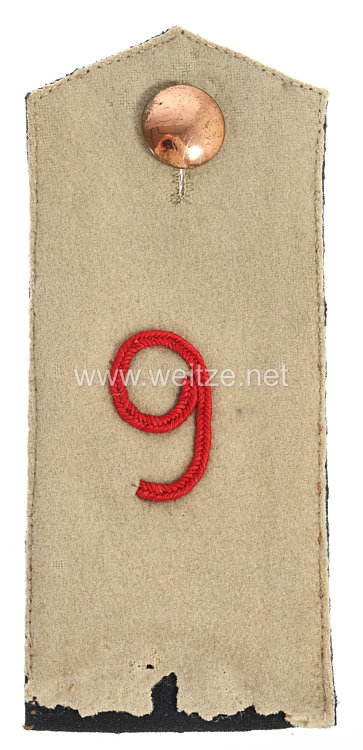
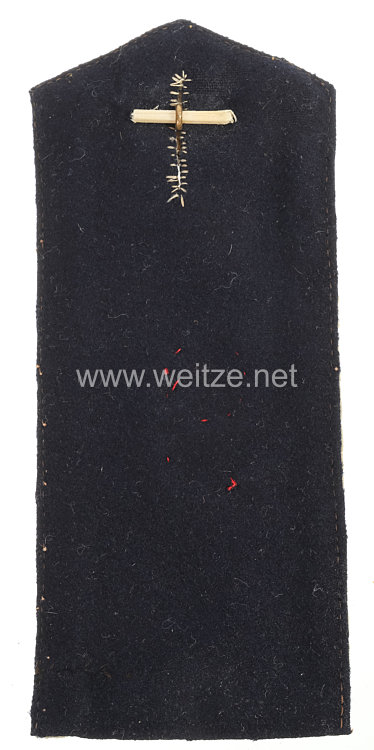
Prussia Single Shoulder Strap for Enlisted Men of Colberg Grenadier Regiment Graf Gneisenau (2nd Pomeranian) No. 9

Garrison Stargard in Pomerania, circa 1910. Worn condition, Grade 2.
367294
75,00

Prussia Single Shoulder Strap for Enlisted Men of Colberg Grenadier Regiment Graf Gneisenau (2nd Pomeranian) No. 9

This single shoulder strap for enlisted men of the Colberg Grenadier Regiment Graf Gneisenau (2nd Pomeranian) Nr. 9 represents a characteristic element of Prussian military uniforms from the late Wilhelmine era. This regiment, stationed in Stargard in Pomerania (today Stargard Szczeciński in Poland), carried a tradition-rich history closely interwoven with Prussian-German military history.

The Grenadier Regiment Nr. 9 bore its honorary name after August Neidhardt von Gneisenau (1760-1831), one of the most significant Prussian military reformers and Field Marshal, who together with Gerhard von Scharnhorst fundamentally reformed the Prussian army after its defeat against Napoleon. The bestowal of this name honored not only Gneisenau personally but also symbolized the regiment's connection to the Wars of Liberation and Prussian military tradition.

The designation “2nd Pomeranian” referred to the regiment's territorial assignment to the Province of Pomerania, one of Prussia's historic core provinces on the Baltic Sea coast. Stargard, the regiment's garrison town, was an important military location in this region. The number “9” placed the regiment in the numerical order of Prussian grenadier regiments.

Shoulder straps had been an integral part of Prussian military uniforms since the early 19th century. Originally conceived as functional protective devices for the shoulder, they increasingly developed into important distinguishing features that indicated the wearer's regiment, branch of service, and rank. The enlisted men's shoulder straps, like this specimen, differed markedly from those of non-commissioned officers and officers, who wore more elaborate versions with metal braiding.

Around 1910, corresponding to the dating of this piece, the German Empire was at the height of the Wilhelmine era under Kaiser Wilhelm II. The army was at this time a central element of society and understanding of the state. Uniforming followed the Supreme Cabinet Orders and various dress regulations that specified down to the smallest detail how each regiment should appear.

The colors and design of shoulder straps were precisely regulated. Specific colors were prescribed for Grenadier Regiment Nr. 9 that distinguished the regiment from others. The base color of the shoulder strap as well as the number embossing or embroidery followed exact specifications of the Prussian Uniform Regulations. Grenadier regiments as elite infantry units enjoyed special prestige and often wore additional distinguishing marks.

The manufacture of such shoulder straps was carried out both by military workshops and by civilian suppliers specialized in military effects. Quality could vary, with simpler versions often used for daily service than for parade uniforms. The indicated condition 2 suggests a worn but well-preserved specimen that was actually used in service and not merely as a parade or spare piece.

The year 1910 marks an interesting phase of European history. Political tensions between the great powers were increasing, and armament was accelerating. Only four years later, World War I would break out, fundamentally changing the entire European order. Grenadier Regiment Nr. 9 participated in the battles of World War I and, like all German regiments, experienced the upheavals of war, revolution, and the end of the monarchy in 1918.

After the war and the dissolution of the Imperial Army as a result of the Treaty of Versailles of 1919, such uniform parts lost their military function. However, they became important memorabilia for veterans and historical documents of a vanished era. Stargard itself fell to Poland after World War II, and the German military presence in Pomerania ended definitively.

Today, such shoulder straps are important study objects for military historians and collectors. They enable detailed insights into the uniform system of the Prussian-German army, the organizational structure of the armed forces, and the material culture of the military. Each piece tells the story of a specific regiment and its soldiers who wore these uniform parts in service.

The scholarly study of such objects requires sound knowledge of military clothing regulations, regimental history, and the general history of the German Empire. Modern research uses such artifacts to gain a more comprehensive picture of soldiers' daily life, military organization, and the significance of the military in Imperial society.