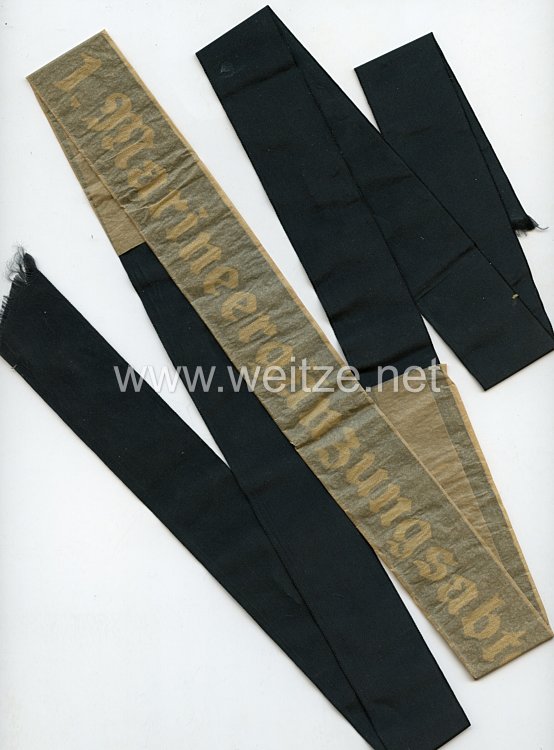
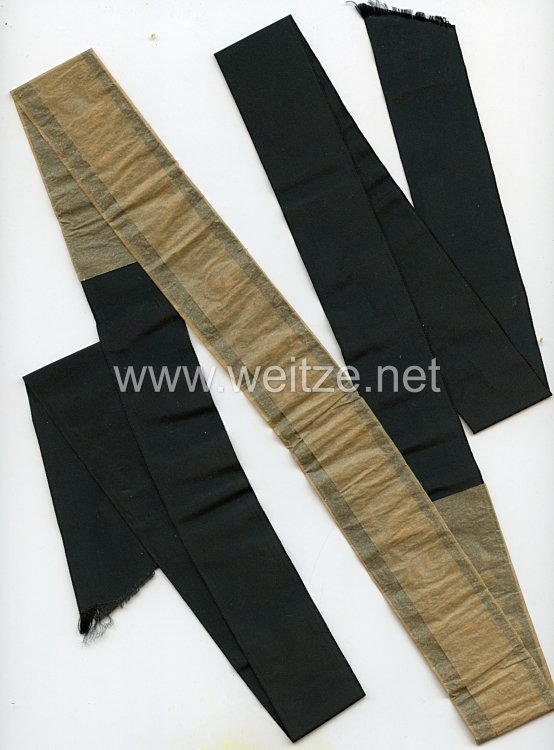
Kriegsmarine Cap Tally "2. Marineergänzungsabteilung 2."

mint condition, partially in original paper packaging, 149 cm. Condition 2
429494
130,00

Kriegsmarine Cap Tally "2. Marineergänzungsabteilung 2."

The Kriegsmarine cap tally represents a significant piece of equipment from the German Navy during World War II. The specimen described here bears the inscription “2. Marineergänzungsabteilung 2.” (2nd Naval Replacement Battalion 2) and represents a specific unit within the training structure of the Kriegsmarine.

Historical Background of the Naval Replacement Battalions

The Marineergänzungsabteilungen (Naval Replacement Battalions) were established as part of the reorganization and expansion of the German Kriegsmarine in the 1930s. Following the Nazi seizure of power in 1933 and the official reintroduction of compulsory military service in 1935, Germany began systematically expanding its armed forces. The Kriegsmarine required a comprehensive system for recruiting, basic training, and distributing personnel.

The Naval Replacement Battalions served as training and replacement units. Their main tasks included basic military training of new recruits, further education of already trained personnel, and providing replacement crews for front-line units. These battalions were distributed throughout the German Reich and later also in occupied territories.

Function and Significance of the Cap Tally

The cap tally was an essential identifying feature of German naval personnel and was worn on the peaked cap (for officers and NCOs) as well as on the sailor's cap (for enlisted ranks). The tradition of the cap tally dates back to the Imperial Navy and was continued in the Reichsmarine and later in the Kriegsmarine.

According to the Kriegsmarine uniform regulations, the cap tally consisted of black ribbon with gold-colored lettering. The inscription identified the unit to which the wearer belonged. For shore-based units such as the Naval Replacement Battalions, this was particularly important since these sailors were not assigned to a ship but to a land installation.

The length of approximately 149 cm corresponds to the standardized measurements of Kriegsmarine cap tallies. The ribbon was wrapped around the cap, with the inscribed ends typically hanging on the left side or at the back of the head. The two ribbon ends were often finished with small metal caps or simple knots.

Manufacturing and Materials

Kriegsmarine cap tallies were produced by specialized manufacturers authorized by the Navy. The lettering was typically incorporated using a weaving process, employing golden-yellow silk threads. This manufacturing method ensured durability and legibility of the inscription.

The fact that this specimen is described as “mint condition” and remains partially in its original paper packaging suggests that it may never have been issued or worn. This could have various reasons: overproduction, storage as reserve stock, or the end of the war before distribution to soldiers.

Organization of the 2nd Naval Replacement Battalion

The precise numbering “2. Marineergänzungsabteilung 2.” indicates a specific organizational structure. The first number likely designated the military district or the superior naval station, while the second number identified the specific battalion within this structure.

These units were typically stationed in naval barracks on the coast or in the hinterland. They had training facilities, exercise grounds, and accommodations for several hundred to a thousand recruits. Training included basic military skills, seamanship, weapons training, and specialized technical instruction.

Collector Value and Historical Significance

Today, original Kriegsmarine cap tallies are sought-after collectibles in the militaria field. Tallies from lesser-known units or in exceptionally good condition command considerable prices. The Condition 2 (very good) combined with the partially preserved original packaging makes this piece particularly valuable for collectors and historians.

From a historical perspective, such objects provide important insights into the organizational structure, material management, and daily life of the Kriegsmarine. They document the extensive bureaucracy and standardization that characterized the German military.

Conclusion

The cap tally of the 2nd Naval Replacement Battalion 2 is more than just a piece of military equipment. It represents a specific chapter of German naval history and the complex training infrastructure of the Kriegsmarine during World War II. Its excellent preservation makes it an important testament to this era.