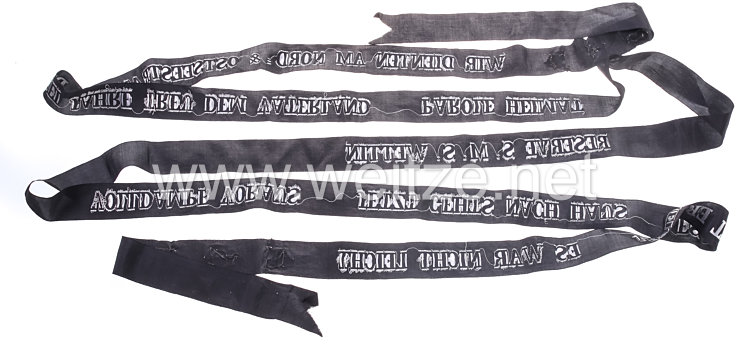
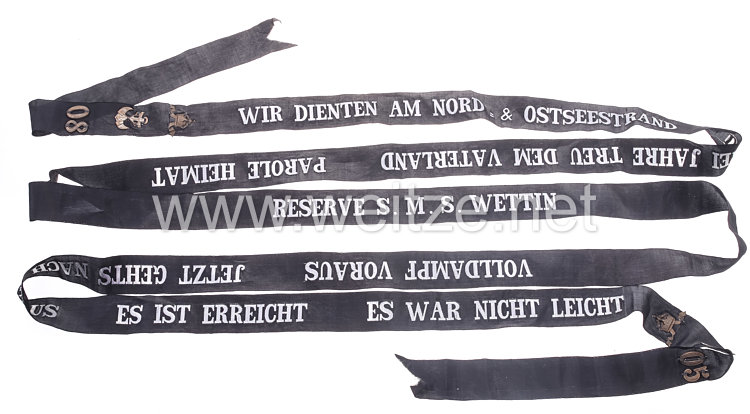
Imperial German Navy Long Reservist Cap Tally of a Stoker on "S.M.S. Wettin" in Silver, 1905-1908
https://de.wikipedia.org/wiki/SMS_Carola
The reservist cap ribbon of the Imperial German Navy (Kaiserliche Marine) represents a fascinating testament to the maritime military culture of the German Empire. These elaborately designed ribbons were worn by sailors who had successfully completed their active service period and transferred to the reserves.
SMS Wettin was a battleship of the Wittelsbach class, named after the Saxon royal house of Wettin. The ship was built between 1899-1901 at the Schichau shipyard in Danzig and commissioned on October 1, 1901. With a displacement of 11,774 tons and a length of 126.8 meters, the Wettin was a significant warship of her time. The crew comprised approximately 680 men, including numerous stokers who were indispensable for operating the coal-fired steam engines.
The profession of stoker was among the hardest aboard a warship. These men worked under extreme conditions in the boiler rooms, where temperatures exceeding 50 degrees Celsius were not uncommon. They were responsible for firing the steam boilers that powered the ship's propulsion. This physically demanding work required endurance, reliability, and technical understanding.
The present cap ribbon from the period 1905-1908 is exceptionally long at four meters – significantly longer than standard active service ribbons. This extra length was characteristic of reservist ribbons, which served as personal mementos and sources of pride for veterans. The silver version with metal appliqués and metal thread weaving demonstrates high craftsmanship and the desire to worthily document one's service time.
The text inscribed on the ribbon is particularly revealing: "Wir dienten am Nord- & Ostseestrand 3 Jahre treu dem Vaterland - Parole Heimat - Reserve S.M.S. Wettin - Volldampf voraus - jetzt gehts nach Haus - Es ist erreicht - Es war nicht leicht" (We served on the North and Baltic Sea coast, 3 years faithful to the Fatherland - Password Home - Reserve S.M.S. Wettin - Full steam ahead - now we're going home - It is achieved - It was not easy). This inscription reflects several aspects: the three-year service period was the standard obligation in the Imperial Navy. The mention of the North and Baltic Seas refers to the main operational areas of the German fleet before World War I. The term "Volldampf voraus" (full steam ahead) is typical maritime command language and emphasizes the affiliation with engine room personnel.
The personal phrases "now we're going home" and "It is achieved - It was not easy" convey the relief at successfully completing service and the hardship of that service. These individual texts made each reservist ribbon a unique memento.
Such ribbons were typically manufactured by specialized craftsmen in naval cities such as Kiel, Wilhelmshaven, or Danzig. Production often followed the individual wishes of departing sailors, while certain design conventions were maintained. The use of metal threads and metal appliqués made these ribbons precious objects that reservists had to afford from their saved pay.
SMS Wettin itself had an eventful service life. She belonged to the I. Division of the I. Squadron and participated in numerous maneuvers in the North and Baltic Seas. After the outbreak of World War I in 1914, the ship was already obsolete and was mainly used for training purposes. In 1916, the Wettin was decommissioned and later scrapped.
Reservist ribbons like this are important cultural-historical documents today. They provide insight into the everyday culture of the Imperial Navy, the social significance of military service in the Empire, and the identity formation of veterans. After returning to civilian life, reservists wore these ribbons on special occasions, such as veteran meetings or national holidays, thereby demonstrating their patriotic sentiment and pride in their service.
The preservation of such objects in good condition is remarkable, as the materials used – particularly the metal threads – are susceptible to corrosion and wear. Today they form an important component of military-historical collections and contribute to understanding the maritime history of the German Empire.