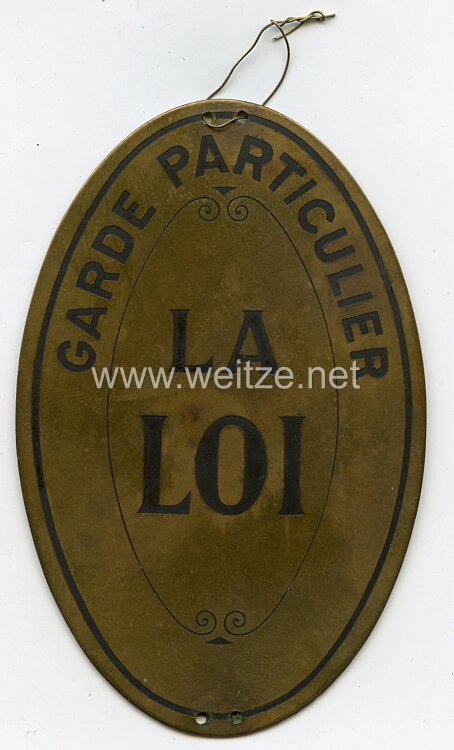
France Badge "Garde Particulier La Loi"
The Garde Particulier badge represents a fascinating testament to French policing history during the 19th and early 20th centuries. Measuring a compact 9 x 5.8 cm, this badge belongs to the category of official identification marks worn by the Gardes Particuliers – a special category of private security forces operating in rural France.
The institution of the Gardes Particuliers was formally regulated by French law on April 12, 1892, although its roots extended back to the Ancien Régime. These security forces differed fundamentally from state police forces such as the Gendarmerie Nationale or Police Municipale. They were privately employed by landowners, hunting associations, or industrial enterprises, yet received their authority through state authorization and acted “in the name of the law” (La Loi).
The legal status of these Gardes was precisely defined in the Code Rural. They had to be sworn in by the Prefecture and received limited police powers, particularly in the areas of protecting private property, hunting supervision, and forestry oversight. The inscription “La Loi” on the badge symbolized their legal legitimacy and distinguished them from mere private watchmen without state authorization.
The typical design of such badge shields followed strict guidelines. They were usually manufactured from brass or silver-plated metal and displayed not only the designation but often symbols of the French Republic or local coats of arms. The number on many of these badges served to uniquely identify each Garde with the competent authority. The format of approximately 9 x 5.8 cm was practically sized to be attached to the uniform coat or headgear.
During the 19th century, the Gardes Particuliers played an important role in France's rural security architecture. While the Gendarmerie was responsible for major offenses and general public order, the Gardes Particuliers monitored specific territories on behalf of their employers. Their main duties included preventing poaching, protecting against timber theft, monitoring fishing rights, and securing agricultural lands.
The Third Republic (1870-1940) marked the heyday of this institution. During this era, thousands of Gardes Particuliers were active throughout France. They typically wore a uniform that distinguished them from state police but nonetheless conveyed authority. The badge was the most visible sign of their official function and protected them from accusations of unauthorized assumption of office.
However, the powers of the Gardes Particuliers were limited. They could detain persons caught committing offenses on the territory they guarded and establish their identity. For more serious violations, they had to call in the Gendarmerie or the competent police authority. They were authorized to draft reports (procès-verbaux) that served as evidence in court.
In the early 20th century, this institution began to decline. The increasing professionalization of state police forces, urbanization, and changing property relationships reduced the need for private security forces in rural areas. Nevertheless, the institution of Gardes Particuliers exists in modified form to this day in French law, albeit in greatly reduced scope.
Today, such badges are sought-after collectibles that offer insights into the social and legal history of France. They document a unique system in which private and public security interests were intertwined. The good condition of many of these objects is explained by their robust manufacture and the fact that they were often kept as personal mementos.
The study of such service badges contributes to understanding the development of modern police systems and shows how different societies have regulated the tension between private property and public order. The badge “Garde Particulier La Loi” thus stands symbolically for an entire epoch of French administrative and legal history.