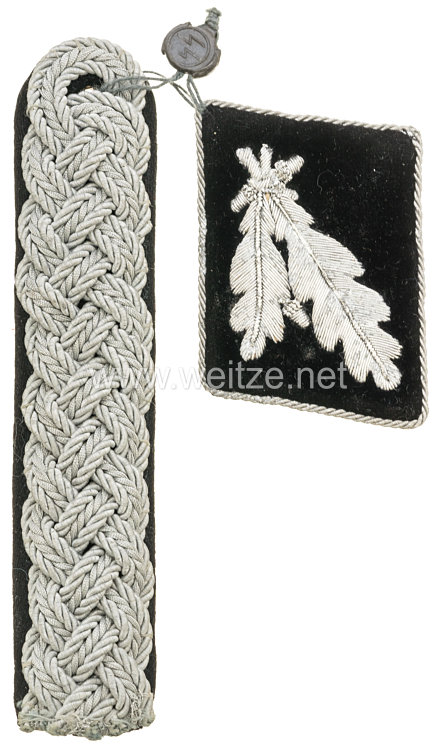
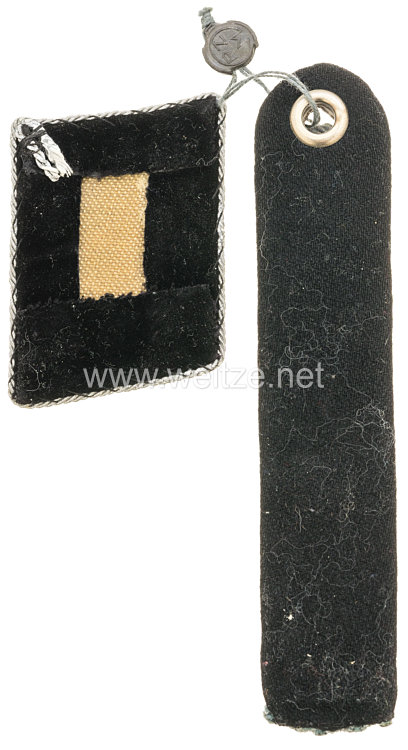
The present Waffen-SS insignia – a single collar tab and shoulder board for an SS-Oberführer – represent an exceptional example of the strictly regulated production of SS uniform insignia during World War II. Particularly noteworthy is their designation as a sealed RZM sample with the metal seal “SS/RZM” embossed on both sides.
The Reichszeugmeisterei (RZM) was established in 1929 as the central procurement and inspection office of the Nazi Party. After the seizure of power in 1933, its area of responsibility expanded considerably to include control over the manufacture of all uniforms, insignia, and equipment for party organizations, including the SS. The RZM granted licenses to private manufacturers, inspected their products for quality and compliance with regulations, and sealed approved sample specimens. These sample pieces served as binding references for series production.
The collar tab presented here is crafted with hand-embroidered metallic thread on black velvet cloth – an execution typical of Waffen-SS officer uniforms around 1941. Hand embroidery with metallic threads required the highest level of craftsmanship and differed significantly from the machine-made or woven variants for enlisted men and non-commissioned officers. The black velvet cloth formed the prescribed background for SS collar tab pairs, with the right side traditionally bearing the runes and the left side displaying rank insignia.
The accompanying braided shoulder board designated ranks from SS-Sturmbannführer (equivalent to a Wehrmacht Major) to SS-Oberführer. These shoulder boards, also known as shoulder cords or epaulettes, were manufactured from aluminum threads in characteristic braiding patterns. The specific execution with its braiding style and rank insignia enabled precise identification of rank within the SS hierarchy.
The rank of SS-Oberführer occupied a special position in the SS rank system. Introduced in 1932, this rank existed exclusively within the SS and had no direct equivalent in the Wehrmacht. It was positioned between SS-Standartenführer (comparable to a Colonel) and SS-Brigadeführer (corresponding to a Major General). This intermediate position became necessary to adequately structure the growing SS organization. SS-Oberführer frequently commanded larger units or held important staff positions.
The dating “circa 1941” falls into a phase of significant expansion of the Waffen-SS. Following successes in Poland and France, the military SS formation was systematically expanded and increasingly received divisional structures. This required a growing number of officers and correspondingly increased production of uniform insignia. The RZM had to simultaneously maintain quality standards and expand production capacities.
The RZM sealing system with metal seals served several purposes: First, it guaranteed the authenticity and regulatory compliance of products. Second, it prevented the manufacture and distribution of unauthorized insignia. Third, it documented the approved sample specimens for future production series. The double-sided embossing “SS/RZM” on the metal seal made any tampering immediately recognizable.
Sample pieces like those presented here were not intended for actual wearing but served as reference patterns in the workshops of licensed manufacturers or in the RZM inspection offices themselves. They thus represent not only military rank insignia but also a sophisticated system of industrial quality control and centralized administration.
The craftsmanship quality of the metallic thread embroidery on the collar tab demonstrates the high requirements placed on officer insignia. The materials used – aluminum or silver threads on velvet cloth – were more costly than the versions for lower ranks. This also reflected the hierarchical structures and prestige consciousness within the SS.
The condition grade 2 (according to numismatic evaluation scale) indicates very good preservation with minor signs of wear. For sealed sample pieces that have survived over 80 years, this is remarkable and underscores their careful storage, presumably in official or company archives.
Today, such RZM-sealed sample pieces possess considerable documentary value for researching uniform history and the administrative structures of the Nazi regime. They illustrate the bureaucratization and standardization even in areas such as uniform manufacturing and document the technical and craftsmanship standards of that era.