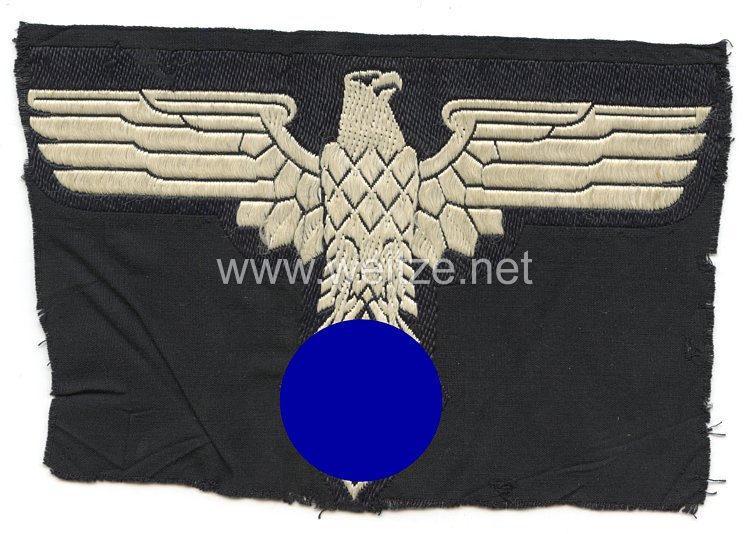
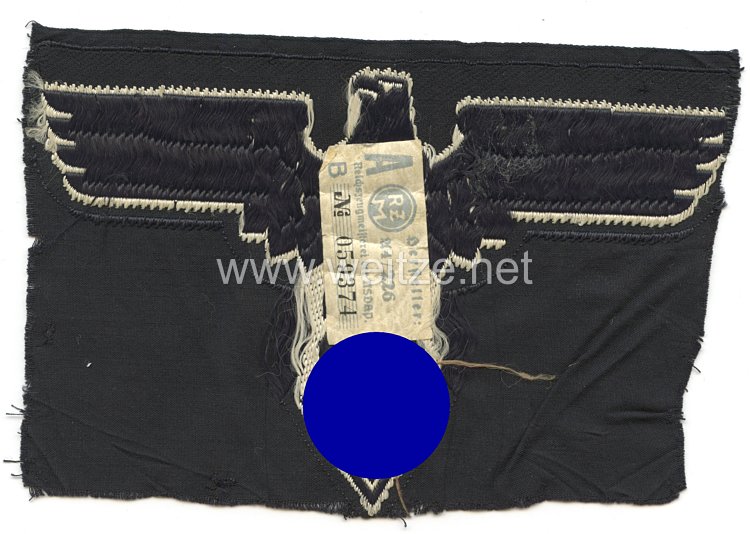
NS-Studentenbund Large Breast Eagle for Sports Shirt
Unfortunately, numerous reproductions exist of this type; this is one of the few originals!
The NS-Studentenbund Large Breast Eagle for Sports Shirts represents a significant example of textile insignia production in National Socialist Germany. This piece, manufactured using the Bevo weaving technique, documents the pervasive organizational structure of the NSDAP in academic circles during the years 1933 to 1945.
The National Socialist German Students' League (NSDStB) was founded in Munich in 1926 and developed into the largest subdivision of the NSDAP in the academic sphere. After the seizure of power in 1933, all competing student associations were either coordinated or dissolved, giving the NSDStB a de facto monopoly over student organization throughout the German Reich. Under the leadership of Baldur von Schirach and later Gustav Adolf Scheel, membership grew to over 300,000 students.
This example was manufactured using the Bevo weaving technique, a special weaving process developed by the company Bandfabrik Ewald Vorsteher in Wuppertal-Barmen. This technique enabled the production of finest details and colorfast insignia that were significantly more durable than embroidered variants. Bevo insignia were considered high quality and were produced for numerous NSDAP organizations.
The reverse RZM paper label is of particular significance for authentication. The Reichszeugmeisterei (RZM) was established in 1929 as the central procurement office of the NSDAP and from 1933 controlled the manufacture and distribution of all party uniforms, insignia, and equipment. The RZM granted licenses to selected manufacturers and provided their products with control numbers to ensure quality and authenticity. The presence of an original RZM label is today an important feature for distinguishing originals from postwar forgeries.
The dimensions of approximately 15.5 cm width and 9.5 cm height correspond to the regular specifications for breast eagles worn on sports shirts. The NSDStB had various uniform items, including sports shirts for athletic activities and competitions. Sport played a central role in National Socialist ideology in the supposed physical conditioning of the “Volksgemeinschaft,” and student sporting events were mandatory.
The mention of numerous copies in the description points to a significant problem in the collectors' market. After 1945, many NS insignia were reproduced, partly for film productions, theater, or for the collectors' market. Particularly from the 1960s to 1990s, numerous reproductions were created that are often falsely offered as originals today. Expert knowledge of materials, weaving techniques, aging characteristics, and RZM markings is essential for correct evaluation of such objects.
The NSDStB was not merely a student organization but functioned as an instrument of ideological indoctrination at universities. The organization controlled student activities, monitored the political reliability of fellow students and lecturers, and actively participated in the expulsion of Jewish students and professors. The book burnings of May 1933 were substantially organized and carried out by NSDStB members.
From a historical perspective, such insignia document the comprehensive penetration of all areas of society by National Socialist organizations. The detailed regulation of uniform items and insignia by the RZM demonstrates the totalitarian claim of the regime to determine even the smallest details of external appearance. Simultaneously, the elaborate production of such textiles reveals the economic structures that developed around the NSDAP and its subdivisions.
Today, such objects are important sources for historical research. They provide insights into production techniques, organizational structures, and the material culture of National Socialism. Museums and academic collections preserve such objects as testimonies of a dictatorial past, whereby the historical-critical context must always remain in the foreground.