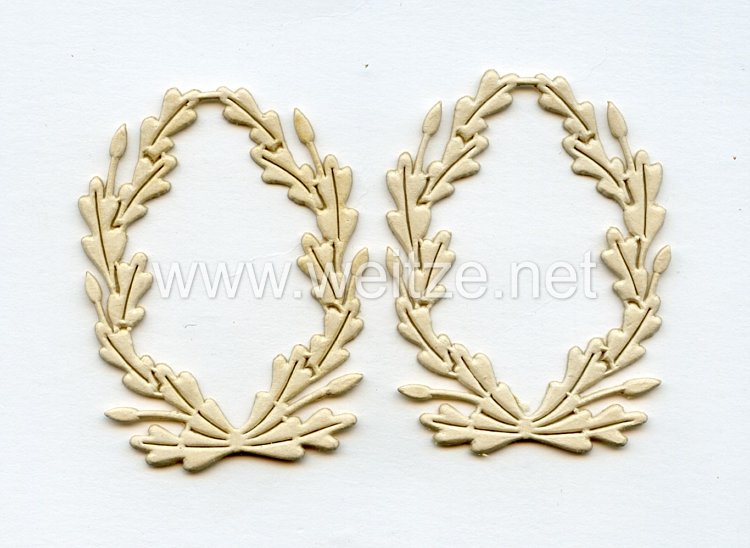
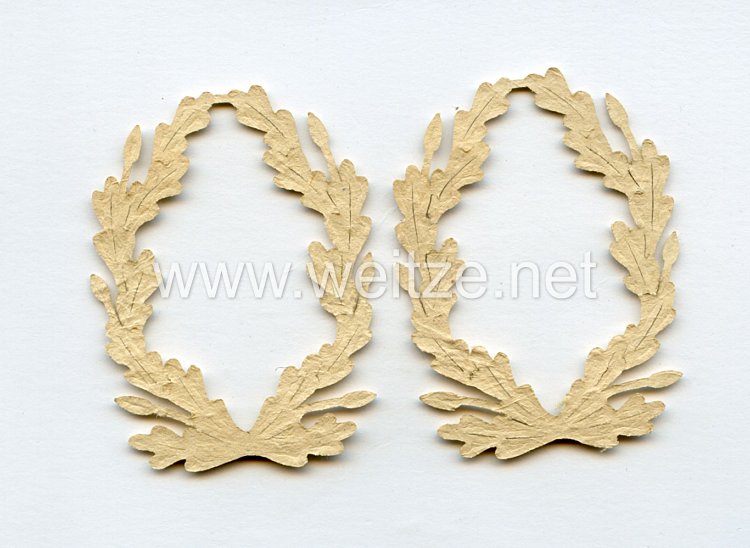
Luftwaffe, 2 Stencils for Officer Collar Tabs

thin cardboard, for hand-embroidered execution. Condition 2.
404993
10,00

Luftwaffe, 2 Stencils for Officer Collar Tabs

These collar patch templates for German Luftwaffe officers from World War II represent a remarkable testament to military craftsmanship and the strict uniform regulations of that era. Made from thin cardboard, these auxiliary tools served officers as patterns for hand-embroidered rank insignia, embodying the connection between military tradition and practical necessity.

The Luftwaffe, as the youngest of the three Wehrmacht branches, was officially founded on February 26, 1935, after the German Reich announced rearmament and rejected the provisions of the Treaty of Versailles. Under the leadership of Reich Marshal Hermann Göring, the Luftwaffe developed into an independent branch of service with its own uniform regulations and rank insignia. The Luftwaffe Clothing Regulation L.Dv. 410 specified in detail the appearance and manner of wearing uniforms and rank insignia.

The collar patches of the Luftwaffe were an essential component of the officer's uniform and served to identify rank and service branch. For officers, these insignia were particularly elaborately designed and frequently manufactured in hand-embroidered versions. The use of templates ensured compliance with the prescribed measurements and shapes that were precisely defined in the uniform regulations.

The hand-embroidered execution of collar patches was particularly common among higher officer ranks and was considered of higher quality than machine-made variants. Specialized military effects manufacturers and tailors offered their services to produce these insignia according to official specifications. The templates made it possible to transfer the complex geometric shapes and proportions precisely onto the fabric before beginning the actual embroidery work.

The material thin cardboard was ideally suited for this purpose, as it could be easily placed on the uniform fabric and outlined with chalk or pencil. At the same time, it was stable enough not to wear out immediately with repeated use. The production of such templates was likely carried out both by official agencies and by private manufacturers specializing in military supplies.

In the context of Luftwaffe rank insignia, it should be noted that the system changed several times during the war. However, the basic form of the collar patches remained largely constant: they displayed specific colors for the various service branches and bore rank insignia in the form of wings, stars, or other symbols. Officers typically wore aluminum or silver-colored embroidery on colored backgrounds on their collar patches.

The procurement and maintenance of uniforms was partly the responsibility of the officers themselves, who had to acquire part of their equipment privately. This explains the existence of such privately used tools as templates, which made it possible to renew damaged or worn collar patches themselves or through a tailor.

From a military-historical perspective, such objects are of particular interest because they provide insight into the everyday life and practical aspects of military existence. While uniforms and insignia themselves have frequently survived, the tools for their manufacture are far rarer. Templates were often disposed of or destroyed after use, making their preservation to this day a fortunate circumstance.

The study of such objects contributes to understanding the material culture of the Third Reich and demonstrates the importance attached to uniforms and rank insignia in the strictly hierarchically organized Wehrmacht. The meticulous adherence to regulations, even in details such as the exact shape of collar patches, reflects the mentality and organization of that time.

These templates also illuminate the complex supply chain and logistical considerations of maintaining military appearance standards. The existence of such standardization tools speaks to the Luftwaffe's emphasis on uniformity and precision in all aspects of military presentation, characteristics that were considered essential to military discipline and esprit de corps.