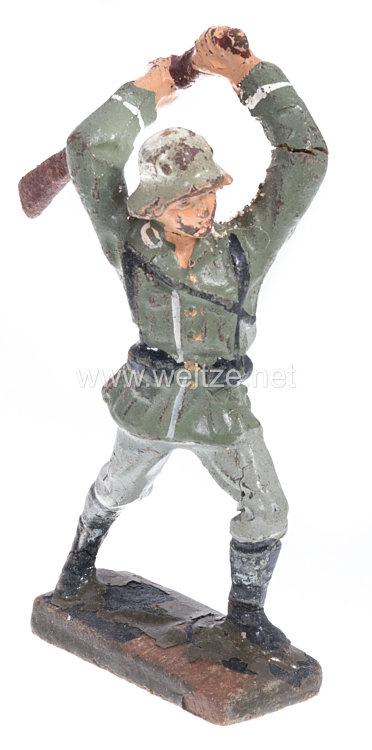
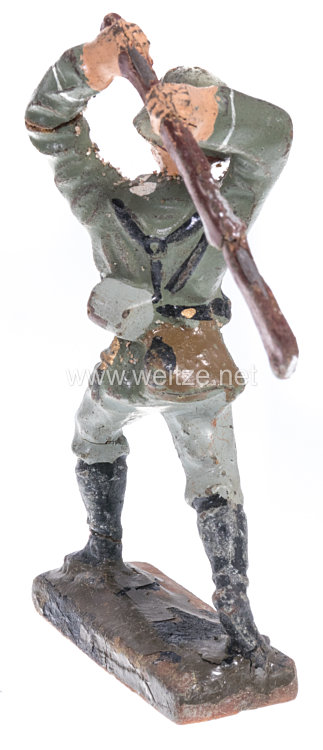
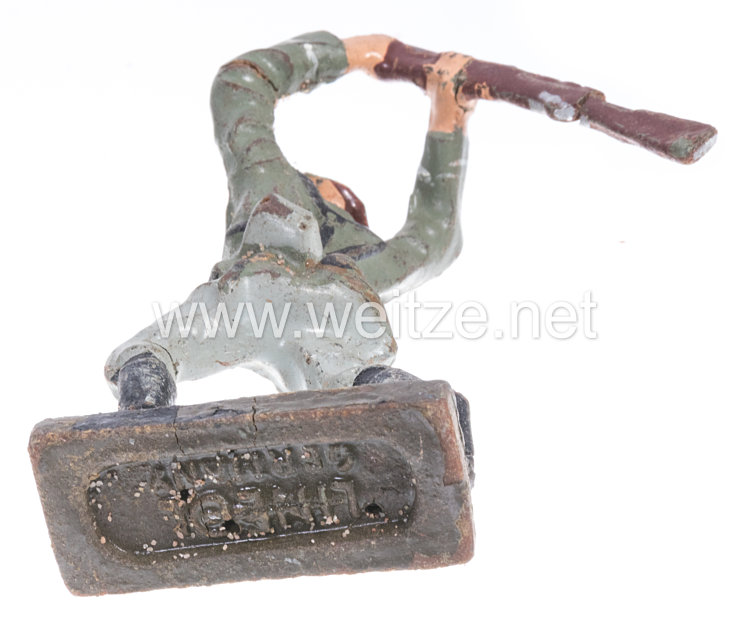
Lineol - Army Soldier with Rifle Striking “Buttstock Striker”

7 cm, condition 2.
358293
20,00

Lineol - Army Soldier with Rifle Striking “Buttstock Striker”

The Lineol soldier figure of the “Kolbenschläger” (rifle-butt striker) type depicts a German Army soldier raising his rifle to strike with the butt. This 7 cm tall figure belongs to the classic products of the Lineol toy factory, which played a leading role in the manufacture of composition figures for military play scenarios between the 1930s and 1940s.

The Lineol company was founded in 1906 by Oskar Wiederholz in Brandenburg an der Havel and quickly developed into one of Germany's most significant manufacturers of toy soldiers. The name “Lineol” derives from “linoleum,” as the figures were made from a special composition material containing sawdust, glue, casein, and other binding agents. This composition enabled cost-effective mass production while maintaining detailed design.

The depiction of the “Kolbenschläger” is militarily significant as it reflects a real close-combat technique. The rifle-butt strike was an acknowledged hand-to-hand combat technique in early 20th-century armies. In H.Dv. 130 (Army Service Regulation) and similar military training manuals, close combat with the rifle was systematically taught. The butt stroke could be executed either from above downward (“striking down”) or sideways and was considered an effective technique in trench warfare and close defense.

The uniforming of Lineol figures was based on the actual uniforms of the Wehrmacht during the Nazi era. The figures typically wore field-gray uniforms with M35 or M40 steel helmets, belts, and boots. Painting was done by hand or by spraying methods, with attention paid to characteristic details such as rank insignia, buttons, and equipment items.

In the 1930s, Lineol production experienced tremendous growth. The figures were used not only as children's toys but also as collectors' items and partly for propagandistic purposes. Lineol's Wehrmacht figures served to convey military values and soldierly virtues and to influence youth in line with National Socialist ideology. Toy production thus stood in the context of the general militarization of society in the Third Reich.

Lineol's production technique was remarkably advanced for its time. The figures were cast in multi-part molds, with head, body, arms, and legs manufactured separately and then assembled. This allowed for great variation in poses and equipment. The weapons, such as the Kolbenschläger's rifle, were usually made of metal and inserted into the figures' hands.

During World War II, the production of toy soldiers was increasingly restricted as raw materials were needed for the armaments industry. After 1945, Lineol production was initially banned under Allied occupation, as military toys were viewed as part of German militarization. Only in the 1950s did Lineol resume production, now with different thematic focuses.

From a collector's perspective, Lineol figures are today sought-after objects of toy history. Condition 2 (on the usual scale of 1-6, where 1 means mint condition) indicates a well-preserved figure with slight signs of use. Typical age-related characteristics of composition figures include paint flaking, cracks in the material, or missing small parts. The 7 cm size corresponds to the standard scale of Lineol infantry figures and enabled play with complete army formations.

The historical evaluation of such objects is complex. On one hand, they document the material culture and toy production of a specific era; on the other hand, they are inseparably linked to the propaganda and militarization of the Nazi regime. Modern collectors and museums preserve these objects as historical documents that provide insight into everyday culture, educational methods, and societal values of the 1930s and 1940s.