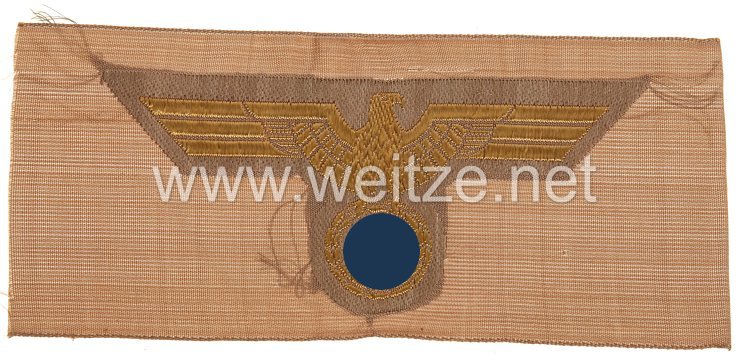
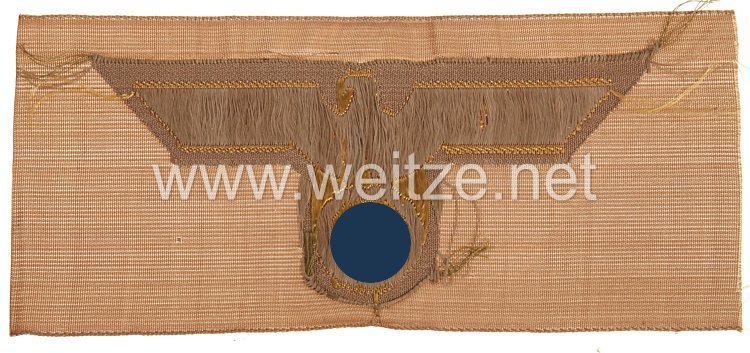
Kriegsmarine Breast Eagle for Tropical Field Blouse
The Kriegsmarine Breast Eagle for the Tropical Field Blouse represents a characteristic uniform insignia of the German Navy during World War II. This special national emblem was manufactured using Bevo weaving technique and is distinguished by its yellow design on a sand-colored background, clearly marking it for use in tropical climates.
The Bevo weaving technique, named after the Barmer Bandweberei Ewald Vorsteher company, revolutionized the production of uniform insignia in the 1930s. This machine weaving technology enabled the production of high-quality, detailed emblems with extraordinary precision. Unlike embroidered versions, Bevo-woven badges were more durable, more cost-effective for mass production, and exhibited consistently high quality.
The tropical uniforms of the Wehrmacht and Kriegsmarine were systematically developed from 1940 onward, as military operations increasingly took place in North African and Mediterranean regions. The African Campaign under Field Marshal Erwin Rommel and the presence of German naval units in the Mediterranean made special uniforms and corresponding insignia necessary. The sand-colored to olive-green coloring was intended to meet both practical and climatic requirements.
The national eagle itself had been the central symbol of National Socialist rule since the seizure of power in 1933 and was worn on all military uniforms. In the Kriegsmarine, the eagle was worn on the chest, in contrast to the Army, where it was attached to the right upper arm. The eagle with spread wings, perched on an oak wreath with swastika, followed strict design specifications of the military clothing regulations.
Special regulations applied to tropical clothing regarding material and coloring. While standard insignia for the dark blue naval uniform were rendered in silver-gray or white, tropical insignia had to be color-coordinated with the sand-colored to khaki fabric of the tropical field blouse. The yellow execution on sand-colored background provided the necessary contrast without being too garish.
The Kriegsmarine tropical field blouse was officially introduced to provide naval personnel with appropriate clothing for land-based operations in hot climates. These uniform pieces were primarily worn by naval personnel serving in coastal fortifications, harbor commands, or support units in North Africa, the Balkans, or the eastern Mediterranean.
Production of such insignia was carried out by various manufacturers throughout the German Reich. Quality varied depending on the manufacturer and production period. Early wartime productions were characterized by finer workmanship, while later versions were often simplified due to wartime conditions. Unworn examples are particularly rare today, as most insignia were actually sewn onto uniforms and worn.
The attachment of the breast eagle to the tropical field blouse was done by sewing it onto the right chest side. The exact position was stipulated by clothing regulations and had to be uniform. Tailors and clothing depots of the Navy were responsible for proper attachment.
From a collecting perspective, tropical insignia of the Kriegsmarine are significantly rarer than their counterparts for standard uniforms. This is due to lower production quantities, limited deployment areas, and shorter period of use. Many of these insignia were lost during the turmoil of war or destroyed after the war's end.
Today, such insignia are important contemporary historical documents that provide insight into uniform studies, textile production, and military organization of World War II. They document the technical development of insignia manufacturing and the adaptation of military equipment to different operational conditions. For military historical research, they offer valuable information about logistics, supply systems, and the global dimension of the war.
The preservation and study of these artifacts serve not only academic interest but also contribute to understanding the material culture of warfare and the industrial capabilities of the period. Museums and research institutions value such pieces for their ability to illustrate the comprehensive nature of military preparation and the attention to detail in uniform regulations, even for specialized equipment needed in diverse theaters of operation.