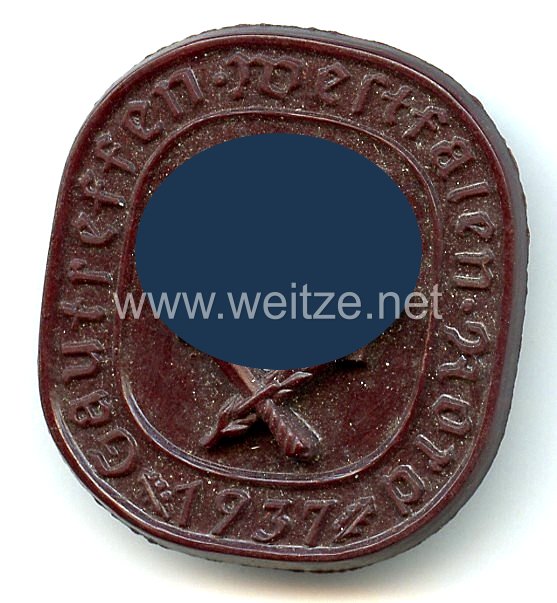
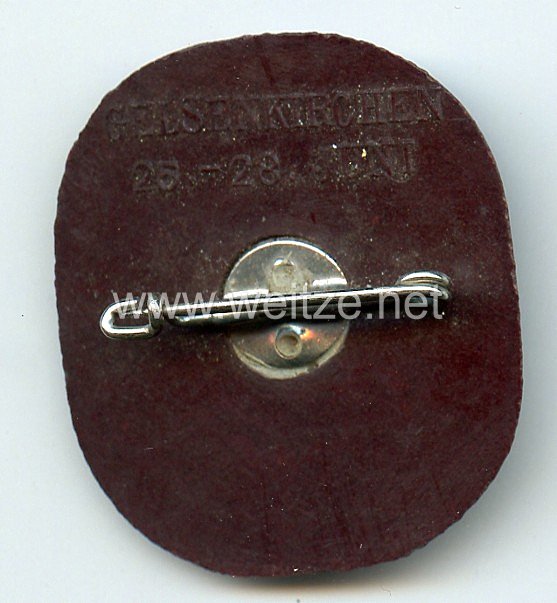
Third Reich - Gau Rally Westfalen Nord June 25-28, 1937 Gelsenkirchen
This badge documents the Gautreffen Westfalen Nord (Regional Rally of North Westphalia), which took place from June 25-28, 1937 in Gelsenkirchen. Such event badges were an essential component of National Socialist representation and propaganda culture in the Third Reich, serving both as souvenirs and demonstrations of political affiliation.
The NSDAP (National Socialist German Workers' Party) divided the German Reich into 42 Gaue (regions), which functioned as central administrative units of the party organization. Gau Westfalen Nord encompassed northern Westphalia with the centers of Münster, Recklinghausen, and the Ruhr area. While the Gau capital was Münster, Gelsenkirchen served as an important industrial city in the Ruhr region and played a significant role in the area. The Gauleiter (regional leaders) held extensive powers and reported directly to Adolf Hitler.
The Gautreffen (regional rallies) were multi-day mass events held annually in various cities within a Gau. They served multiple purposes: demonstrating power and unity, mobilizing the population, spreading National Socialist ideology, and stimulating the local economy of host cities. Such events typically included marches, rallies, torchlight processions, sporting competitions, and cultural performances.
The year 1937 marked a phase of consolidation of Nazi rule. The economy was recovering from the Great Depression, unemployment had dropped drastically, and the regime could point to considerable successes. Simultaneously, rearmament intensified and foreign policy aggression increased. Gautreffen like the one in Gelsenkirchen served to unite the population behind the regime and cultivate the Führer cult.
The present badge is made of plastic, which was characteristic for mass production of such commemorative items. While higher-quality badges were manufactured from metal, plastic enabled cost-effective production in large quantities. These badges could be sold or issued as admission credentials and were intended for participants and visitors. The use of plastic became increasingly popular in the 1930s as modern manufacturing techniques facilitated mass production.
The design of such badges typically followed a uniform pattern: they displayed the occasion, date, and location of the event, often supplemented by Nazi symbolism such as swastikas, imperial eagles, or regional coats of arms. The badges were worn on a pin, typically on the lapel of a jacket or on a uniform, demonstrating participation in the event.
Gelsenkirchen was particularly significant as a venue. The city was an important center of coal and steel industry in the Ruhr area and had suffered from the economic crisis in the 1920s. The NSDAP achieved significant electoral success here by promising workers economic improvements. A Gautreffen in Gelsenkirchen underscored the importance of the industrial working class for the regime and its efforts to integrate this demographic traditionally inclined toward the left.
The events spanned four days and likely included an extensive program. In addition to political speeches and rallies, there were usually demonstrations by various Nazi organizations such as the SA, SS, Hitler Youth, League of German Girls, and the Reich Labor Service. Sporting competitions, musical performances, and evening torchlight processions completed the program.
From a historical perspective, such badges are important period documents. They demonstrate the penetration of everyday life with National Socialist propaganda and the instrumentalization of mass events for political mobilization. The dense network of events at local, regional, and national levels created a permanent presence of the party in public life.
The condition is given as Condition 2, which according to common collector categories indicates very good to good condition. The badge shows minimal signs of wear but is largely intact and well preserved. This is remarkable as plastic badges are more susceptible to damage than metal ones.
For collectors and historians, such badges are of interest because they provide concrete insights into the propaganda practices of the Nazi regime. They document the organization of mass events, regional peculiarities, and the material culture of the Nazi era. At the same time, they remind us of a dark chapter in German history and serve as warnings to remain vigilant against totalitarian tendencies.