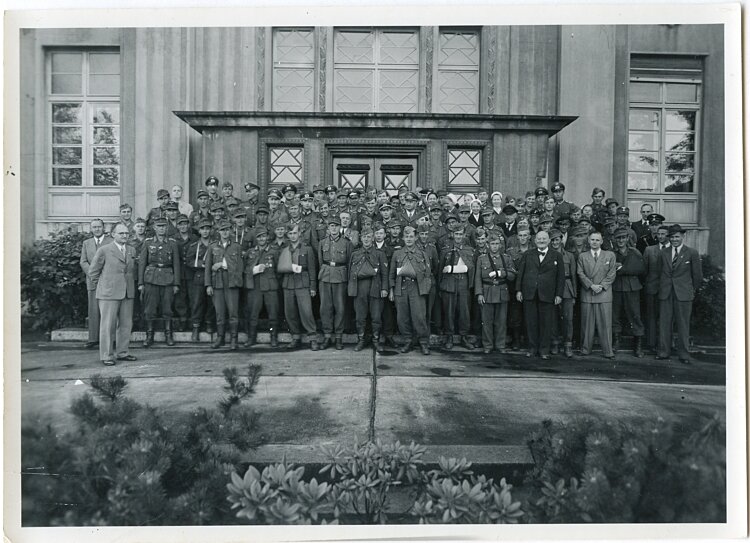
Photograph Visit to the Lübecker Flender-Werke by Wounded Wehrmacht Personnel

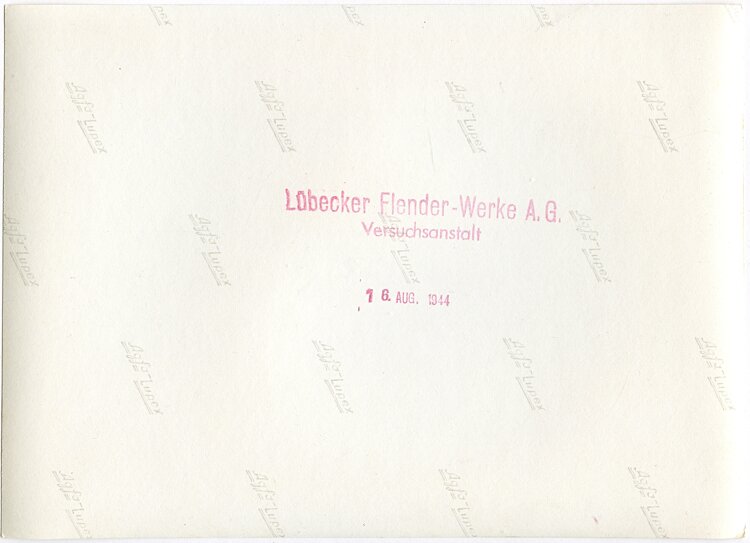
this is a factory photograph, verso with stamp “Lübecker Flender-Werke Versuchsanstalt”, 13 x 17 cm, condition 2
144093
10,00

Photograph Visit to the Lübecker Flender-Werke by Wounded Wehrmacht Personnel

Historical Context: Factory Photography from the Lübeck Flender Works During World War II

This object represents a factory photograph from the Lübeck Flender Works (Lübecker Flender-Werke), documenting a visit by wounded Wehrmacht servicemen to the production facility. The reverse stamp reading “Lübecker Flender-Werke Versuchsanstalt” (Lübeck Flender Works Testing Institute) identifies the photograph as an official document from the company's testing department, lending it authentic character as a contemporary witness to German armaments industry during World War II.

The Flender Works in Lübeck belonged to the significant industrial enterprises of Northern Germany and played an important role in the war economy during the Nazi period. The company, originally active in mechanical engineering, was integrated into armaments production like many German industrial firms. The Flender Works manufactured gearboxes and mechanical components that were used for military purposes.

Propaganda Photography and Wounded Servicemen Visits

Visits to armaments factories by wounded soldiers were an integral part of National Socialist propaganda. These carefully staged visits served multiple purposes: they were meant to show wounded soldiers that their sacrifices were not in vain and that the home front stood behind them. Simultaneously, such events served to strengthen worker morale by demonstrating the direct connection between their labor and support for the fighting troops.

Factory photography held special significance under National Socialism. Nearly all larger industrial enterprises maintained their own photographers or photography departments that documented operational events, production processes, and special occasions. These photographs served both internal purposes and the company's public relations. The reverse stamp indicates that the photo came from the archive of the factory's testing institute, suggesting systematic documentation.

The Testing Institute (Versuchsanstalt)

The mention of the Versuchsanstalt in the stamp is particularly significant. Testing institutes were specialized departments in industrial enterprises concerned with the development, testing, and improvement of products and production methods. In the armaments industry, these departments played a crucial role in technical innovation and adaptation of manufacturing processes to the increasing demands of warfare.

Lübeck During World War II

The Hanseatic city of Lübeck was an important industrial location during the war. The city suffered a severe British air raid on March 28/29, 1942, which largely destroyed the old town. This attack was part of the British strategy to strike at German war economy and civilian morale. Despite the destruction, many industrial facilities remained operational or were rebuilt, as they were indispensable for war production.

Format and Preservation

The format of 13 x 17 cm corresponds to a standard format commonly used for factory photography and press photography at the time. The stated condition 2 indicates, according to common collector categories, a well-preserved photograph with minor signs of use. The fact that the photograph survived the war and post-war period makes it a valuable historical document.

Historical Classification

Such factory photographs are today important sources for researching German war economy and everyday history during National Socialism. They document not only technical and production-related aspects but also social practices and propaganda measures. The visits of wounded soldiers to armaments factories illustrate the close interlocking of home front and war front that was characteristic of National Socialist warfare.

The systematic documentation of such events by company photographers also demonstrates how important visual propaganda was to the Nazi state. Photographs were a central medium for conveying war ideology and maintaining the population's readiness for war. At the same time, these images today offer insights into the real conditions and circumstances of war production as well as the situation of wounded soldiers during their convalescence.

This particular photograph, with its official stamp and professional character, represents a type of visual documentation that was ubiquitous in Nazi Germany's industrial landscape. It serves as a reminder of how industry, military, and propaganda apparatus worked together in the totalitarian system, and how even routine industrial documentation was integrated into the larger narrative of the war effort.