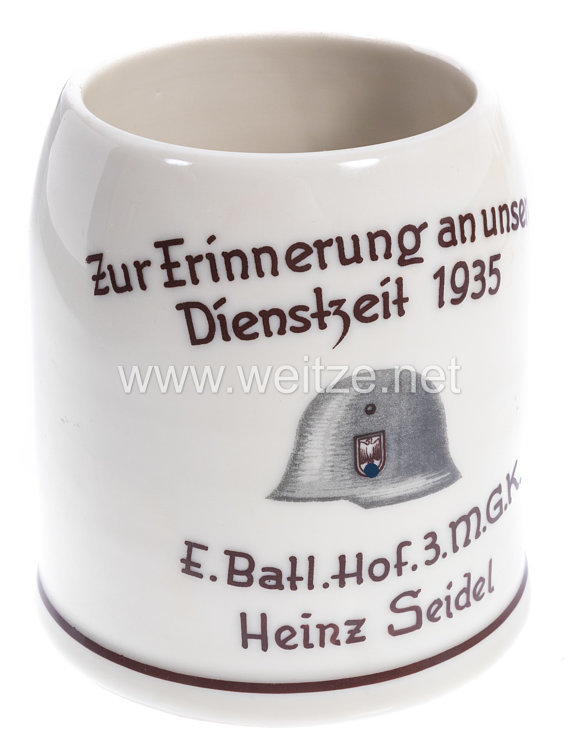
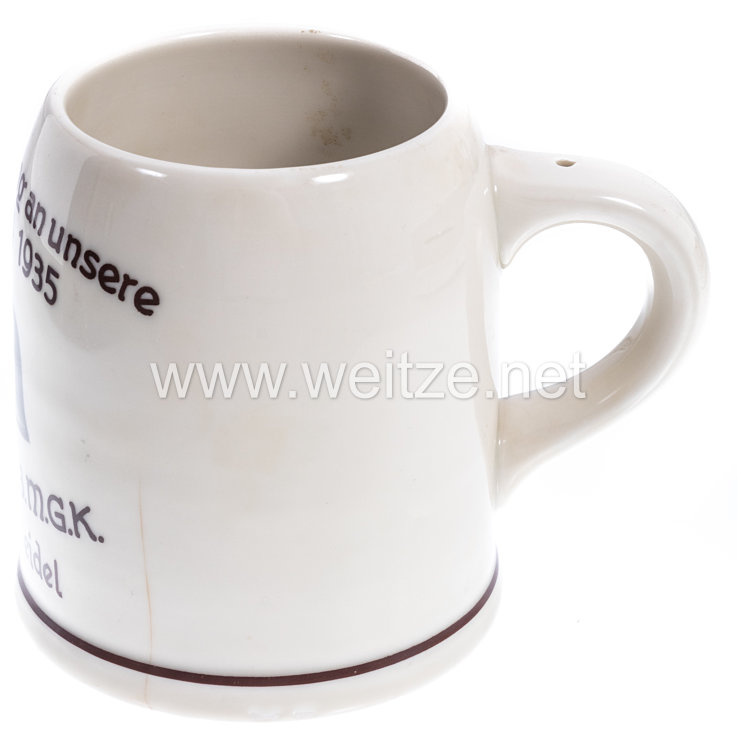
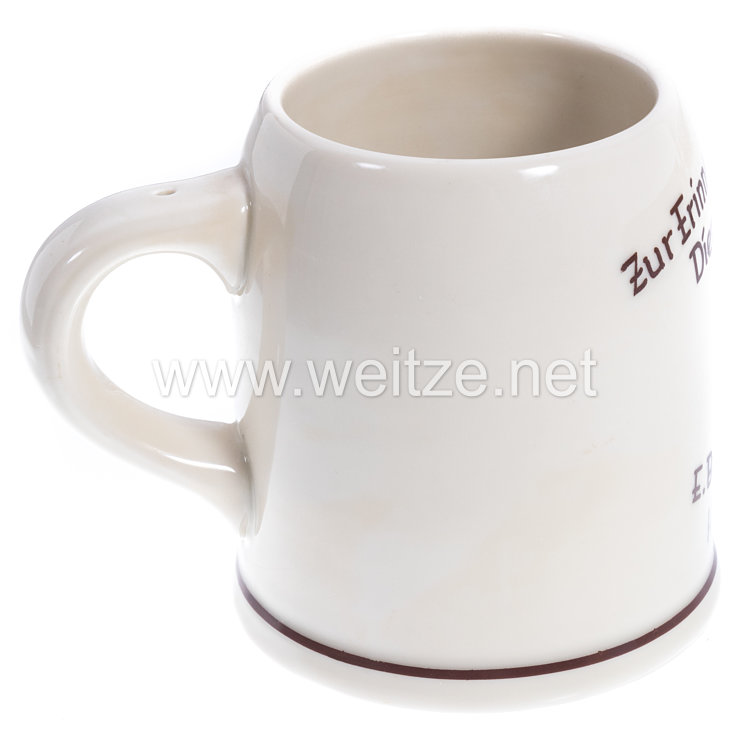
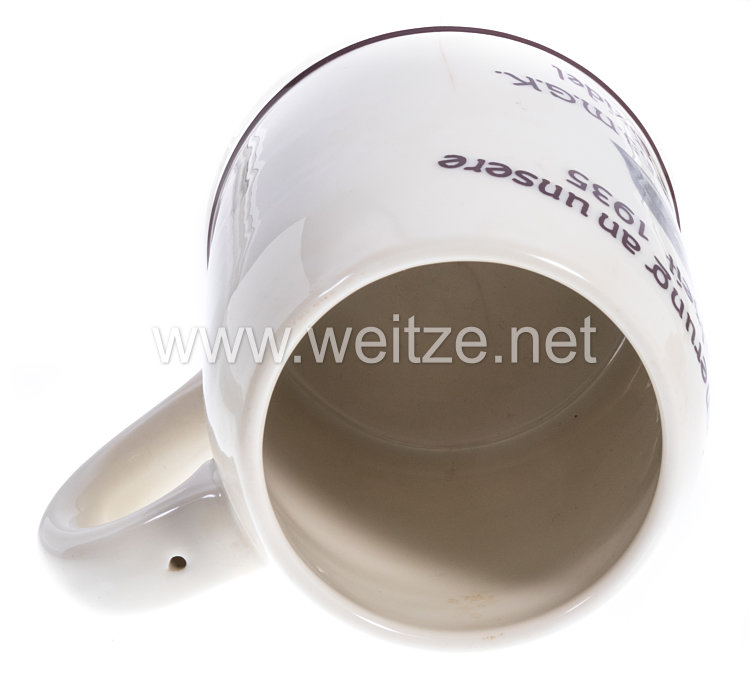
Wehrmacht Heer - Commemorative Stein "In Memory of Our Service 1935 - E.Batl.Hof. 3.M.G.K. Heinz Seidel"

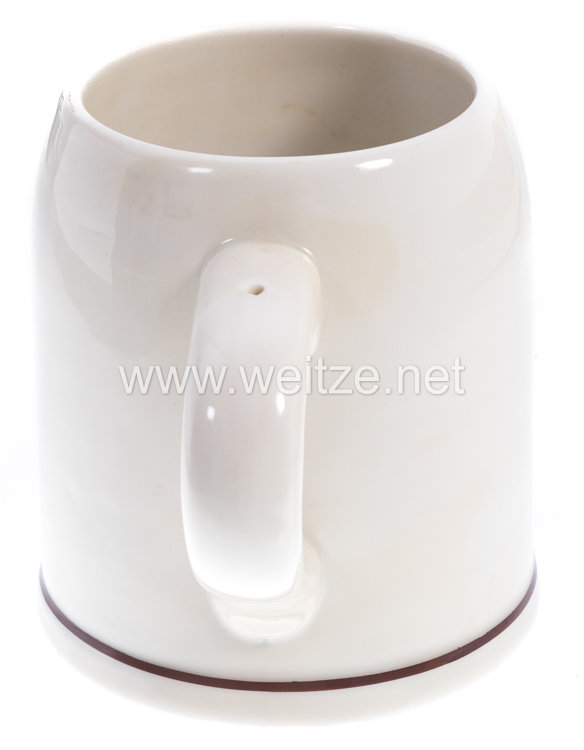
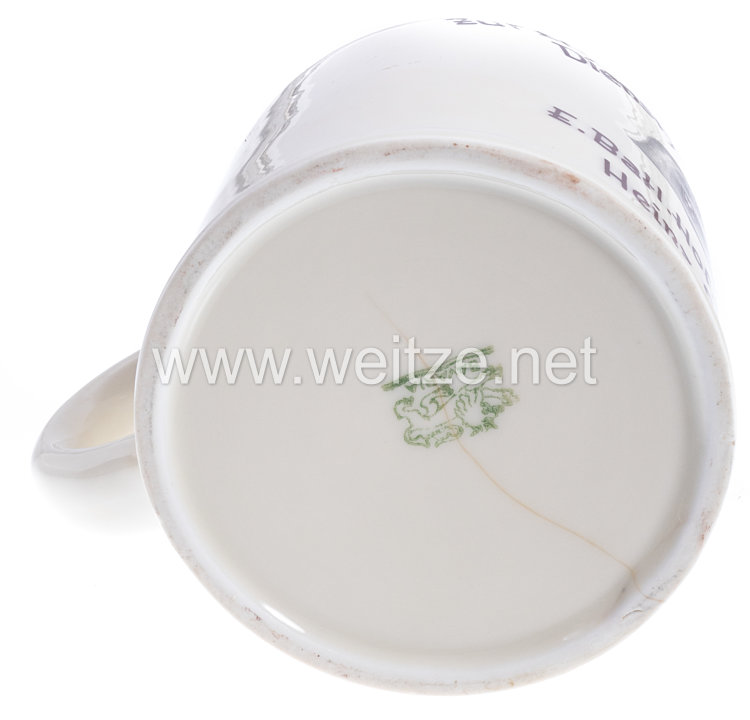
Beer stein made of glazed porcelain, 0.5 liter capacity, with color-printed design featuring Stahlhelm with swastika, manufacturer mark on base, condition 2.
359492
300,00

Wehrmacht Heer - Commemorative Stein "In Memory of Our Service 1935 - E.Batl.Hof. 3.M.G.K. Heinz Seidel"

This commemorative beer stein represents a significant category of military memorabilia from the era of the Third Reich, specifically from the period between 1935 and 1937. Such steins were commissioned by soldiers of the Wehrmacht to document their service time and preserve personal memories of their military career.

The inscription “Zur Erinnerung an unsere Dienstzeit 1935 - E.Batl.Hof. 3.M.G.K.” (In memory of our service time 1935 - Replacement Battalion Hof, 3rd Machine Gun Company) refers to the Ersatz-Bataillon (Replacement Battalion) in Hof, a Bavarian garrison town, as well as to the 3rd Machine Gun Company. The year 1935 is of particular historical significance, as this was when universal conscription was reintroduced in Germany, representing a flagrant violation of the Treaty of Versailles. On March 16, 1935, Adolf Hitler officially announced rearmament and the establishment of a peacetime strength of 36 divisions.

The tradition of military commemorative steins in Germany dates back to the 19th century and was particularly widespread during the Imperial era. Soldiers often had these steins manufactured by local porcelain manufacturers or specialized workshops. The steins served not only as personal mementos but also as expressions of comradeship and regimental pride. After the seizure of power in 1933 and especially after 1935, these traditions were adopted into the new military structures of the Wehrmacht.

The steel helmet with swastika depicted on this stein was the official symbol of the Wehrmacht. The Model 35 steel helmet, introduced in 1935, was a development of the proven M16/18 from World War I. The swastika as a national emblem was affixed to the right side of the helmet according to the regulation of February 17, 1934. This symbolism on commemorative steins reflected the ideological permeation of the Wehrmacht.

Replacement battalions played a central role in the military buildup of the Wehrmacht. They were responsible for basic training of recruits, military instruction, and the provision of replacement personnel for active units. In Hof, a city with a long garrison tradition, several such training facilities were located. The machine gun companies were specialized units trained for the deployment of heavy and light machine guns - a crucial component of Wehrmacht tactical doctrine.

The personalization with the name “Heinz Seidel” was typical for these memorabilia. It documents the individual service time of a single soldier and makes the stein a personal testimony. Such steins were often acquired upon discharge from active service or after completion of basic training.

Production typically occurred at regional porcelain manufacturers specialized in military memorabilia. The manufacturer's mark on the base of the stein often enables precise dating and attribution. The glazed porcelain with colored print was the common production method, with motifs usually applied using transfer prints (lithographs).

From a historical perspective, such objects are important sources for military and everyday history. They document not only the organizational structures of the Wehrmacht but also the self-perception of soldiers and the continuation of military traditions. At the same time, they are testimonies to the ideological appropriation by the Nazi regime, visible in the prominent display of National Socialist symbols.

The preservation of such objects in collections serves exclusively historical and scientific purposes. They enable a better understanding of military everyday culture and propaganda of the Third Reich. The trade and collection of such items are subject to strict legal regulations in Germany and other countries, particularly regarding the display of unconstitutional symbols under Section 86a of the German Criminal Code, although use for educational and informational purposes is expressly permitted.

r