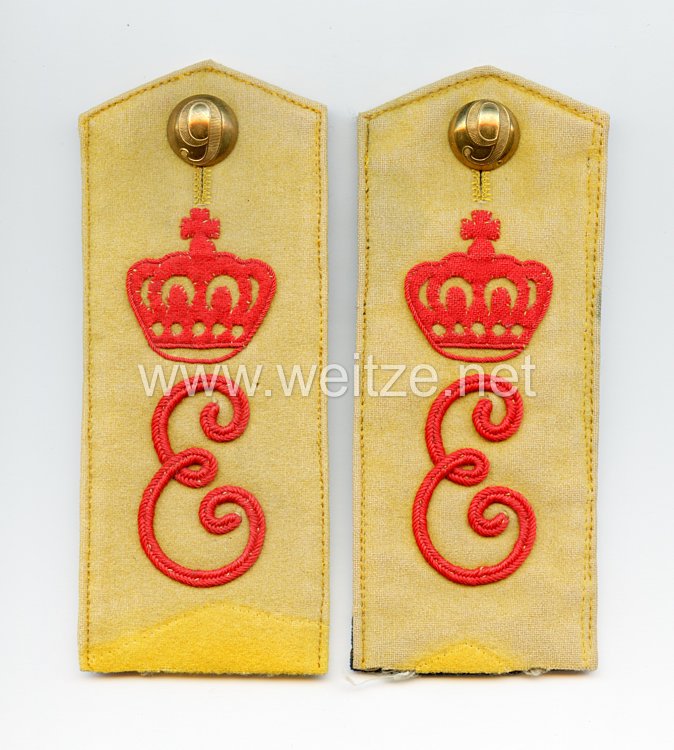
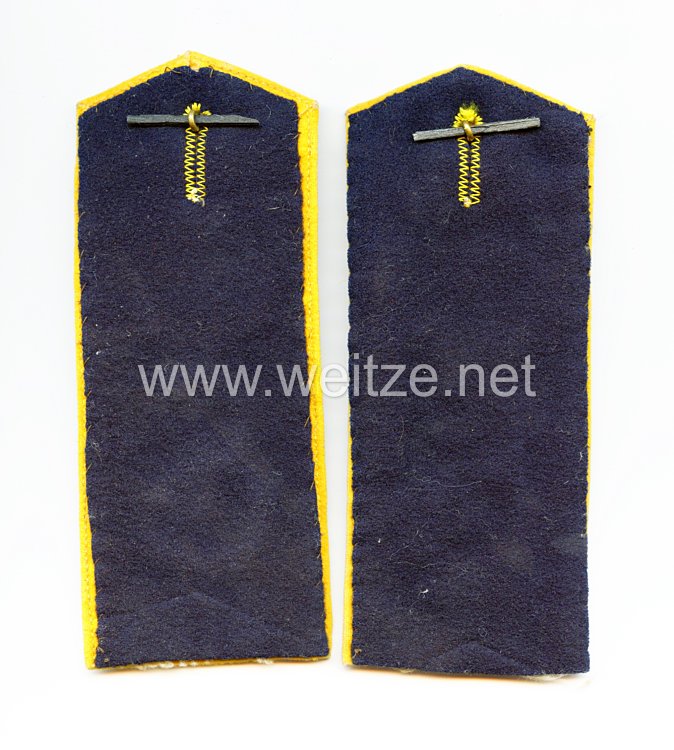
Prussia Pair of Enlisted Men's Shoulder Straps for Königin Elisabeth Garde-Grenadier-Regiment Nr. 3
This pair of enlisted men's shoulder straps from the Queen Elisabeth Guard Grenadier Regiment No. 3 represents an authentic testimony to Prussian military history from around 1910. These paired shoulder pieces, manufactured for wear on the greatcoat, originate from the final phase of the German Empire and reflect the strict uniform regulations of the Prussian Army.
The Guard Grenadier Regiment No. 3 was founded in 1814 as the 3rd Guard Regiment on Foot and received the designation Emperor Franz Guard Grenadier Regiment in 1826. In 1860, it was renamed in honor of Queen Elisabeth of Prussia, consort of King Frederick William IV. The regiment was stationed in Berlin-Charlottenburg and belonged to the most prestigious units of the Prussian Army. As part of the Guard troops, the regiment held a special position and was directly subordinate to the King.
Shoulder straps were an essential element of the Prussian military uniform and served multiple purposes. They protected the shoulder area from chafing by rifle slings while simultaneously identifying the soldier's unit affiliation. For enlisted men – soldiers without non-commissioned officer rank – the shoulder straps were typically made from basic cloth and bore the characteristic regimental number as well as monograms or other identifying features where applicable.
The greatcoat version differed from those worn on the tunic. Greatcoat shoulder straps were often somewhat plainer and had to meet the practical requirements of service. Prussian uniform regulations precisely dictated how these uniform parts should appear. For Guard Grenadier Regiment No. 3, the shoulder straps were made in the regimental colors, with the number “3” clearly visible.
Around 1910, corresponding to the dating of these shoulder straps, the German Empire was under the rule of Kaiser Wilhelm II. The army was undergoing a process of modernization at this time but retained traditional uniform elements that had their roots in the Napoleonic Wars. The Guard regiments in Berlin were considered the elite of the Prussian armed forces and were frequently deployed at parades and ceremonies.
Regiment No. 3 distinguished itself through a long tradition and numerous battle honors. The soldiers of this regiment had participated in the Wars of Liberation against Napoleon, the Austro-Prussian War of 1866, and the Franco-Prussian War of 1870-71. This military history was carefully maintained in regimental culture and contributed to the unit's identity.
The fact that these shoulder straps are “somewhat worn” indicates they were actually used in service. This gives them special historical value, as they were not merely equipment items but were worn by a Prussian soldier. Their preservation in condition 2 speaks to careful storage over more than a century.
The enlisted ranks of the Prussian Army were recruited through universal conscription, introduced in 1814. Every able-bodied man had to perform military service, with the length of service varying throughout the 19th century. Around 1910, active service typically lasted two to three years, followed by several years in the reserve. For many young men, military service was a formative experience.
With the outbreak of World War I in 1914, Guard Grenadier Regiment No. 3 would see action once more. The regiment fought on various fronts and suffered heavy casualties. After the war's end and the Kaiser's abdication in 1918, the Prussian Army was dissolved, and with it disappeared the traditional Guard regiments.
Today, such shoulder straps are important collectibles and sources for military history research. They allow historians and collectors to trace uniform development and understand the organizational structure of the Imperial Army. Each pair of shoulder straps tells the story of a specific unit and its soldiers.