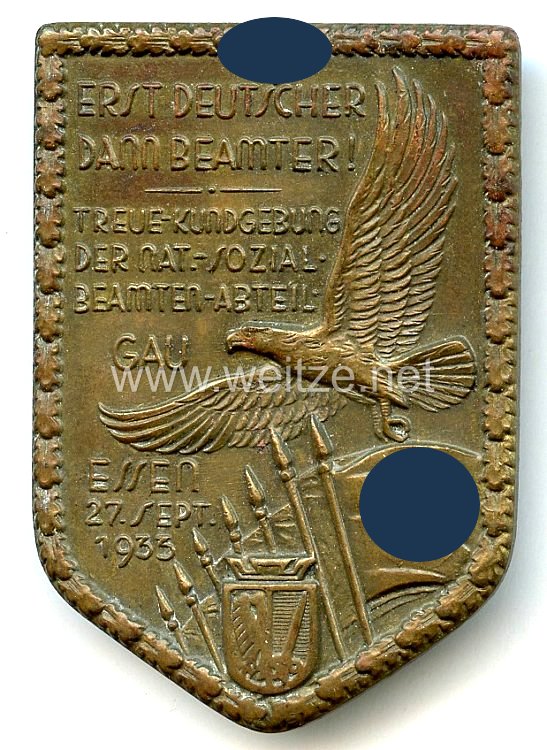
Third Reich - Loyalty Declaration of the National Socialist Civil Servants Section Gau Essen September 27, 1933 "German First - Civil Servant Second"
This badge documents a significant chapter in the early National Socialist penetration of the German civil service in 1933. The loyalty demonstration of the National Socialist Civil Servants Division of Gau Essen on September 27, 1933, took place at a time when the NS regime was systematically coordinating all areas of society under Nazi control.
After the seizure of power on January 30, 1933, the NSDAP immediately began restructuring the German state apparatus. The Law for the Restoration of the Professional Civil Service of April 7, 1933, provided the legal basis for purging the public service of political opponents and Jewish civil servants. This law enabled the removal of undesirable officials and their replacement with loyal National Socialists.
Gau Essen, later renamed Gau Essen-Düsseldorf, was one of the important administrative units of the NSDAP in the Ruhr region. The area was characterized by heavy industry and had a strong Social Democratic and Communist tradition, making the Nazi coordination efforts particularly urgent.
The National Socialist Civil Servants Division was part of the NSDAP's comprehensive organizational apparatus. It served to ideologically train the civil service and secure their unconditional loyalty to the new regime. The slogan engraved on the badge, “First German - Then Civil Servant”, reveals the ideological thrust: national and racial identity was to be placed above the professional duty of the impartial civil servant.
This motto represented a fundamental break with German civil service tradition. Since the 19th century, the German civil servant was considered a non-partisan state servant, obligated to law and constitution. National Socialist ideology, however, demanded personal loyalty to the Führer and to the Volksgemeinschaft (people's community) according to racial criteria.
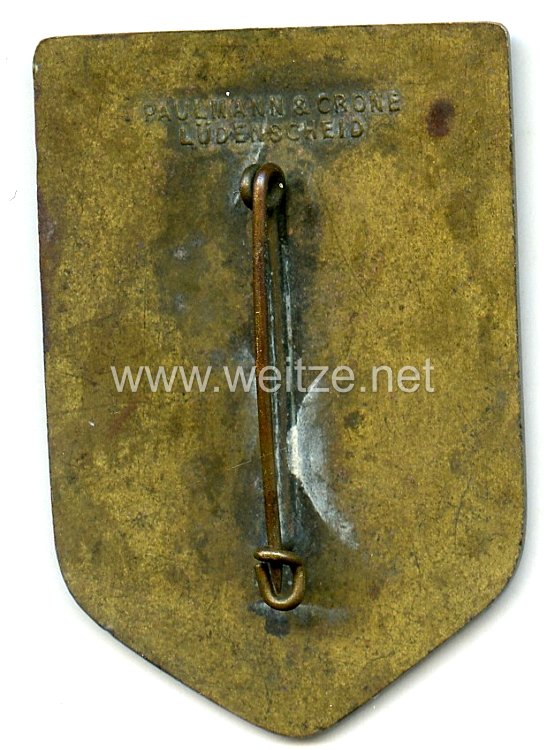
The badge was manufactured by Paulmann & Crone of Lüdenscheid, a town traditionally a center of German metalworking. Numerous companies in Lüdenscheid produced orders, medals, and badges for military and paramilitary organizations. The designation as a “solid non-ferrous metal badge” indicates high-quality workmanship, underscoring the importance attached to such loyalty demonstrations.
September 1933 marked a phase of intensive Gleichschaltung (coordination). Opposition was largely crushed, trade unions dissolved, and the NSDAP consolidated its power. Loyalty demonstrations and public commitments to the new regime were systematically organized to create the appearance of broad support and pressure doubters.
Such badges served multiple purposes: they were visible signs of political loyalty, strengthened the sense of solidarity among wearers, and marked participation in a historic event in terms of Nazi propaganda. Wearing such badges was often less a voluntary decision than a professional necessity for civil servants who wanted to keep their positions.
The pin construction allowed attachment to civilian clothing, which was typical for civil servant badges. Unlike military decorations, such political badges were usually issued without official presentation ceremonies.
From today's perspective, this badge documents the systematic undermining of rule-of-law principles and the instrumentalization of the civil service for totalitarian purposes. The German civil service, which theoretically should have been a bulwark against arbitrary rule, was transformed into a tool of dictatorship. The consequences were devastating: civil servants implemented discriminatory racial laws, organized deportations, and contributed to the functionality of the criminal regime.
Such objects are today important historical documents that remind us of the mechanisms of totalitarian rule and underscore the importance of an independent, constitutionally bound administration.