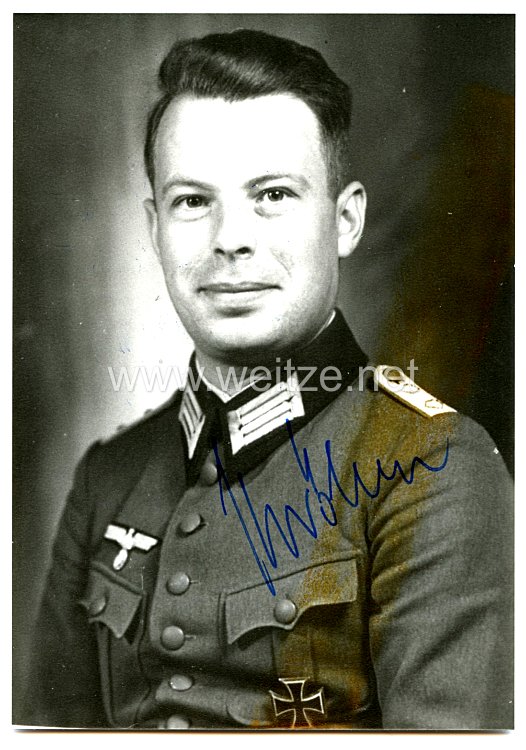
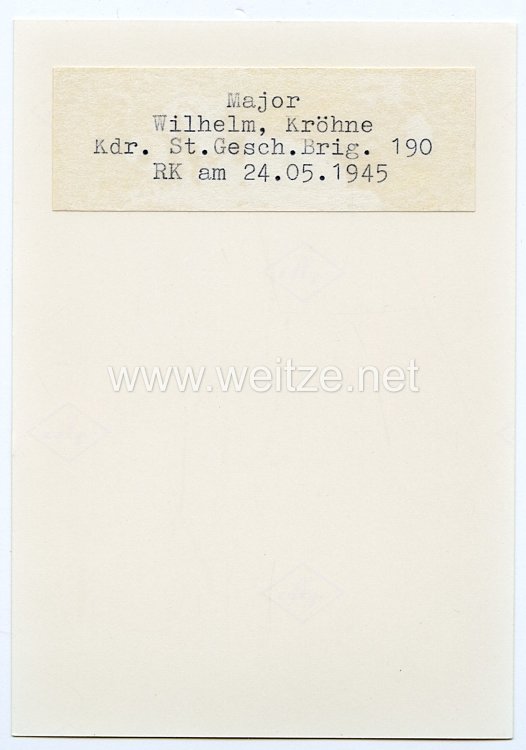
Army - Post-war Signature of Knight's Cross Recipient Wilhelm Kröhne

Photograph dimensions approx. 8.8 x 12.6 cm. This photograph is a print made after 1945, condition 2.
412892
30,00

Army - Post-war Signature of Knight's Cross Recipient Wilhelm Kröhne

The object in question is a post-war photograph with signature of Wilhelm Kröhne, a recipient of the Knight's Cross of the Iron Cross. The photograph dates from after 1945 and measures 8.8 x 12.6 cm. Such post-war signatures of Knight's Cross recipients form a distinct category within military historical collecting and raise interesting questions about memory culture and the processing of the past.

Wilhelm Kröhne served during World War II in the Wehrmacht and was awarded the Knight's Cross for his military achievements. The Knight's Cross of the Iron Cross was instituted on September 1, 1939, by Adolf Hitler as the highest grade of the Iron Cross and was awarded to approximately 7,300 individuals during the war. It was considered one of the highest military decorations of the Third Reich and was given for exceptional bravery or outstanding military leadership.

After the war ended in 1945, many former Knight's Cross recipients found themselves in a complex social position. While some were prosecuted, others returned to civilian life. In the following decades, a veteran culture developed in which former soldiers gathered at meetings and comradeship events. This also gave rise to the practice of creating and exchanging signed photographs.

Post-war signatures differ fundamentally from contemporary documents from the war period. They were often created at the request of collectors, at veteran meetings, or through postal contact. The photographs frequently show the recipients in uniform, sometimes original wartime photographs, sometimes post-war portraits. Signatures were usually made with ink or ballpoint pen and occasionally included additional information such as rank, unit, or the date of decoration award.

The authenticity of such post-war signatures can be assessed through various criteria: handwriting analysis, comparison with known authentic signatures, the type of paper and ink used, and the object's provenance. Experts have built up comparative collections over decades that aid in evaluation.

The historical and collecting significance of such objects is controversial. While some regard them as important contemporary historical documents providing insight into post-war biographies and memory culture, others see them as problematic glorification of military decorations from a criminal regime. Academic military history primarily uses such materials as sources for researching veteran organizations and memory politics in the post-war period.

The collecting market for post-war signatures developed particularly in the 1970s and 1980s. Many Knight's Cross recipients were still alive then and willing to give autographs. With the death of the last recipients in the 2000s, this era ended. The valuation of such objects depends on factors such as the fame of the recipient, the quality of the photograph, the rarity of the signature, and the condition.

From a legal perspective, trade in such objects is generally legal in Germany as long as no unconstitutional symbols within the meaning of §86a of the Criminal Code are depicted. The swastika may only be shown in contexts of historical education or research. However, many platforms have their own stricter guidelines for trading in NS memorabilia.

For academic research, such post-war documents are particularly interesting in the context of examining how former Wehrmacht members dealt with their past and how societal perception of military decorations changed over the decades. They are part of the larger history of coming to terms with and dealing with the Nazi past in Germany and Austria.

The practice of collecting autographs from military figures raises ethical questions that continue to be debated today. Museums and archives approach such materials with scholarly detachment, focusing on their value as historical sources rather than as objects of veneration. The distinction between historical documentation and glorification remains a subject of ongoing discussion in the field of military history and collecting.