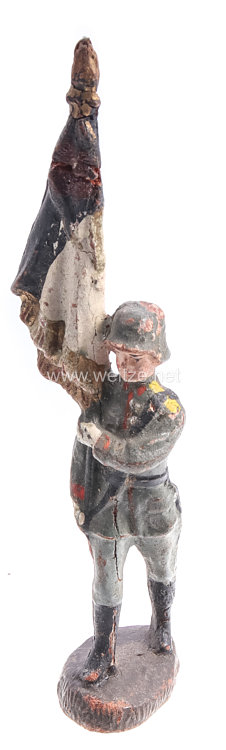
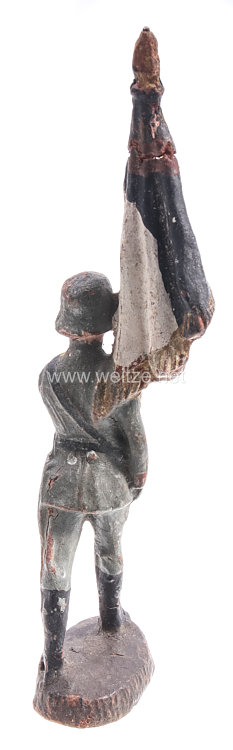
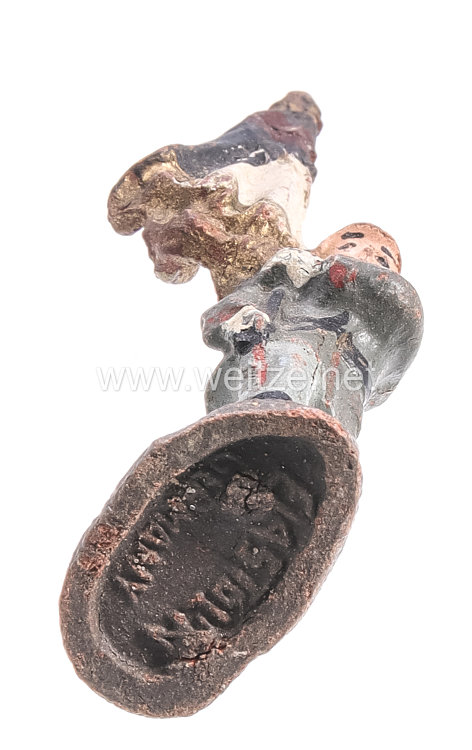
Elastolin - Army Standard Bearer Marching with State Flag (black-white = Prussia)

6.5 cm, composition flag non-removable, condition 2-.
402492
30,00

Elastolin - Army Standard Bearer Marching with State Flag (black-white = Prussia)

This Elastolin figure of a marching German Army flag bearer with the black-and-white Prussian state flag represents a fascinating piece of German toy and military history from the first half of the 20th century. This 6.5 cm figure made of composition material with a non-removable flag is a typical product of the Hausser Company, which became world-renowned under the Elastolin brand name.

The Elastolin Company and Its History

The O. & M. Hausser Company was founded in Ludwigsburg in 1904 and developed into one of Germany's most significant manufacturers of toy figures. The name “Elastolin” refers to the patented material, a composition made from casein, glue, chalk, and other fillers, which was molded around a metal core. This material was lighter and more durable than lead figures and allowed for more detailed modeling. From the 1920s onward, Hausser mass-produced military figures in various scales, with the 7-cm series (actually usually between 6.5 and 7 cm) becoming the standard.

The Prussian State Flag

The black-and-white flag on this figure represents the historical colors of Prussia, which had been associated with the Kingdom of Prussia since the 18th century. These colors derived from the black Prussian eagle on a white background. After the founding of the Empire in 1871, Prussia remained the dominant federal state within the German Empire, and its colors retained great symbolic significance. Even during the Weimar Republic (1918-1933), the Free State of Prussia continued to exist with its traditional colors until it was effectively dissolved in 1932/33.

The Flag Bearer in Military Context

The flag bearer (also called Fähnrich or Fahnenträger) held special significance in German military tradition. The flag was not merely a practical means of identification and rallying point in combat, but above all a symbol of honor and tradition for a military unit. The loss of a flag was considered the greatest disgrace. Flag bearers were therefore usually selected from particularly reliable and courageous soldiers. They were typically accompanied by a flag guard that was to protect the flag at all costs.

Military Representation and Uniforms

Elastolin figures from the interwar period and during World War II depicted German soldiers in contemporary uniforms. Marching figures like this one were particularly popular as they recreated parades and military processions that played an important role in public life in the German Reich. The figures were modeled with great attention to detail and hand-painted, representing various branches of service and ranks.

Production Period and Historical Context

Figures of this type were mainly produced between 1920 and 1945. In the 1930s, the production of military toys in Germany experienced an enormous upswing, promoted by the increasing militarization of society under the Nazi regime. Elastolin figures were not only children's toys but were also appreciated by adult collectors and used for depicting military scenarios. During World War II, production became increasingly restricted as raw materials and labor were needed for armaments production.

Collector and Cultural-Historical Value

Today, Elastolin figures are sought-after collector's items that represent important documents of German social and cultural history. They reflect the military culture of their time of origin and demonstrate how military values were transmitted to young generations through toys. The condition rating of “2-” for this figure indicates very well-preserved, nearly original paintwork and minimal signs of use, making it particularly valuable. The non-removable composition flag is a characteristic feature of early production series, while later models often had metal flags or removable flags.

This figure thus stands as an example of an important chapter in German toy history and military commemorative culture, which today is critically examined in the context of its time and preserved as a historical witness.