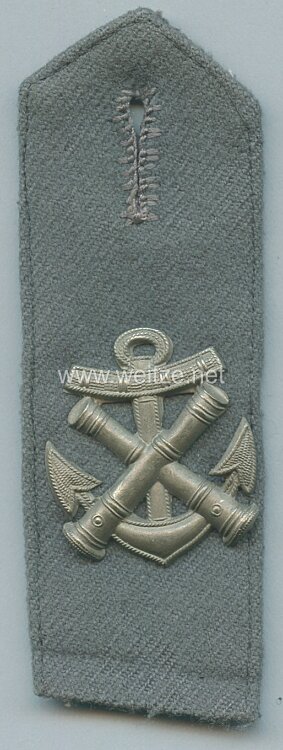
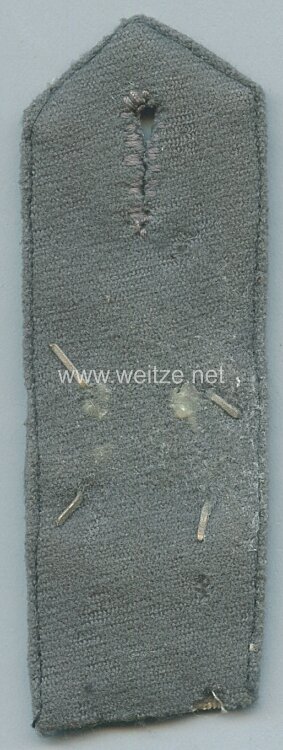
World War I Marine-Infantry Flandernkorps Single Shoulder Strap for an Artificer
This single shoulder strap for a Feuerwerker (artificer) of the Marine-Infantry Flandern Corps from World War I represents a remarkable example of the specialized uniform history of this unique branch of service. Manufactured around 1916, this field-gray shoulder strap with its characteristic field-gray metal mount documents a significant chapter of German naval history on the Western Front.
The Marine-Korps Flandern (Marine Corps Flanders) was established in August 1914 and evolved into one of the most unusual formations of World War I. Originally conceived as a provisional unit to secure the threatened Belgian coast, the corps eventually grew to three divisions. The naval infantrymen, often recruited from crews of blockaded or decommissioned warships, were repurposed as land warriors and fought in the bloody trench warfare of Flanders.
The rank of Feuerwerker in the Imperial Navy corresponded roughly to a non-commissioned officer with technical specialization. Feuerwerkers were responsible for ammunition, explosives, and pyrotechnic matters. In the naval infantry, they retained these important functions, now in the context of land warfare. Their expertise was particularly valuable when handling hand grenades, mines, and other explosives that became increasingly important in trench warfare.
The field-gray execution of the shoulder strap is particularly significant. At the outbreak of war, naval units still wore their traditional dark blue uniforms, but the realities of modern warfare required adaptation. From 1915/1916 onwards, field-gray clothing was gradually introduced to reduce visibility and enable alignment with army units. The field-gray metal mount instead of the previously common gold or yellow embroidery reflects this war-induced simplification and camouflage.
The shoulder strap served not only for rank identification but also for identification of the branch of service. While army units wore their regimental numbers, the Marine-Korps Flandern used special markings that emphasized their maritime origins. The metal mount for Feuerwerkers typically displayed special emblems or letters identifying the technical service.
The Marine-Korps Flandern was involved in significant battles, including the Flanders Battles of 1917 and numerous smaller engagements along the Belgian coast. The naval infantrymen acquired a reputation for toughness and perseverance, despite not having been originally trained for land warfare. Their presence in Flanders was also strategically significant, as they secured coastal positions and thus prevented potential Allied landing operations.
The rarity of such shoulder straps, especially as single pieces, can be explained by several factors. First, the naval infantry units were numerically much smaller than corresponding army formations. Second, harsh combat conditions led to high casualty rates for both personnel and equipment. Third, after the war's end, many uniform parts were destroyed, reworked, or simply lost.
The preservation of such military historical objects is of great importance for understanding the everyday reality and organizational structures of the Imperial armed forces. Each shoulder strap tells the story of an individual who served in one of the most devastating conflicts in human history. For collectors and historians, they offer tangible connections to this era.
The technical execution of the shoulder strap itself reflects the production conditions of the later war years. Field-gray cloth and simplified metal mounts replaced the more elaborate pre-war and early-war variants with embroidery. This development was typical for all warring nations confronted with material shortages and the necessity of mass production.
The Marine-Korps Flandern held a unique position in German military organization. Unlike regular army units, it maintained naval traditions and command structures while operating in a land warfare environment. This hybrid nature is reflected in their uniforms and insignia, which combined naval and army elements. The Feuerwerker's shoulder strap embodies this intersection of maritime and terrestrial military culture.
Today, shoulder straps of the Marine-Korps Flandern are sought-after collectibles that provide important insights into uniform history and the organization of the Imperial Navy in World War I. They document the transformation from sailors to infantrymen and the adaptability of military organizations under wartime conditions.