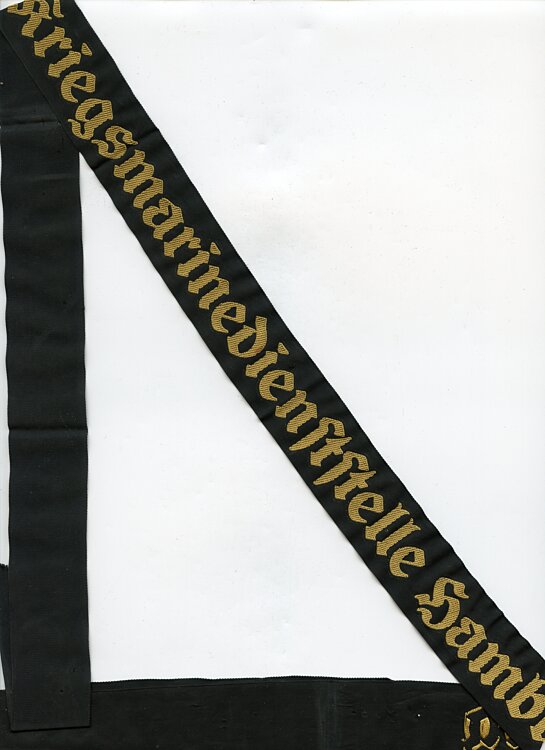
Kriegsmarine Cap Tally "Kriegsmarinedienststelle Hamburg"

Cotton construction, lightly worn, 110 cm long. Condition 2
107691
70,00

Kriegsmarine Cap Tally "Kriegsmarinedienststelle Hamburg"

The Kriegsmarine cap tally bearing the inscription “Kriegsmarinedienststelle Hamburg” represents a characteristic piece of equipment from the German Navy during World War II. Cap tallies were an essential component of naval uniforms, serving both identification purposes and maintaining maritime tradition.

Historical Background

The tradition of cap tallies in the German Navy dates back to the 19th century. Following the establishment of the Kriegsmarine in 1935 as the official successor to the Reichsmarine of the Weimar Republic, uniform regulations were comprehensively revised. The Kriegsmarine, under the supreme command of Grand Admiral Erich Raeder and later Karl Dönitz, introduced various cap tally variants that bore different inscriptions depending on assignment to ships, flotillas, or shore establishments.

Naval Shore Establishments

Not all naval personnel served aboard ships. Numerous sailors and officers were stationed at shore-based Kriegsmarinedienststellen (naval service establishments). These installations were responsible for administrative, logistical, technical, and training duties. Hamburg, as a major port and shipyard location, housed several important Kriegsmarine facilities. The city was home to large shipyards such as Blohm & Voss and Howaldtswerke, which constructed and maintained U-boats, destroyers, and other warships.

Naval personnel assigned to such establishments wore cap tallies bearing the designation of their service establishment rather than a ship's name. This enabled clear identification and fostered esprit de corps within the respective unit.

Technical Specifications

The present cap tally in cotton construction with a length of 110 cm conforms to the standard measurements of the Kriegsmarine. The cotton variant was the most commonly used version, while versions in artificial silk existed for certain occasions. The inscription was typically embroidered or woven in golden-yellow color on a black background.

Production was carried out by various Wehrmacht suppliers who worked according to the regulations of the Heeres-Dienstvorschrift (HDv) and corresponding naval regulations. Quality and execution were largely standardized, although simplified versions were produced toward the end of the war due to wartime constraints.

Wearing and Significance

The cap tally was worn on the peaked cap (also called the service cap) of enlisted men and non-commissioned officers. It was wrapped around the cap with the ends hanging down at the back. Different regulations applied to officers, who did not wear inscribed cap tallies but rather emblems and cockades.

Cap tallies fulfilled multiple functions: they served to identify troop affiliation, strengthened the sense of belonging, and continued a long maritime tradition. Cap tallies were already widespread in the Imperial Navy, and this tradition was continued in the Reichsmarine and Kriegsmarine.

Hamburg as a Naval Location

Hamburg played a central role for the Kriegsmarine during World War II. In addition to the aforementioned shipyards, the city housed training facilities, administrative offices, supply depots, and technical service establishments. The port served as an important hub for military goods and as a base for various naval units.

From 1940 onward, the city increasingly became the target of Allied bombing raids, with Operation Gomorrah in July 1943 causing particularly devastating destruction. Many naval establishments and shipyard facilities were damaged or destroyed, yet Hamburg remained an important Kriegsmarine location until the end of the war.

Historical Context and Documentation

The variety of cap tally inscriptions provides insight into the organizational structure of the Kriegsmarine. While ship names were most common, designations for shore establishments, training units, and specialized services reflected the complex nature of naval operations. The Hamburg designation indicates the wearer's assignment to one of the numerous shore-based facilities in this strategically important port city.

Contemporary photographs and documents show that cap tallies were worn with pride and were an important element of naval identity. The replacement of ship names with establishment designations was regulated and followed specific guidelines issued by the Naval High Command.

Collector Value and Preservation

Today, original Kriegsmarine cap tallies are sought-after collector items. They document an important aspect of German naval history and uniform studies. The condition described as “lightly worn” indicates that this piece was actually used in service, which enhances its historical value. The cotton construction is susceptible to wear, making well-preserved examples relatively rare.

When collecting such militaria, scientific and historical interest should be emphasized. These objects serve as material witnesses to a complex and dark period of German history and should be appropriately viewed and preserved in their historical context.