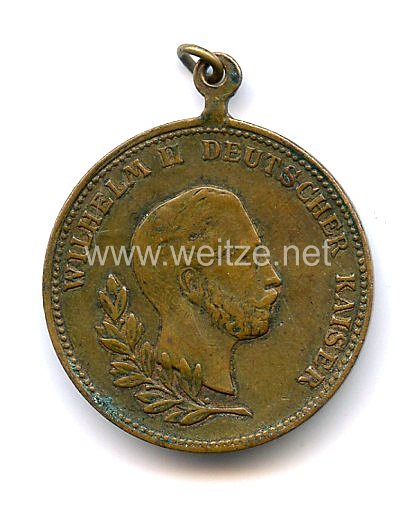
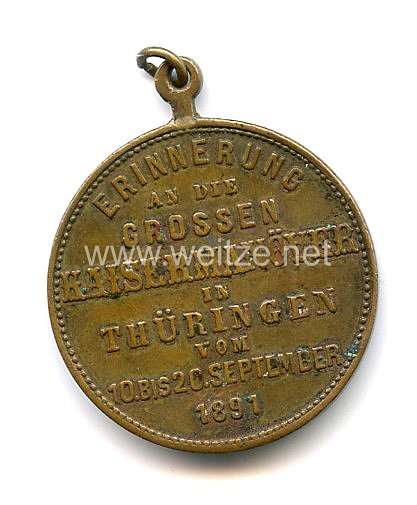
Commemorative Medal for the Imperial Maneuvers 1891 - Wilhelm II German Emperor
The Commemorative Medal for the Imperial Maneuvers of 1891 represents a remarkable testament to the military tradition of the German Empire under Kaiser Wilhelm II. This medal was created to commemorate one of the most significant large-scale military exercises of the late 19th century and documents the intense militarization and power aspirations of the young Kaiser during the early years of his reign.
Historical Context
Kaiser Wilhelm II ascended to the German throne in 1888 and shaped the following decades through his expansive foreign policy and passion for military affairs. The Kaisermanöver (Imperial Maneuvers) were large-scale military exercises that took place annually under the personal participation of the Kaiser, fulfilling both military and representative functions. The 1891 maneuver occurred only three years after Wilhelm's accession, at a time when he sought to consolidate his personal rule and demonstrate the striking power of the German armed forces.
These large maneuvers served several purposes: they were intended to improve the tactical and strategic training of officers and troops, test new military concepts, and not least, display the power and unity of the German Empire both domestically and internationally. The maneuvers regularly attracted foreign military observers, diplomats, and journalists, lending them considerable international significance.
The Imperial Maneuvers as an Institution
The annual Imperial Maneuvers developed under Wilhelm II into monumental events, frequently involving between 40,000 and 70,000 soldiers. They took place in various regions of the German Empire, with special emphasis placed on realistic combat scenarios. The 1891 maneuvers represented a phase of reorientation in German military strategy, combining lessons from the Franco-Prussian War of 1870-71 with modern developments in weapons technology and tactics.
Wilhelm II himself took active part in these exercises, often wearing the uniform of different regiments, observing the maneuvers on horseback or from elevated positions. His presence gave the events a ceremonial character that extended far beyond purely military utility.
Commemorative Medals as Military Tradition
The practice of striking commemorative medals for special military events had a long tradition in the German Empire. Such medals served multiple purposes: they honored participants, strengthened esprit de corps, and created lasting memories of significant military events. Unlike orders and decorations, which were awarded according to strict regulations, commemorative medals had a more memorial character.
These medals were typically commissioned by participating units, local organizations, or private parties. They were not part of the official Prussian or German order system but complemented it as an expression of regional or regiment-specific identity. Nevertheless, they were valued by their bearers and worn or preserved with pride.
Design and Symbolism
Commemorative medals of this type typically displayed the Kaiser's portrait on the obverse, often in profile following the manner of classical ruler representations. The reverse usually contained information about the occasion, date, and location of the maneuver, as well as patriotic or military symbols such as the Prussian eagle, laurel wreaths, or crossed swords. Inscriptions were in German and emphasized the connection between Kaiser, army, and nation.
Material execution varied depending on the commissioner and purpose: while some medals were made in bronze or brass, versions in silver also existed for officers or special participants. The medals were worn on ribbons in the Reich or Prussian colors (black-white-red).
Significance for Collectors and Historians
Today, commemorative medals such as those from the 1891 Imperial Maneuvers are important sources for military history research. They document not only the military practice of the time but also the self-representation of the Empire and the veneration of the monarchy in military circles. For collectors of military antiques, they represent a fascinating field that embodies the connection between personal memory, military tradition, and political symbolism.
The preservation of such objects enables subsequent generations to understand the military culture of the German Empire and trace the development toward World War I. They remind us of an era when military power and imperial authority were inseparably linked.