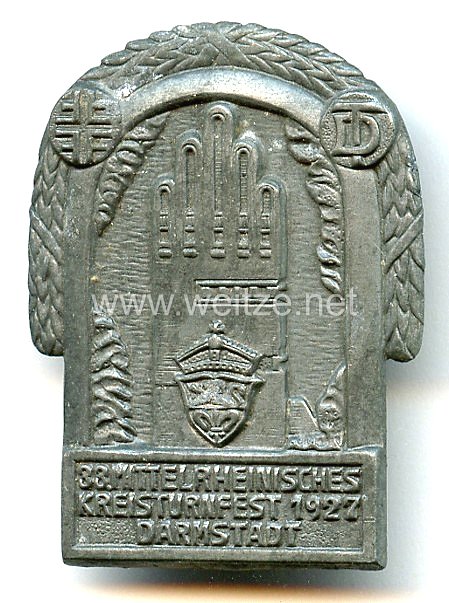
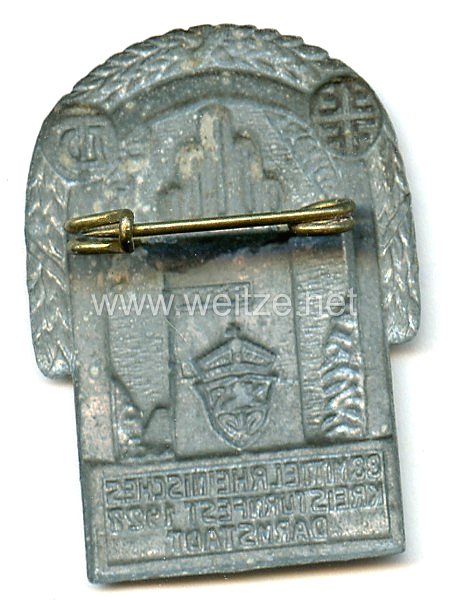
Weimar Republic - Deutscher Turnerbund - 33rd Mittelrheinisches Kreisturnfest 1927 Darmstadt
This tin badge represents a fascinating testament to the German gymnastics and sports movement during the Weimar Republic. It was issued for the 33rd Middle Rhine District Gymnastics Festival held in 1927 in Darmstadt. Such badges not only document major sporting events but also reflect the sociopolitical significance of the gymnastics movement during the interwar period.
The Deutsche Turnerbund (German Gymnastics Federation) was the largest and most influential gymnastics organization in Germany. After World War I and the establishment of the Weimar Republic in 1918/19, the gymnastics movement underwent a reorientation. The Turnerbund, which had its roots in Friedrich Ludwig Jahn's national-patriotic gymnastics movement of the early 19th century, had to position itself within the new democratic order. The organization largely maintained its conservative-national orientation while increasingly emphasizing health and social aspects of gymnastics.
The Kreisturnfeste (District Gymnastics Festivals) were regional major events held at regular intervals that served multiple functions. On one hand, they provided a competition platform where gymnasts from various clubs demonstrated their abilities in disciplines such as parallel bars, horizontal bar, floor exercises, and other classical gymnastics activities. On the other hand, they were important social events that strengthened community spirit and publicly presented the ideals of the gymnastics movement.
The year 1927 marked a phase of relative stability in the Weimar Republic, the so-called “Golden Twenties.” After the crisis years of the early 1920s with hyperinflation and political unrest, Germany experienced a period of economic recovery and cultural flourishing. In this context, the gymnastics movement could intensify its activities and organize large festivals.
Darmstadt, the capital of the former Grand Duchy of Hesse and since 1919 part of the People's State of Hesse, was a significant cultural and sporting center in the Rhine-Main region. The city had an active gymnastics community and the necessary infrastructure to host such major events.
The production of tin badges for gymnastics festivals had a long tradition in Germany. These badges were usually made from nickel-plated or enameled tin and typically displayed symbolic representations: the Turner cross (four Fs for “Frisch, Fromm, Fröhlich, Frei” - Fresh, Pious, Happy, Free), local landmarks, gymnastics equipment, or stylized gymnasts. They were attached to clothing with a pin and served multiple purposes: as admission authorization, as a souvenir, and as a visible sign of belonging to the gymnastics community.
The designation “33rd Middle Rhine District Gymnastics Festival” illustrates the long continuity of this event series. Even the interruption caused by World War I (1914-1918) had not completely ended the tradition. The numbering shows that these district festivals had begun in the 19th century and shaped the regional gymnastics scene for decades.
For the gymnastics movement of the Weimar Republic, organizing such festivals was also a form of political positioning. The Deutsche Turnerbund competed with other sports organizations such as the social-democratically oriented Arbeiter-Turn- und Sportbund (Workers' Gymnastics and Sports Federation, ATSB). While the ATSB had about 1.2 million members, the Deutsche Turnerbund united around 1.7 million gymnasts and emphasized its supposed non-partisanship, though it factually leaned toward conservative-national positions.
The condition grade 2 according to the German collector's system means that the badge is well preserved, possibly with slight signs of use but without significant damage. This is remarkable for an almost 100-year-old object and speaks to the quality of manufacturing at the time as well as careful preservation by previous owners.
After 1933 and the Nazi seizure of power, all gymnastics organizations were synchronized and incorporated into the Nationalsozialistischer Reichsbund für Leibesübungen (National Socialist League for Physical Exercise). The independent tradition of gymnastics festivals thus ended. Objects like this badge document a vanished culture of bourgeois associational life in the Weimar Republic, which oscillated between tradition and modernity, between local patriotism and national identity.