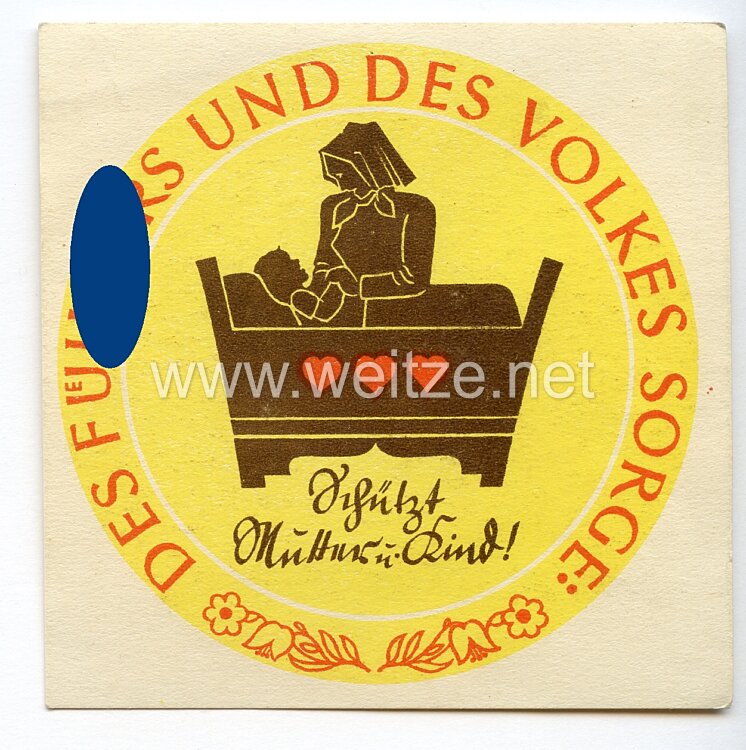
WHW - 2nd Winterhilfswerk des Deutschen Volkes 1934/35 - Door Plaque for February 1935
Door Plaque from the Winterhilfswerk des Deutschen Volkes (WHW) - February 1935
This door plaque from the 2nd Winter Relief of the German People 1934/35 for the month of February 1935 represents a significant artifact from the National Socialist welfare and propaganda organization. Measuring 100 x 100 mm, it exemplifies the monthly door plaques that served as visible proof of charitable donations and simultaneously as an instrument of social control.
The Winter Relief of the German People
The Winterhilfswerk (WHW) was personally inaugurated by Adolf Hitler on September 13, 1933, and became one of the largest Nazi mass organizations. Officially conceived as a welfare organization to support needy Germans during the winter months, the WHW quickly evolved into a comprehensive propaganda and control instrument. The organization operated under the patronage of Joseph Goebbels and the Reich Ministry of Propaganda, but was administered by the National Socialist People's Welfare (NSV).
The first Winter Relief 1933/34 served as a pilot project. The second WHW 1934/35, from which this door plaque originates, was already fully established and systematically organized. The campaign typically ran from October to March and encompassed various collection activities, including street collections, sacrifice Sundays, and the sale of badges.
Function and Significance of Door Plaques
The monthly door plaques fulfilled multiple functions within the WHW system. Primarily, they served as proof of donation and were issued to households that had paid the monthly collection contribution. The plaques were to be displayed prominently on apartment doors or windows. This created immediate social pressure: households without current plaques were instantly recognizable as “non-donors,” which could have considerable social consequences in the increasingly coordinated society.
The standardized size of 100 x 100 mm was designed to ensure adequate visibility. Each month of the WHW season had its own plaque with specific designs, frequently featuring seasonal or propagandistic motifs. The February 1935 plaque dates from a period when the Nazi regime had already largely consolidated its power and the coordination of society was advancing.
Organization and Implementation
The WHW collection activities were strictly organized. Block wardens of the NSDAP maintained lists of donors, and the distribution of door plaques was precisely documented. The expected donation amount theoretically corresponded to income, though considerable social pressure existed to donate appropriately or even above average. Besides door plaques, there were also smaller pin badges that were to be worn daily.
The WHW collected enormous sums. For the year 1934/35, total receipts of approximately 358 million Reichsmarks are documented. These funds officially flowed into food distributions, coal deliveries, and other support measures for needy “national comrades.” However, the money was also used for propaganda purposes and to finance party projects.
Propaganda Dimension
The WHW was far more than a mere welfare organization. It served to demonstrate the alleged “Volksgemeinschaft” (people's community), a central ideological concept of National Socialism. The collections were meant to demonstrate the solidarity of all “national comrades” and suggest the overcoming of class differences. Prominent National Socialists had themselves photographed during collection activities, and the press reported extensively on the successes.
The door plaques were part of this system of visible participation. They made private donation decisions public and contributed to the atmosphere of surveillance and mutual control characteristic of the Nazi system.
Collectible Value and Historical Significance
Today, WHW door plaques are sought-after historical documents. They are collected in various states of preservation, with the indicated “condition 2” typically denoting good condition with slight signs of use. The plaques document not only the organizational structure of the Nazi regime but also the daily life of people in the “Third Reich” and the mechanisms of social control.
For historical research, these objects are important sources for understanding the penetration of daily life by National Socialist organizations and the mechanisms through which the regime enforced conformity and participation. The February 1935 plaque originates from a phase of consolidation of Nazi rule, two years after the seizure of power and before the major foreign policy escalations of the later 1930s.