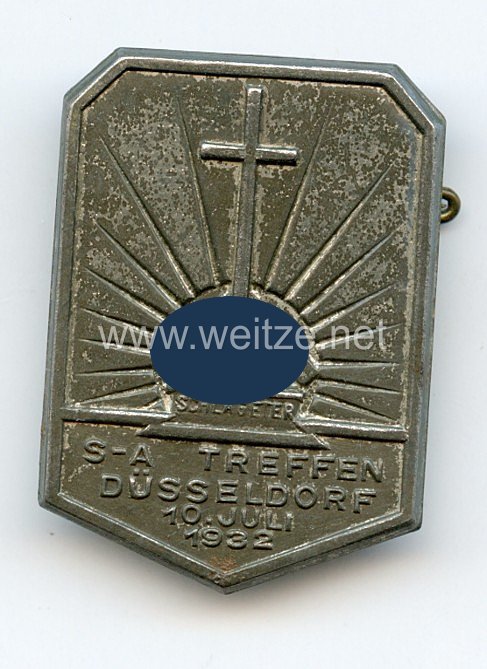
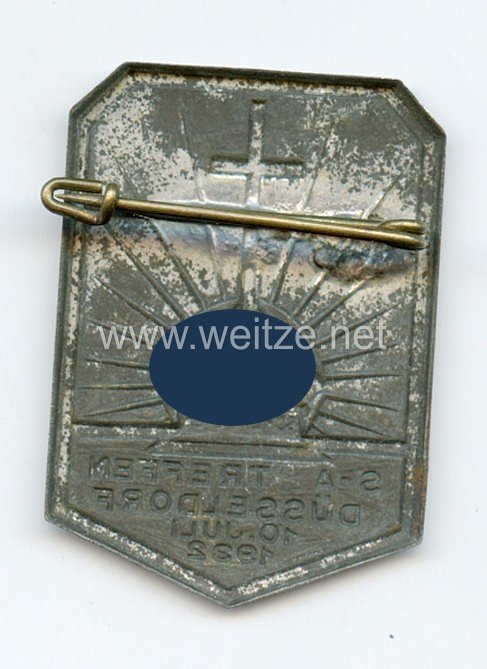
SA Rally Düsseldorf 10 July 1932 "Schlageter"
The SA Meeting Düsseldorf July 10, 1932 “Schlageter” represents a significant historical artifact from the final phase of the Weimar Republic. This sheet iron badge documents a mass rally of the Sturmabteilung (SA) of the NSDAP during a period of intense political confrontation that brought Germany to the brink of civil war in the summer of 1932.
The SA, founded in 1921 as the paramilitary combat organization of the NSDAP, had developed by 1932 into a powerful mass organization with several hundred thousand members. Under the leadership of Ernst Röhm, the SA regularly staged marches, rallies, and violent street fights against political opponents, particularly Communists and Social Democrats.
July 1932 marks a peak of political violence in Germany. That month saw Reichstag elections in which the NSDAP became the strongest party with 37.3 percent of the vote. In preparation, the SA organized numerous propaganda events to mobilize the National Socialist movement. The Düsseldorf meeting on July 10, 1932, was one of these mass rallies taking place throughout Germany.
The naming of the meeting after Albert Leo Schlageter carries particular propagandistic significance. Schlageter was a Freikorps fighter who was executed in 1923 by French occupation forces in the Ruhr region for acts of sabotage during the Ruhr struggle. The National Socialists stylized him as a martyr and symbol of resistance against the Versailles peace order. The NSDAP systematically used Schlageter's name for events, streets, and organizations to reinforce their nationalist propaganda.
The choice of Düsseldorf as a venue was strategically significant. The Rhineland and Ruhr regions were traditionally contested political territories where Communists and Social Democrats were strongly represented. The SA attempted through massive marches to demonstrate their presence in these areas and exercise intimidation.
This badge is made of sheet iron, a material that could be produced cost-effectively during the economic crisis. Mass production of such badges enabled the NSDAP to visibly mark their supporters while simultaneously generating additional revenue. Participants and sympathizers wore these badges as signs of their affiliation with the movement and as mementos of their participation in significant events.
The production and distribution of event badges was part of the sophisticated propaganda and merchandising strategy of the NSDAP. Every major SA meeting, party rally, and significant demonstration was documented with specific badges, plaques, and commemorative items. These objects served not only for financing but also for creating collective identity and a sense of belonging among supporters.
The summer of 1932 was characterized by unprecedented political violence. The so-called “Altona Bloody Sunday” on July 17, 1932, just one week after the Düsseldorf SA meeting, during which 18 people died in clashes between National Socialists and Communists, illustrates the explosive atmosphere of this period. The Prussian government under Otto Braun attempted to restrict SA activities, but the Reich government under Franz von Papen lifted the SA ban that had been in place since April on June 14, 1932, further escalating the situation.
From today's perspective, such badges are important historical sources documenting the mobilization capacity and organizational structure of the National Socialist movement. They show how the NSDAP systematically used mass events for demonstrations of power and propaganda. At the same time, they illustrate the role of the SA as an instrument of political intimidation and violence in the final phase of the Weimar Republic.
The collection and scholarly documentation of such objects today serves historical education and research. They enable us to understand the mechanisms through which a democratic republic was transformed into a dictatorship. The badge exemplifies the connection between mass mobilization, paramilitary organization, and ideological indoctrination that characterized the rise of National Socialism.