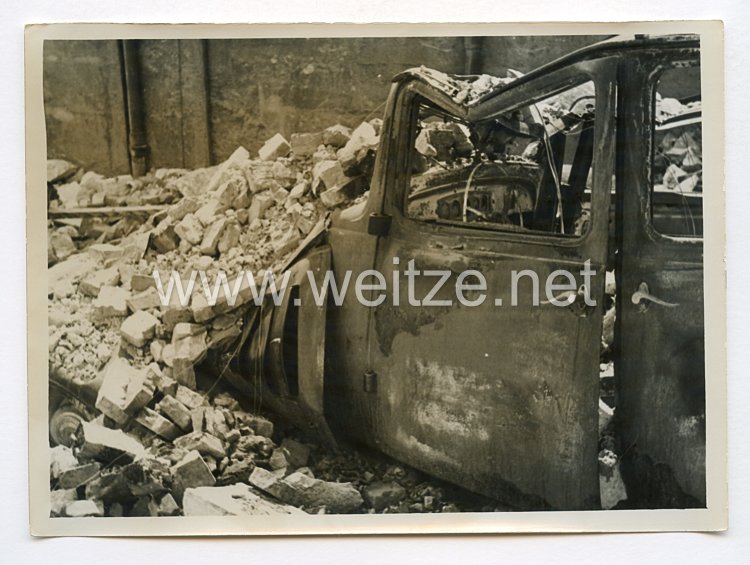
Press Photograph, Occupation of France 1940:

, approx. 13 x 18 cm, condition 2.
317590
20,00

Press Photograph, Occupation of France 1940:

This press photograph documents one of the most significant moments of World War II: the German occupation of France in 1940. With dimensions of approximately 13 x 18 cm, it corresponds to the standard press photo format of that era, produced by war correspondents and propaganda photographers.

The Western Campaign began on May 10, 1940, with the German attack on the neutral Benelux countries and France. Within just six weeks, the Wehrmacht succeeded in defeating the French army, considered invincible at the time. On June 14, 1940, German troops marched into Paris, and on June 22, the armistice was signed in the forest of Compiègne – symbolically in the same railway carriage where Germany had accepted defeat in World War I in 1918.

Press photographs of this type played a central role in the National Socialist propaganda machinery. The Reich Ministry for Public Enlightenment and Propaganda under Joseph Goebbels strictly controlled the photographic coverage from occupied France. Photographers from the Propaganda Companies (Propagandakompanien or PK) accompanied the advancing troops and documented the advance, the capitulation of French units, and the occupation of significant cities and symbols of French statehood.

The technical characteristics of such press photos from 1940 show typical features of the photographic technology of that time. They were usually developed on baryta paper, a photographic paper coated with barium sulfate, known for its excellent image quality and durability. The reverse sides often bore stamps from photo agencies, censorship marks, captions, and sometimes usage instructions for editorial offices.

The 13 x 18 cm format was a standard size in professional press photography. This size allowed newspaper editors to use the images directly or crop them for various publication formats. The photos were often produced in multiple copies and distributed to various media outlets – from major daily newspapers like the Völkischer Beobachter to illustrated weekly magazines and regional papers.

The motifs from the occupation of France were diverse: German soldiers in front of the Eiffel Tower, tank columns on the Champs-Élysées, the swastika flag on French government buildings, jubilant German troops, but also images intended to demonstrate the supposed “correctness” of the German occupiers. Each of these images was carefully selected to support specific narratives: the superiority of the German Wehrmacht, the inevitability of victory, and the new order in Europe under German leadership.

For historians today, such press photographs are valuable primary sources. They document not only military events but also the propaganda and information policy of the Nazi regime. The condition rating of “2” indicates a well-preserved photograph, which is remarkable for documents from this period given the materials used and the more than eight decades that have passed.

The collection and preservation of such historical photographs serve important functions for historical scholarship and education. They enable subsequent generations to gain visual impressions of one of the darkest chapters in European history. At the same time, they serve as a reminder of the need for critical engagement with propaganda and image manipulation – issues that remain highly relevant in today's media landscape.

Archives such as the Bundesarchiv in Germany, the National Archives in the United States, or the Imperial War Museum in Great Britain preserve extensive collections of such press photographs and make them accessible to researchers and the public. The scholarly cataloging of these holdings contributes significantly to understanding the visual propaganda of World War II.

r