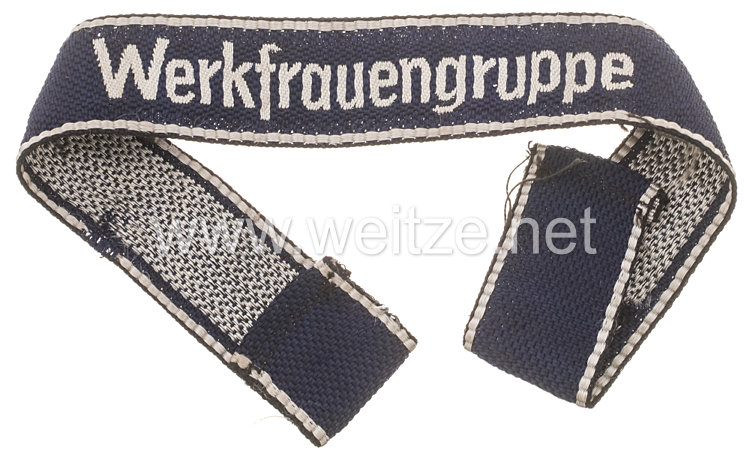
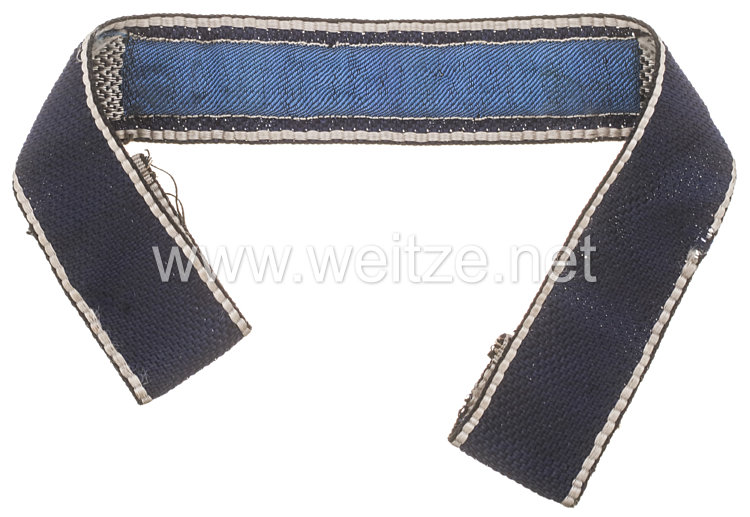
NSV/DAF Armband "Werkfrauengruppe"

Bevo metal thread woven construction, silver lettering on dark blue, with medium blue side stripes. Full length 39 cm with sewn ends, slightly damaged, condition 2-.
372190
300,00

NSV/DAF Armband "Werkfrauengruppe"

The NSV/DAF armband “Werkfrauengruppe” (Factory Women's Group) represents a remarkable testimony to the National Socialist organizational structure that permeated all aspects of social life during the Third Reich. This special insignia connects two central Nazi mass organizations: the National Socialist People's Welfare (NSV) and the German Labor Front (DAF).

The NSV was initially founded in September 1931 as a local Berlin organization and developed after the seizure of power in 1933 into the largest Nazi mass organization after the DAF. Under the leadership of Erich Hilgenfeldt, the NSV grew to over 17 million members by 1943. The organization took over wide areas of social welfare and systematically displaced church and other independent welfare associations. The German Labor Front, founded on May 10, 1933, after the destruction of the free trade unions, was the unified organization of employees and employers in National Socialist Germany under the leadership of Robert Ley.

The Werkfrauengruppen (Factory Women's Groups) emerged as special organizational units within factories and industrial plants. They were designed to register female employees and provide care for them in the National Socialist spirit. These groups were part of the comprehensive penetration of the working world with Nazi ideology and simultaneously an instrument of social control. The Factory Women's Groups organized not only social care but also ideological training, community events, and leisure activities for female workers.

The present armband displays the high-quality Bevo weaving with metal thread typical of NS organizational insignia. The company Bevo (Bandfabrik Ewald Vorsteher) from Wuppertal was the most renowned manufacturer of such woven badges and armbands. The weaving technique enabled permanent, non-printed lettering characterized by exceptional durability. The silver script on dark blue background with medium blue side stripes follows the design conventions of Nazi organizational insignia, whereby coloring and design signaled hierarchical and organizational assignments.

The length of 39 centimeters corresponds to the standard size for armbands worn on the left upper arm. The hemmed ends allowed for permanent sewing onto service clothing or uniforms. Wearing such armbands was mandatory for functionaries within the organization and served the immediate recognition of their position and function.

The Factory Women's Groups gained particular importance during World War II, as increasing numbers of women were deployed in the armaments industry and other war-essential factories. National Socialist women's policy found itself in a fundamental contradiction: on one hand, Nazi ideology propagated the traditional role model of women as mothers and housewives; on the other hand, the war economy required the massive mobilization of female labor. The Factory Women's Groups were supposed to manage this balancing act by caring for female workers while simultaneously motivating them for war production.

The organizational connection between NSV and DAF in this armband reflects the complex overlap of responsibilities and the characteristic polycracy of the Nazi regime. Both organizations claimed competencies in the area of social care and population registration. The NSV theoretically concentrated on welfare and public assistance, while the DAF was responsible for organizing the working world. In practice, however, there were numerous overlaps and jurisdictional disputes.

Such armbands are today important historical documents for researching National Socialist organizational history and the role of women in the Third Reich. They document the systematic registration and control of all areas of life by Nazi organizations. At the same time, they shed light on the often-overlooked history of female functionaries in the Nazi machinery, who operated between ideological conviction, social engagement, and system-stabilizing function.

The preservation and scientific documentation of such objects is significant for historical education and coming to terms with the National Socialist past. They serve as material witnesses to a system of total control and penetration of society.

r