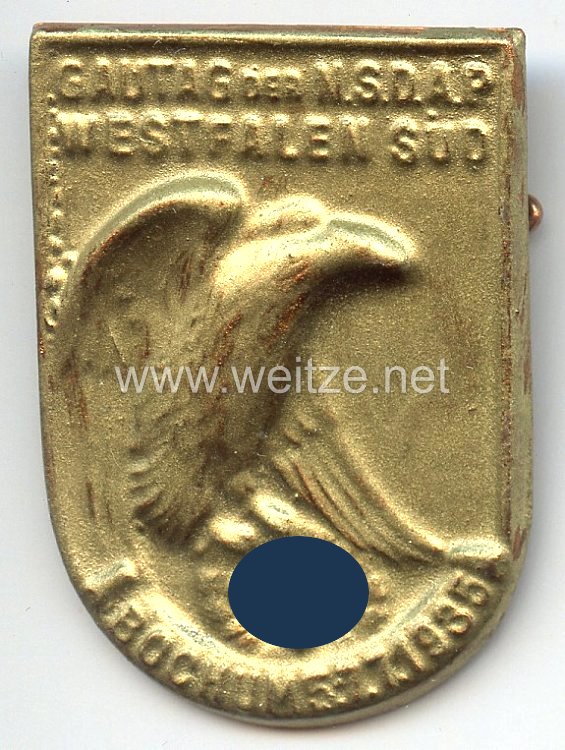
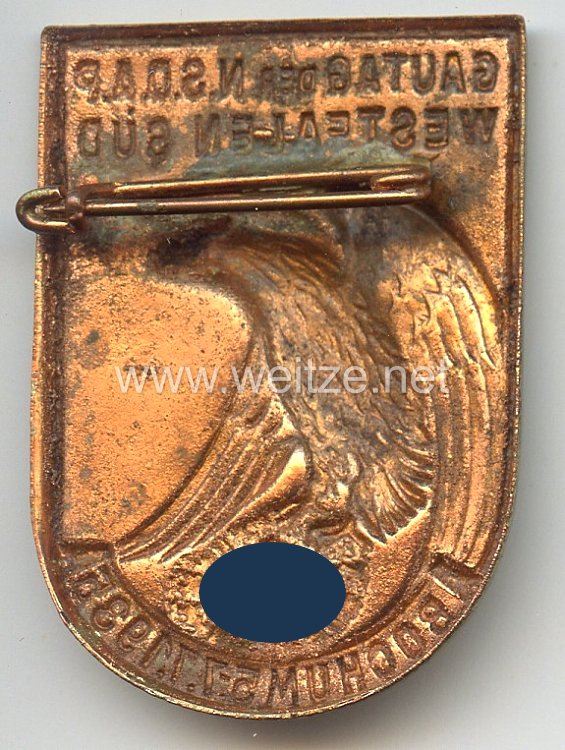
NSDAP - Gau Rally of the NSDAP Westfalen-Süd Bochum July 5-7, 1935
The NSDAP Gautag Badge Westfalen-Süd Bochum 5-7.7.1935 represents a significant document of National Socialist party organization in the Weimar Republic and early Third Reich. This gold-plated sheet iron badge was issued for the Gautag (regional party rally) of the NSDAP (National Socialist German Workers' Party) in Bochum from July 5-7, 1935.
The Gaue (singular: Gau) were the most important regional administrative units of the NSDAP. Gau Westfalen-Süd (South Westphalia) was created in 1926 from the division of the original Gau Ruhr and encompassed southern Westphalia, including important industrial cities such as Bochum, Dortmund, and Hagen. This Gau was of particular importance to the party as it included one of Germany's most important industrial regions, making it strategically valuable for National Socialist consolidation of power.
Gautage were multi-day party events held in the various Gaue that served several functions. They were used for ideological training of party members, demonstrations of power and unity, and mobilization of the population. These events typically included marches, speeches by leading party functionaries, cultural performances, and various propagandistic presentations.
The year 1935 was particularly significant in the history of the Nazi regime. In September of that year, the infamous Nuremberg Laws were passed, legally enshrining the systematic discrimination of the Jewish population. The Gautage of this year also served to prepare the population for the increasingly radical policies of the regime.
The production of such badges followed certain guidelines from NSDAP headquarters. They were typically manufactured from inexpensive materials such as sheet iron and then gold-plated to create a representative appearance. The gilding was usually a thin coating that gave the badges a festive character without incurring high production costs. These badges were sold or distributed to participants and served both as entry authorization and as souvenirs.
The design of such Gautag badges varied but followed certain conventions. They typically contained the swastika as the central symbol of the NSDAP, the name of the Gau, the venue, and the date. Sometimes local landmarks or symbolic representations of the region were also integrated. The badges were fitted with a pin on the back so they could be attached to clothing.
The Gauleiter of Westfalen-Süd at this time was Josef Wagner, who held this office from 1932 to 1941. Wagner was also Oberpräsident (senior president) of the Province of Westphalia and was one of the most influential NS functionaries in the region. He organized numerous mass events and was responsible for implementing NS policy in his Gau.
Such badges are today important historical testimonies that provide insight into the organizational structure, propaganda methods, and everyday culture of National Socialism. They document how the regime attempted to create a collective identity and ideologically penetrate the population through regular events and symbolic objects. For historians, they are valuable sources for researching the regional history of National Socialism.
The preservation and scientific documentation of such objects is important for historical research and educational work. They help to understand the mechanisms of totalitarian rule and serve as a warning against extremist ideologies. In Germany, the handling of NS memorabilia is subject to strict legal regulations designed to prevent glorification of National Socialism while enabling scientific and pedagogical engagement.