Luftwaffe - Small Document Group of a Later Feldwebel and Flight Engineer

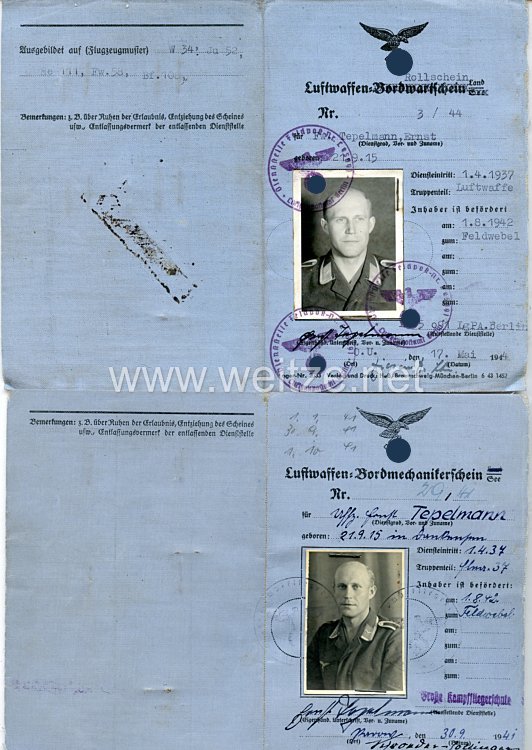
Flight Engineer Certificate See/Nr. 29/41 with uniform photograph; issued on 30.9.1941 by “Große Kampffliegerschule”.
Taxiing Certificate Land/Nr. 3/44, issued Berlin on 17.04.1944, with photograph, various aircraft types, used condition.
426890
200,00

Luftwaffe - Small Document Group of a Later Feldwebel and Flight Engineer

This document group of a Luftwaffe flight mechanic offers a fascinating insight into the technical training and qualification of flying personnel in the German Air Force during World War II. The collection consists of two essential documents: a Bordmechanikerschein See (Seaplane Flight Mechanic Certificate) from 1941 and a Rollschein Land (Land Aircraft Taxiing License) from 1944, which together document the professional development of a non-commissioned officer.

The Bordmechanikerschein See No. 29/41, issued on September 30, 1941, by the Große Kampffliegerschule (Large Combat Flying School), certifies successful training as a flight mechanic for seaplanes. This qualification was of considerable importance, as flight mechanics played a key role in aerial warfare. They were not only responsible for maintenance and upkeep of aircraft on the ground, but also accompanied operational flights to resolve technical problems during missions and operate weapon systems.

The Große Kampffliegerschulen were central training facilities of the Luftwaffe, responsible for advanced training of aircraft crews. Training to become a flight mechanic was comprehensive and demanding, encompassing theoretical knowledge of aircraft engines, hydraulic systems, electrical installations, and weapon systems, as well as practical skills in maintenance and repair. Specialization in seaplanes required additional knowledge about the particular requirements of operating over water, including floats, corrosion protection, and maritime navigation aids.

The year 1941, when the flight mechanic certificate was issued, marks a phase of intense military activity. The Luftwaffe was engaged in numerous operations at this time, from the Battle of Britain to the Balkans Campaign and the beginning of Operation Barbarossa against the Soviet Union. The need for qualified technical personnel was enormous, and training was intensified accordingly.

The second component of the document group, the Rollschein Land No. 3/44, issued in Berlin on April 17, 1944, documents an extended qualification. Taxiing licenses authorized the holder to taxi aircraft on the ground, an activity requiring considerable technical understanding and experience. The document lists various aircraft types, indicating the holder's broad technical competence. By 1944, the Luftwaffe's inventory included a wide variety of aircraft models, from fighters such as the Messerschmitt Bf 109 and Focke-Wulf Fw 190, to bombers like the Heinkel He 111 and Junkers Ju 88, to transport aircraft such as the Junkers Ju 52.

The fact that the taxiing license was issued in Berlin is noteworthy. By April 1944, the strategic air situation had changed dramatically. Allied bombing raids on the German Reich had increased significantly, and Berlin itself was subject to regular heavy air attacks. Nevertheless, the Reich capital continued to house important military administrative and training facilities.

The used condition of the taxiing license testifies to its active use. These documents had to be presented upon reporting for duty and on various occasions, and were accordingly handled frequently. The attached uniform photographs served for identification purposes and were standard requirements on military documents of this type.

The professional development from flight mechanic to Feldwebel (Sergeant) reflects a typical career in the Luftwaffe. Feldwebel were non-commissioned officers with many years of experience and considerable responsibility. In technical functions, they often led entire ground personnel groups and were responsible for the operational readiness of multiple aircraft. The rank was usually awarded after several years of service and proven performance.

Such document groups are valuable historical sources today. They enable the reconstruction of individual military careers and offer insights into the training system, organizational structure, and daily life of the Luftwaffe. The combination of various qualification certificates over a period of three years documents both the personal development of the holder and the changing requirements of warfare.

The period from 1941 to 1944 witnessed dramatic changes in the air war. The Luftwaffe, which had dominated European skies in the early years of the war, increasingly found itself on the defensive. By 1944, Allied air superiority was evident, and the technical and logistical challenges facing German ground crews had multiplied enormously. Spare parts shortages, fuel rationing, and the need to maintain an increasingly diverse fleet of aircraft types placed unprecedented demands on mechanics and technical personnel.

In summary, this document group represents an important aspect of German military history during World War II: the highly specialized technical training without which modern aerial warfare would not have been possible. The documents testify to a complex training system and the importance attached to the qualification of ground personnel in maintaining the operational capability of one of history's most formidable air forces.

r