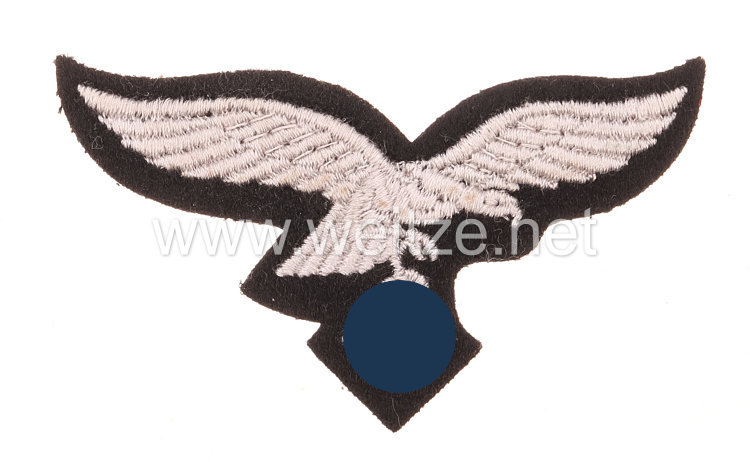
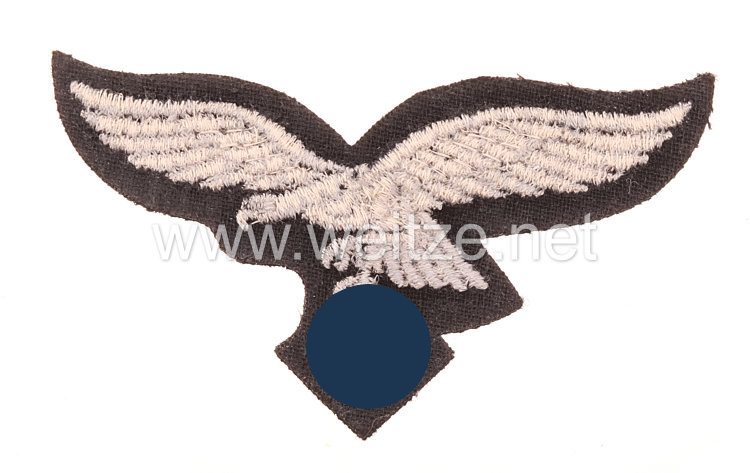
Luftwaffe Overseas Cap Eagle for Enlisted Men LW-Fallschirm-Panzerkorps "Hermann Göring"

Machine-embroidered version on black wool base. Unissued condition, Condition 1.
443790
90,00

Luftwaffe Overseas Cap Eagle for Enlisted Men LW-Fallschirm-Panzerkorps "Hermann Göring"

The Luftwaffe Schiffchen Eagle for Enlisted Men of the LW-Fallschirm-Panzerkorps Hermann Göring represents a significant distinction badge from one of the Third Reich's most elite and complex military formations. This machine-embroidered example on black backing embodies the unique position this formation held within the German armed forces during World War II.

The Fallschirm-Panzerkorps Hermann Göring evolved from modest beginnings into one of Germany's largest divisions. Originally established in 1933 as the Prussian state police unit Polizeiabteilung z.b.V. Wecke, the formation was incorporated into the Luftwaffe under Hermann Göring's command in 1935 and renamed Regiment General Göring. This unit initially served as a guard regiment and ceremonial formation but rapidly developed into a combat unit.

Throughout the war, the formation expanded considerably. In 1942, it was enlarged to become the Brigade Hermann Göring, and in May 1943 it was upgraded to Division Hermann Göring. Continuous expansion ultimately led to the formation of the Fallschirm-Panzerkorps Hermann Göring in 1944, which comprised the Panzer-Division Hermann Göring and the Fallschirm-Panzer-Division 2 Hermann Göring.

The Schiffchen eagle or side cap eagle was an essential identification symbol of the Luftwaffe and was worn on the Schiffchen, the side or garrison cap. The black backing of this example is characteristic of the branch color for armored troops within the Luftwaffe. This symbolizes the hybrid nature of this formation, which belonged organizationally to the Luftwaffe but operated as an armored ground combat force.

The machine-embroidered construction corresponds to the standard production method for enlisted ranks. In contrast to the hand-embroidered or metal-effect thread variants used for officers, enlisted badges were typically simpler and more economically produced. The embroidery typically shows the characteristic eagle with outstretched wings holding a swastika in its talons—the standardized national emblem of the Wehrmacht.

The Hermann Göring formation enjoyed special status throughout the war. As a Luftwaffe unit, it reported directly to Reichsmarschall Hermann Göring and frequently received priority in the allocation of personnel, equipment, and weapons. This resulted in the division often being better equipped than comparable Army units. The formation fought on several theaters of war, including North Africa, where it suffered heavy losses near Tunis in 1943, in Sicily and Italy, and later on the Eastern Front and in the defense of Reich territory.

The uniforms of Hermann Göring troops reflected their unique position. They wore Luftwaffe uniforms with the characteristic blue service tunics but combined these with elements of the Panzer forces, including the black special clothing for tank crews. The use of the Schiffchen eagle on black backing for tank crews was one of these peculiarities that underscored the dual nature of the formation as both a Luftwaffe and Panzer unit.

The distinction badges of the Hermann Göring Division are today sought-after military historical collectibles, as they document the complex organizational structure and special status of this formation. The unworn condition of this example is particularly noteworthy, as many of these badges were issued and worn during the war. Such unworn pieces may have been stored as replacement badges or no longer issued as the military situation deteriorated.

The military effectiveness of the Hermann Göring divisions varied. While they fought well in some operations, they often suffered from frequent reorganizations and deployment on different fronts. Toward the end of the war, the remnants of the corps were involved in the chaotic defensive battles in Germany, where the formation was ultimately destroyed.

From today's perspective, such uniform badges serve as material witnesses to a complex military organization within a criminal regime. They document the military structures, hierarchies, and material culture of the Wehrmacht, enabling historians and researchers to better understand the organization and development of these armed forces.