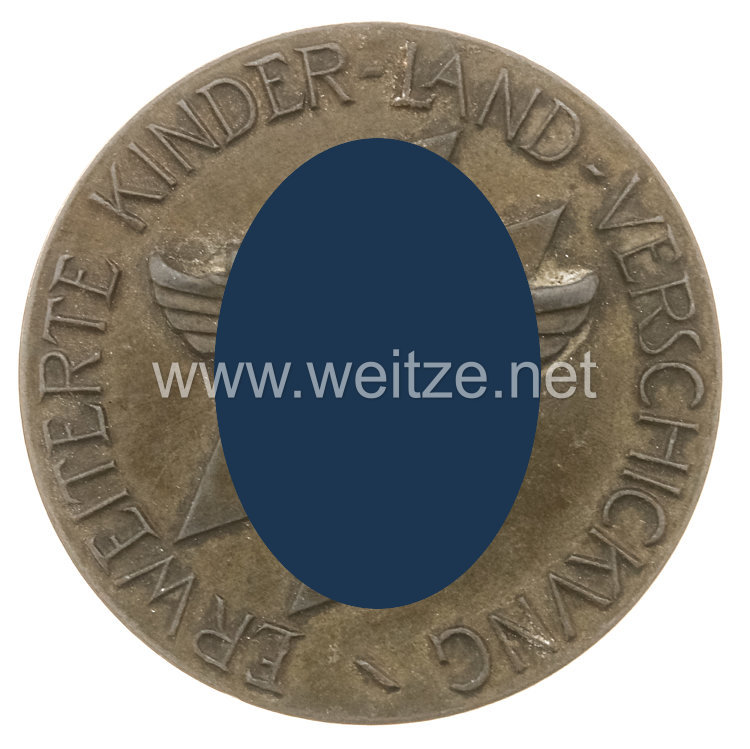
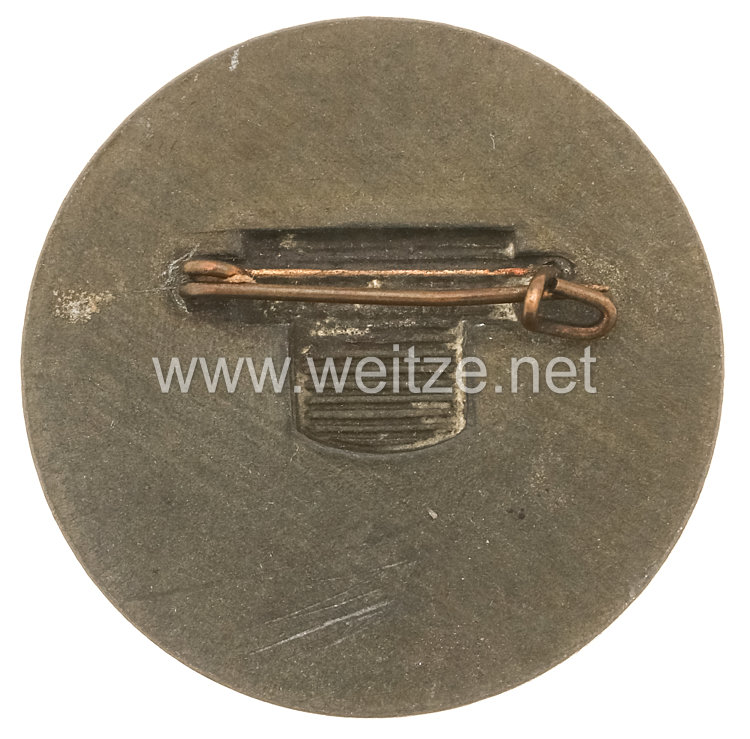
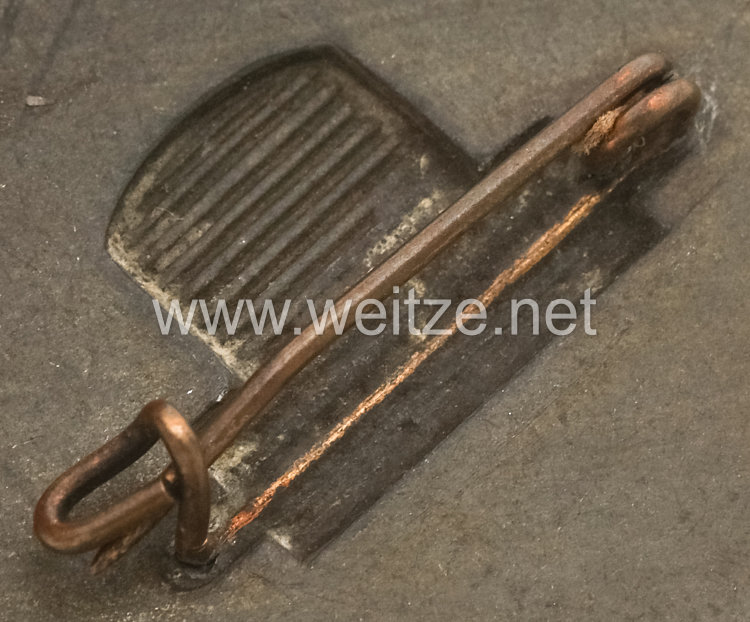
HJ - “Erweiterte Kinder-Land-Verschickung” (Extended Children's Evacuation Program) Portable Badge for Accompanying Personnel

Round brooch, 38 mm, toned fine zinc, condition 2.
This badge was instituted as a commemorative award on December 12, 1942, for all youth after a minimum 4-week camp participation, but was already annulled on April 1, 1943. Within this brief period, only a few pieces were manufactured and awarded.
297890
450,00

HJ - “Erweiterte Kinder-Land-Verschickung” (Extended Children's Evacuation Program) Portable Badge for Accompanying Personnel

The Badge of Honor for Accompanying Personnel of the Extended Children's Evacuation Program (Erweiterte Kinder-Land-Verschickung or KLV) represents one of the rarest awards from the National Socialist era. This round brooch with a diameter of 38 mm was made from toned fine zinc and represents a fascinating chapter of German social history during World War II.

The Kinder-Land-Verschickung (Children's Country Evacuation) was originally a welfare program that existed in the Weimar Republic, sending city children to the countryside for recuperation. With the beginning of Allied air raids on German cities from 1940 onwards, this program was significantly expanded by the Hitler Youth (HJ) and the National Socialist People's Welfare (NSV) and took on a new, war-related dimension. The “Extended KLV” now primarily served to evacuate children and adolescents from areas threatened by bombing to rural regions and occupied territories.

By the end of the war, an estimated 2.5 million children had been sent away as part of the KLV program. Implementation was primarily in the hands of the Hitler Youth, whose leaders and helpers supervised the children in special camps. These camps were strictly organized according to National Socialist principles and served not only to protect against air raids but also for the ideological education of youth.

The present badge of honor was instituted on December 12, 1942 by the Reich Youth Leader. It was to be awarded to all young people and accompanying personnel who had participated in a KLV measure for at least four weeks. The establishment of this badge reflected the regime's attempt to honor and promote participation in the KLV program and to increase the motivation of supervisors.

The extraordinary rarity of this badge is explained by its extremely short period of award. On April 1, 1943 – only about four months after its introduction – the badge of honor was annulled. The exact reasons for this rapid withdrawal are not clearly established in historical research. Several factors likely played a role: increasing material shortages as the war progressed, organizational problems in production and distribution, and possibly considerations regarding the hierarchy within the NS award system.

During this brief period of approximately 3.5 months, only very few examples were produced and actually awarded. This makes the badge an extraordinarily rare collector's item today, documenting the chaotic conditions and often contradictory administrative practices of the Nazi regime during wartime.

The manufacture from fine zinc is typical for awards from this later war phase. Due to the war economy situation and metal shortages, substitute materials increasingly had to be used. Bronze, silver, and other non-ferrous metals were reserved for the armaments industry, so zinc served as an alternative. The toning was intended to make the material appear more precious metal-like.

The design of the round brooch corresponded to the typical formal language of HJ awards of that time. Such badges of honor were important elements of the NS system for social control and motivation. They served to reward loyalty, make hierarchies visible, and strengthen cohesion within organizations.

From a historical perspective, this badge documents several important aspects: First, the increasing militarization of civilian life and the integration of youth into war measures. Second, the propaganda and motivation strategies of the regime. Third, the practical problems and organizational difficulties that the NS system faced in the later war phase.

For collectors and historians, this badge of honor is of particular interest because it represents a very specific and brief episode of German history. The low number of awards and the documented annulment make it an important contemporary witness to the chaotic administrative conditions in the German Reich from 1943 onwards.

The KLV program itself remains a controversial historical subject, representing both a protective measure for children during wartime and an instrument of ideological indoctrination. The badge serves as a tangible reminder of this complex historical reality and the regime's attempt to systematize and honor even evacuation measures within its elaborate system of awards and recognition.