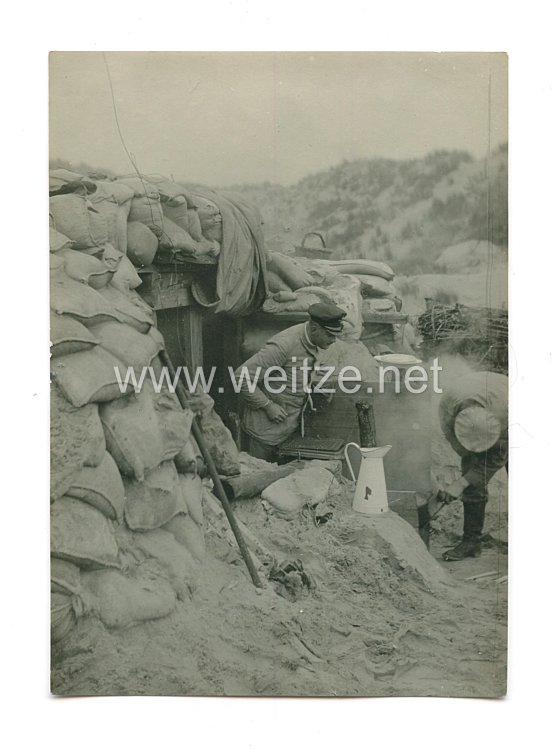
World War I German Army Photograph, Soldier in Trench

Dimensions approx. 7.5 x 10.5 cm. Used condition.
355790
8,00

World War I German Army Photograph, Soldier in Trench

Photographs from the First World War (1914-1918) represent important historical documents that chronicle the life and suffering of soldiers at the front. This photograph shows a soldier of the German Army in a trench and belongs to an extensive photographic record that visually captures the trench warfare on the Western and Eastern Fronts.

Trench warfare developed from autumn 1914 into the defining form of combat on the Western Front. After the failure of the Schlieffen Plan and the German offensive, the fronts solidified into a system of trenches that stretched from the North Sea coast to the Swiss border. These trench systems became increasingly complex throughout the war and included front-line trenches, communication trenches, dugouts, bunkers, and rear positions.

The photographic documentation of warfare was a relatively new phenomenon. While the Franco-Prussian War of 1870/71 had already been photographically documented, technical developments in the early 20th century enabled more comprehensive visual reporting for the first time. Both official war correspondents and soldiers with private cameras captured daily life at war. The Prussian War Ministry regulated photography at the front through various decrees, yet numerous private photographs still made their way home.

The size of this photograph, approximately 7.5 x 10.5 cm, corresponds to a common format of the period. Such images were frequently produced in postcard format or similar dimensions, which facilitated mailing to the home front. Many soldiers had photographs developed and sent them as signs of life to their families. These images served both personal memory and communication with the home front.

Life in the trenches was characterized by extreme hardships. Soldiers of the German Army had to contend with artillery fire, snipers, gas attacks, and adverse weather conditions. The autumn and winter months were particularly dreaded, when rain transformed the trenches into mud holes. Diseases such as trench fever and trench foot were widespread. Sanitary conditions were catastrophic, and the constant presence of rats and vermin made life additionally unbearable.

The equipment of German soldiers in the trenches included the characteristic field uniform M1907/10 in field grey color, the steel helmet M1916 (introduced from 1916, previously the Pickelhaube), the Gewehr 98 rifle, ammunition pouches, knapsack, bread bag, canteen, and gas mask. The gas mask became vital standard equipment from 1915 onward, following the first chlorine gas attacks at Ypres.

Photographs like this served various functions: military documentation, propaganda, but also private memory. The Supreme Army Command recognized early the importance of visual material for influencing public opinion. Official war photographers from the Bild- und Film-Amt (BUFA), founded in 1917, produced material for newsreels and propaganda publications.

Private photographs like this example often offer a more authentic insight into daily warfare than official propaganda images. They show the reality of trench warfare without heroic embellishment: the cramped quarters of dugouts, the mud, the exhaustion of soldiers, and the primitive improvisations of front-line life.

The condition of such historical photographs varies greatly. After more than a century, many examples show signs of use such as creases, discoloration, or damage to the edges. These traces are themselves part of the object's history and testify to its use and preservation across generations.

Today, such photographs are important sources for military-historical research and the culture of remembrance of the First World War. They are preserved in museums, archives, and private collections and help maintain the memory of the horrors of war and the fate of the millions of soldiers who fought and suffered in the First World War.