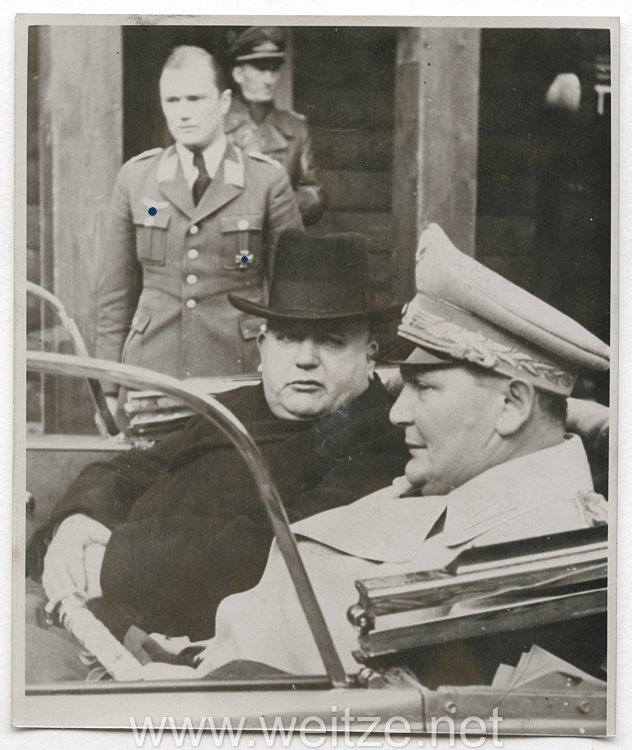
On 19 July 1940, following the German victory in the Battle of France, Adolf Hitler held a ceremony in which he promoted twelve generals to the newly awarded rank of Generalfeldmarschall. During the same ceremony, Hermann Göring was elevated to the newly created rank of Reichsmarschall. Reichsmarschall was an honorary military rank, specially created for Hermann Göring during World War II, and the de jure highest rank in the Wehrmacht. A symbolic move to highlight his seniority over other Wehrmacht commanders and to fulfill his ambitions for prestige, though it conferred no additional authority. The only recipient of this rank during the Second World War was Reichsmarschall Hermann Göring, who was awarded the decoration on 19 July 1940 for his command of the Luftwaffe, after the Battle of France in 1940.
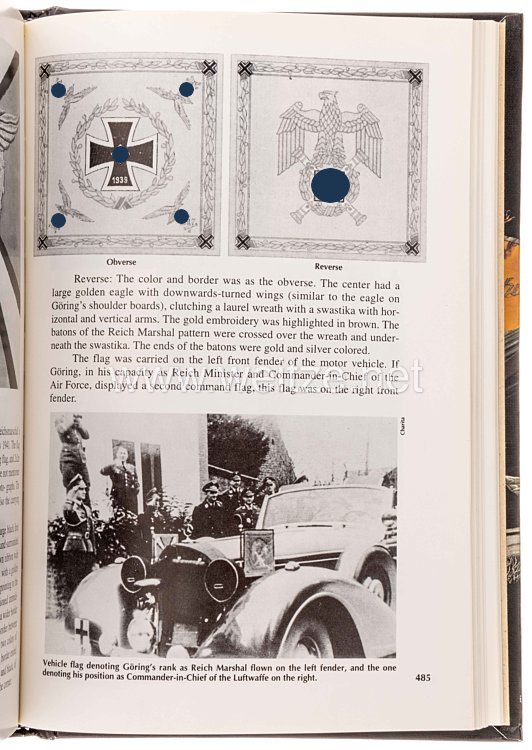
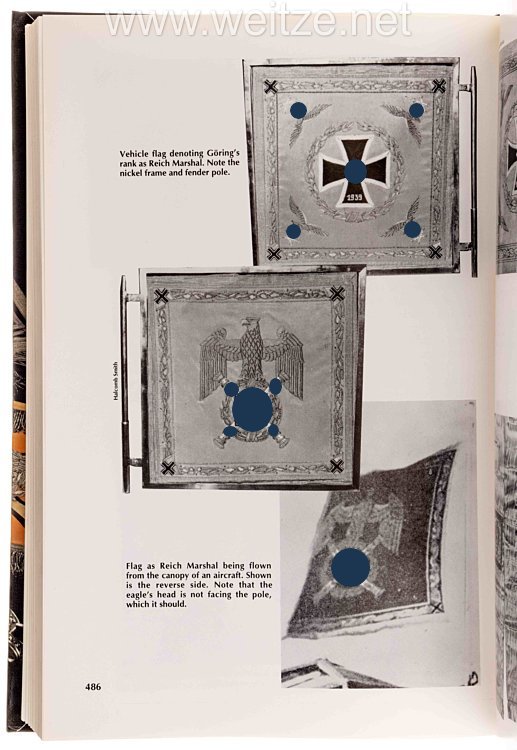
The personal standards of the Reichsmarschall were used circa 1940 to 1945 to denote Göring's presence. Command flags, which were flown by the leader of a military unit, were mainly used as car and vehicle flags. They never replaced the unit's colours or standard, and represented only the commanding officer as his personal vehicle flag. These car pennants were used to mark the presence of Reichsmarschall Göring in official vehicles.
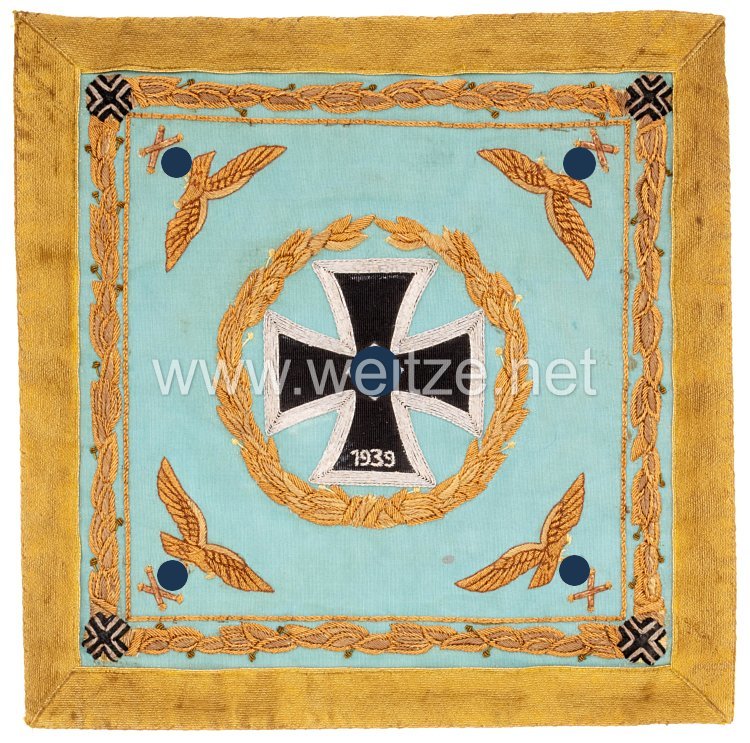
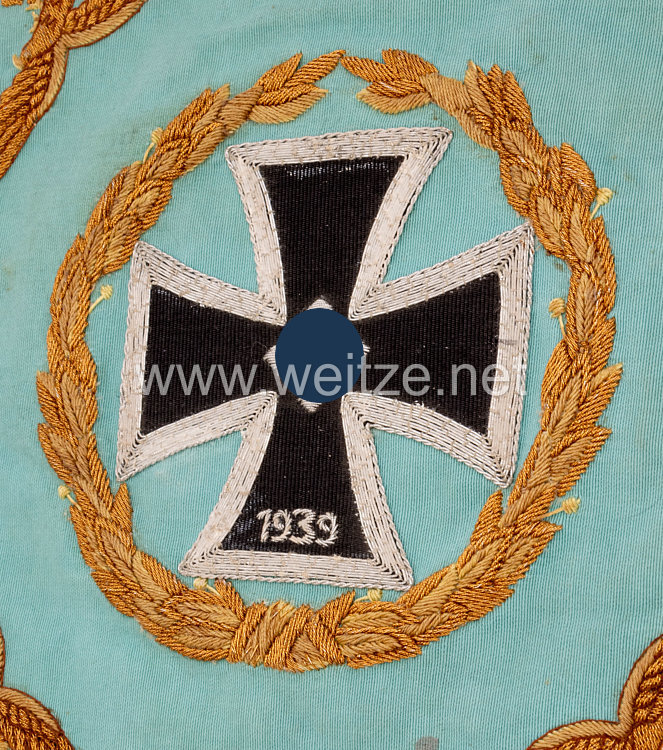
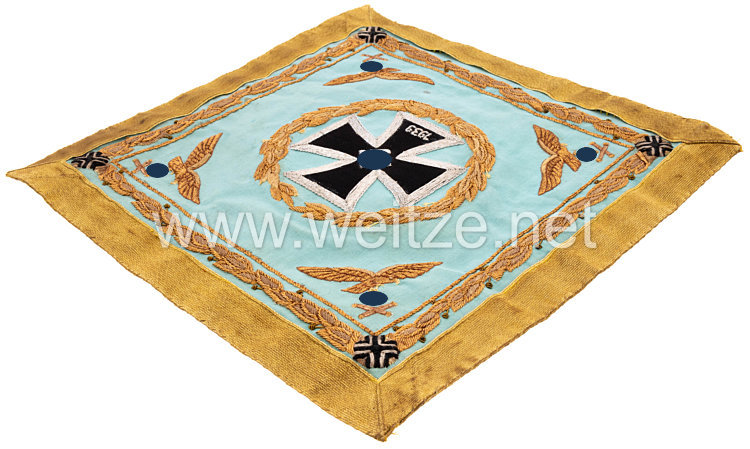
The square car pennants were produced in two known patterns. The first pattern was used from July 1940 to February 1941 and featured on the reverse a large Iron Cross extending to the border, with four Luftwaffe eagles in the corners. In February 1941, a second pattern was introduced to reflect the new design of the national eagle. In this revised version, the large 1939 Iron Cross was replaced by a 1939 Iron Cross about half the previous size surrounded by a gold laurel wreath.
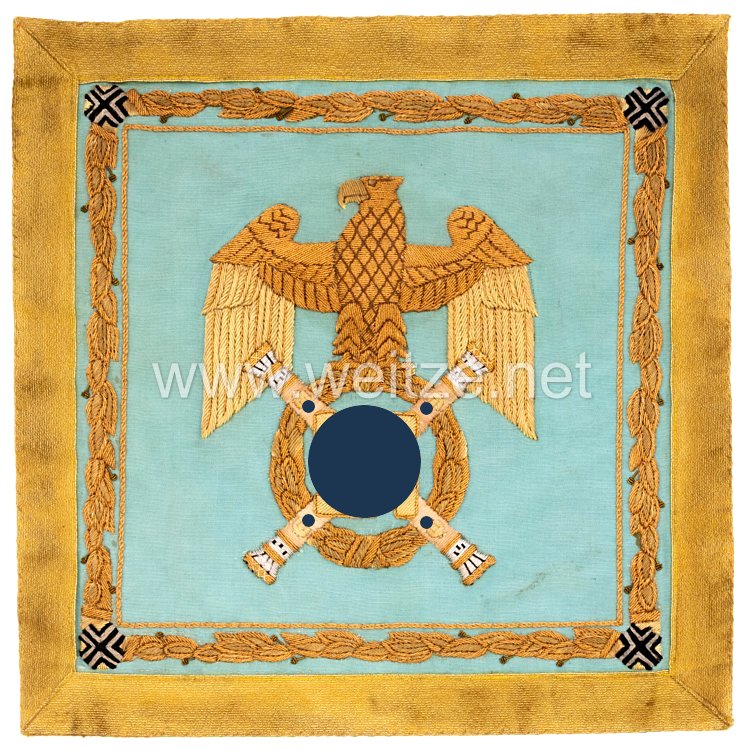
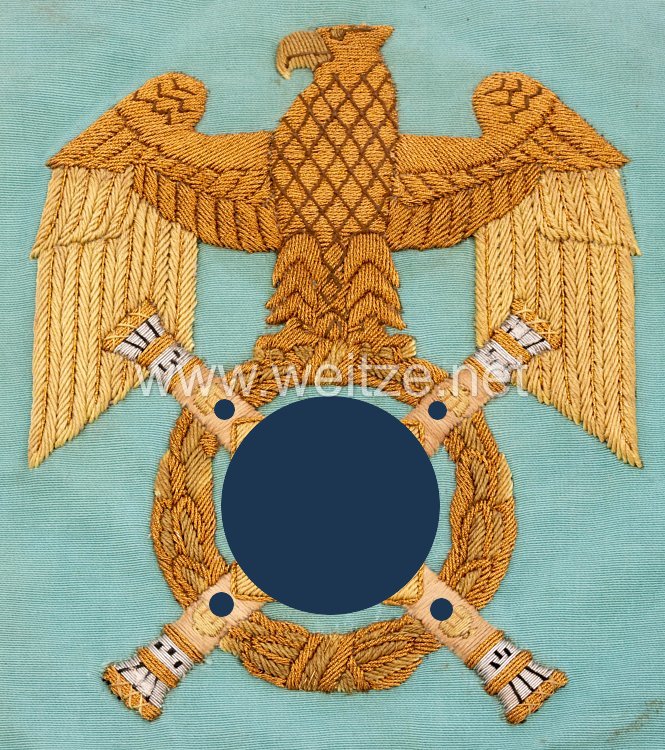
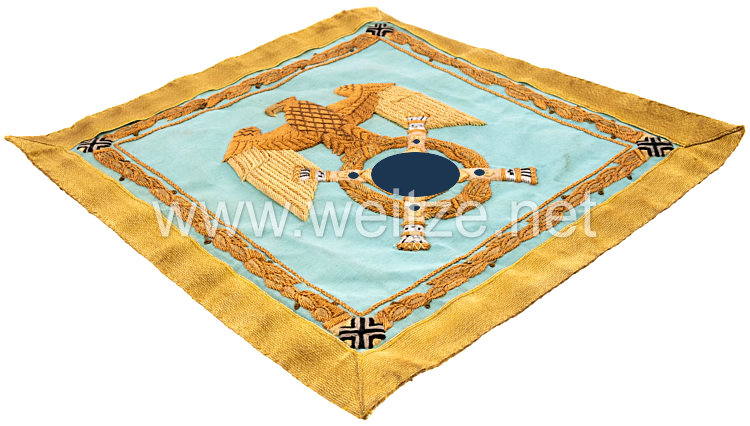
The construction of these personal standards was executed in blue silk fabric, hand-embroidered on both sides in metal threads. A mixture of bullion, aluminum, brocade and yarn was used in elaborate examples. The obverse featured the large personal eagle of the Reichsmarschall in finest embroidery quality of gilded metal or Cellon threads. The light blue field displayed a gold Nazi National Eagle grasping a gold wreath with swastika, behind which crossed marshal's batons.
The reverse displayed a large laurel wreath, in the center the Iron Cross 1939 in silvered metal thread embroidery on black silk reps. In the corners were Luftwaffe eagles with crossed Reichsmarschall batons. The border consisted from the inside of a thin yellow line followed by a broader light blue stripe, in the center of which was a line of yellow laurel leaves and berries. The outer stripe was gold and somewhat narrower than the blue stripe. In each corner was a white bordered black Balkenkreuz. The outer edge featured broad gold braid trim, executed in gold thread and Cellon embroidery.
Hermann Göring was the only man to hold the rank of Reichsmarschall during World War II, having been promoted on 19 July 1940 by Adolf Hitler. Göring, who was the Commander-in-Chief of the Luftwaffe, had several personal command flags produced for different uses, including vehicle pennants and larger presence standards. This particular flag was produced upon his promotion to Reichsmarschall and was a very elaborately rendered work of art. The Reichsmarschall command flag was also produced in a version that was printed, but hand-embroidered examples such as this represent the highest level of quality.
On May 8, 1945, Herman Göring, commander in chief of the Luftwaffe, president of the Reichstag, head of the Gestapo, prime minister of Prussia and Hitler's designated successor was taken prisoner by the U.S. Seventh Army in Bavaria. He was tried at Nuremberg and charged with various crimes against humanity. Despite a vigorous attempt at self acquittal, he was found guilty and sentenced to be hanged, but before he could be executed, he died by suicide by swallowing a cyanide tablet. He was the only person awarded this rank during the Nazi era, and it was abolished after the fall of the Nazi regime.