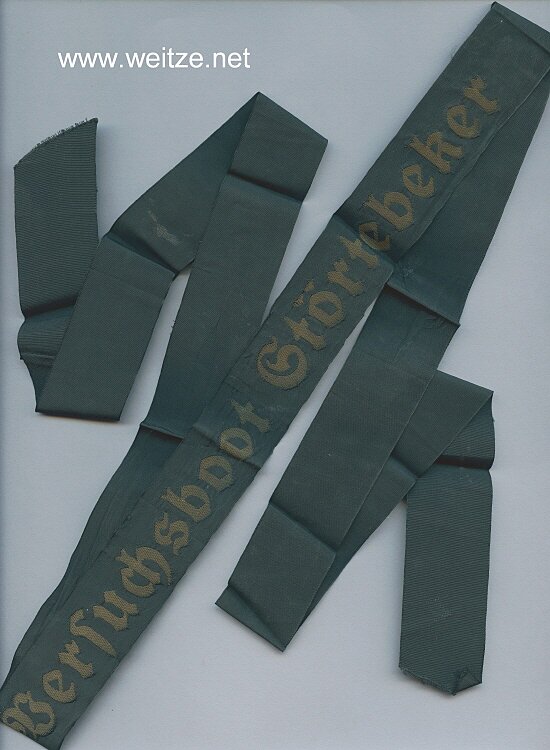
Kriegsmarine Cap Tally "Versuchsboot Störtebeker"

worn condition, lettering slightly faded, rare piece. Condition 2
35089
100,00

Kriegsmarine Cap Tally "Versuchsboot Störtebeker"

The Kriegsmarine cap tally bearing the inscription “Versuchsboot Störtebeker” represents an extremely rare and historically significant collector's item from the Second World War era. Cap tallies were an essential component of the German naval uniform and served to identify the specific unit or vessel on which a sailor served.

Historical Background of Cap Tallies

The tradition of cap tallies in the German Navy dates back to the 19th century. In the Imperial Navy (Kaiserliche Marine), golden inscriptions on black ribbons were introduced in 1872. This tradition continued in the Reichsmarine of the Weimar Republic and was adopted by the Kriegsmarine from 1935 onwards. Cap tallies were worn on the peaked cap (Tellermütze) of enlisted personnel and non-commissioned officers, displaying the name of the ship or unit in golden letters.

Experimental Vessels in the Kriegsmarine

The term “Versuchsboot” (experimental boat) designates vessels used for technical trials, testing of new weapons systems, or tactical procedures. During World War II, the Kriegsmarine operated various experimental units to develop and test technological innovations. These boats played an important role in advancing submarine technology, torpedo systems, and other maritime weapons systems.

The Choice of Name “Störtebeker”

The naming after Klaus Störtebeker, the legendary pirate and leader of the Victual Brothers from the 14th century, followed a long tradition in the German Navy of naming ships after historical personalities, mythological figures, or geographical designations. Störtebeker, who lived approximately between 1360 and 1401, was executed in Hamburg after his capture and evolved over the centuries into a romanticized figure of North German culture. The use of his name for an experimental boat presumably symbolized boldness and maritime tradition.

Manufacture and Execution

Kriegsmarine cap tallies were manufactured according to strict specifications. The ribbon consisted of black wool fabric or artificial silk, on which the inscription was embroidered or woven in golden letters. The standard length was approximately 130 centimeters, with two golden stripes bordering the upper and lower edges of the ribbon. Production was carried out by specialized suppliers authorized by the Navy. Quality and execution were subject to military regulations, though quality fluctuations could occur during the war due to material shortages.

Manner of Wearing and Significance

The cap tally was attached to the service cap of enlisted personnel and non-commissioned officers and served as an important identifying feature of membership in a particular unit. For crew members, wearing the cap tally was associated with pride, as it symbolized attachment to one's own ship and the camaraderie aboard. During special operations or for security reasons, however, neutral ribbons bearing the inscription “Kriegsmarine” could also be worn.

Rarity and Collector's Value

Cap tallies from experimental boats are extremely rare today, as these units often had only small crews and correspondingly few ribbons were produced. Many cap tallies were lost during the war or destroyed after its end. The present specimen shows typical signs of wear with slightly faded lettering, indicating authentic use. The condition is classified as “Condition 2,” which indicates good to very good preservation with slight aging and wear marks.

Historical Context

The existence of experimental boats like the “Störtebeker” illustrates the intensive research and development activities of the Kriegsmarine. Particularly in the field of submarine warfare, new technologies were continuously tested, including improved snorkel systems, new propulsion concepts, and weapons systems. This development work was frequently conducted under the strictest secrecy, which complicates documentary transmission and makes authentic artifacts particularly valuable.

Documentation and Research

Due to the classified nature of experimental vessels, official documentation is often sparse or was destroyed during the war's final phase. Cap tallies therefore represent important primary sources for maritime historians studying the organizational structure and technological development of the Kriegsmarine. Each authenticated specimen contributes to a better understanding of naval operations and the daily life of sailors during this period.

Conclusion

The cap tally “Versuchsboot Störtebeker” represents a significant historical artifact of German naval history. It documents not only the material culture of the Kriegsmarine but also the technological ambitions and organizational structure of this service branch. For collectors and historians, it constitutes an important contribution to the research and documentation of Second World War naval history.

r