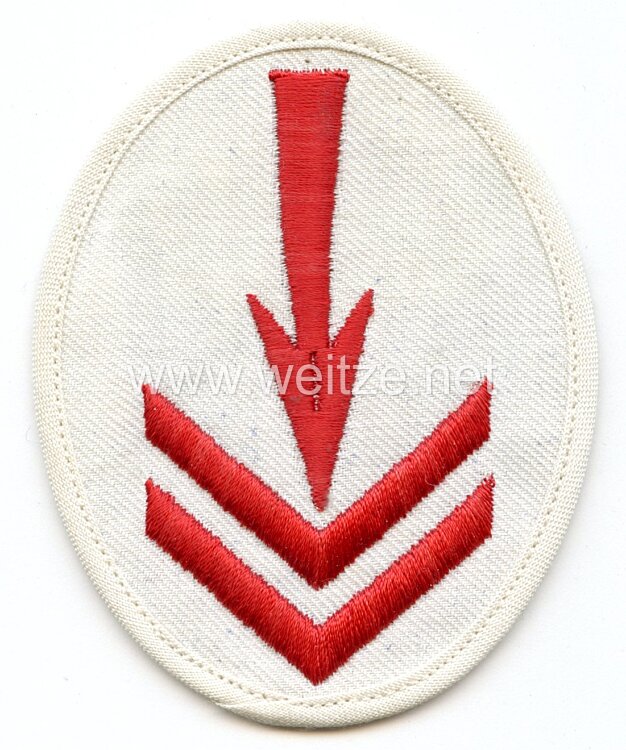
Kriegsmarine Sleeve Insignia Special Training Underwater Sound Detection Non-Commissioned Officer Course

For the white blouse, condition 2.
441289
25,00

Kriegsmarine Sleeve Insignia Special Training Underwater Sound Detection Non-Commissioned Officer Course

The Kriegsmarine sleeve badge for special training in underwater sound detection represents a fascinating testimony to the highly specialized technical training within the German Navy during World War II. This special badge was awarded to non-commissioned officers who successfully completed a course as underwater sound operators – a qualification that was crucial for submarine warfare and coastal defense.

Underwater sound operators (acoustic sensor operators) formed an elite specialization within the Kriegsmarine. Their task was to locate enemy ships and submarines using hydrophones and other acoustic devices. This capability was particularly crucial at a time when radar technology was still in its infancy and acoustic detection was often the only way to detect submerged submarines or approaching surface vessels.

Training as an underwater sound operator was extraordinarily demanding and required not only technical understanding but also exceptionally good hearing and the ability to identify different ship types based on their characteristic sound signatures. The non-commissioned officer course lasted several months and included both theoretical and practical training phases. Participants had to understand the physics of sound propagation underwater, operate various listening devices, and make precise decisions under extreme pressure.

The present badge was designed for the white blouse, which was part of the Kriegsmarine's summer uniform. The Kriegsmarine strictly distinguished between different uniform variants, and accordingly, special badges existed in different versions for blue and white uniforms. White blouses were typically worn during summer months or in warmer climates.

Sleeve badges for special training were systematically introduced in the Kriegsmarine from the late 1930s onwards. They served for quick identification of specialists on board and contributed to the recognition of special qualifications. The Army Regulation Bulletins and Navy Regulation Bulletins precisely regulated who could wear which badges and at which position on the uniform they were to be attached.

The technological development of underwater sound detection made considerable progress during the war. Initially, relatively primitive listening devices were used, but as the war progressed, increasingly sophisticated systems came into use. German U-boats were equipped with various listening devices, including the Group Listening Device (Gruppenhorchgerät - GHG) and later passive sonar systems that enabled 360-degree surveillance.

The strategic importance of underwater sound operators cannot be overestimated. In the Battle of the Atlantic, the ability to detect the enemy first often determined life and death. Allied convoys attempted to locate German U-boats with ASDIC (later called SONAR), while German listeners tried to locate convoys from a safe distance before attacking.

Training facilities for underwater sound operators were located in various places, including special departments in Kiel, Wilhelmshaven, and other naval bases. The training was so specialized that only a small percentage of naval personnel achieved this qualification. Successfully completing the course entitled one to wear the corresponding sleeve badge, which represented considerable honor.

Today, such sleeve badges are important military-historical artifacts that provide insight into the highly specialized organization and training structure of the Kriegsmarine. They document the technological dimension of naval warfare and the importance attached to acoustic reconnaissance. Collectors and military historians value these badges as authentic witnesses to a specific military-technical development that later formed the basis for modern sonar and underwater reconnaissance systems.