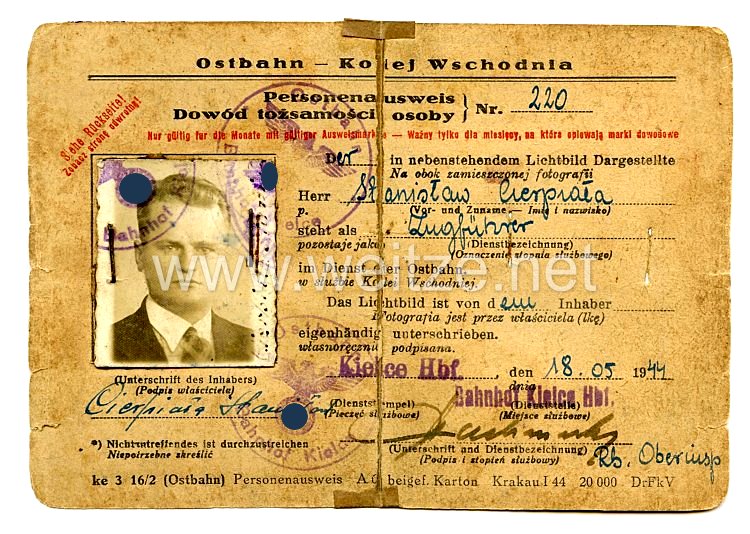
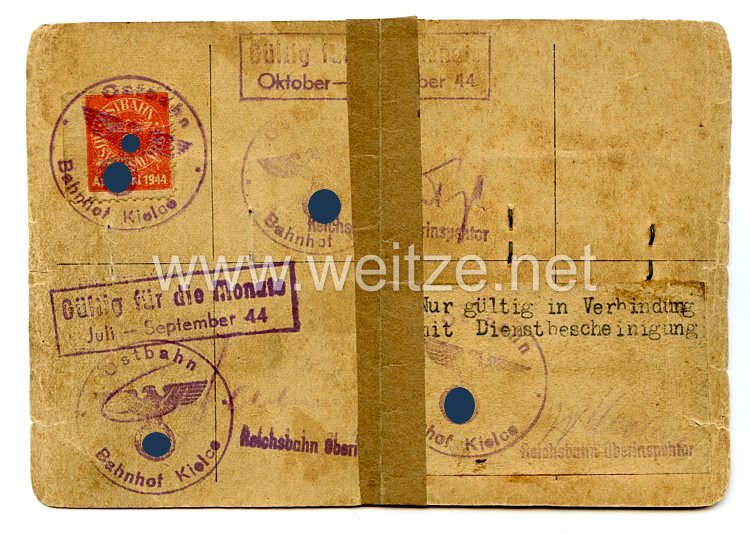
Third Reich - Ostbahn - Kolej Wschodnia Personnel Identity Card for a Man

as train conductor, issued on 18.05.1944 in Kielce, bilingual form in German-Polish, with stamp "Bahnhof Kielce", heavily used condition.
413289
70,00

Third Reich - Ostbahn - Kolej Wschodnia Personnel Identity Card for a Man

This personnel identity card of the Ostbahn (Kolej Wschodnia) from the Third Reich represents a remarkable testimony to the German occupation administration in the General Government during World War II. This bilingual identity card, issued on May 18, 1944, in Kielce for a man serving as a train conductor, documents the complex organizational structure of railway administration in the occupied Polish territories.

Following the German invasion of Poland in September 1939 and the subsequent occupation, the Polish railway network came under German control. The Ostbahn (Eastern Railway/Kolej Wschodnia) was the official designation for the railway administration in the General Government, the part of Poland that was not directly incorporated into the German Reich. The organization was founded on November 1, 1939, and was subordinate to the General Directorate of the Ostbahn in Kraków. It was responsible for all railway operations in this occupied territory.

The city of Kielce, where this identity card was issued, was located in the Radom District of the General Government and was an important railway junction. The stamp “Bahnhof Kielce” (Kielce Station) on the document underscores the local administrative structure of the Ostbahn, which was regionally organized with various directorates and stations.

The bilingual design of the card in German and Polish was characteristic of many administrative documents in the General Government. Although German was the official administrative language, the occupation authorities had to include the Polish population for practical reasons, as German specialists were not available in sufficient numbers. The railway was of strategic importance to the German occupiers, both for military transport and for the economic exploitation of the occupied territories.

The position of train conductor (Zugführer) was a responsible role in railway operations. The train conductor was responsible for the proper execution of train journeys, passenger safety, and adherence to timetables. In the hierarchical structure of the Ostbahn, this position belonged to the middle operational staff. The fact that a Pole held this position demonstrates that the German administration was dependent on local skilled personnel.

The issue date of May 18, 1944, falls during a critical phase of World War II. At this time, the German Reich was already on the defensive on all fronts. The Red Army had pushed German troops back from large parts of the Soviet Union, and the Western Allies were preparing the invasion of Normandy, which would take place a few weeks later on June 6, 1944. In the General Government, Polish resistance was intensifying, and partisan activity was increasing, which also endangered railway operations.

Such personnel identity cards were essential for railway staff. They served not only for identification but also as authorization to enter railway facilities and to perform their respective duties. In the heavily regulated occupation society, such documents were vital for survival. They allowed holders to move during curfews and pass checkpoints.

The heavily worn condition of the card testifies to its intensive use over an extended period. This suggests that the holder continued his work until the end of the German occupation. In January 1945, the General Government was liberated by the Red Army, and the Ostbahn ceased to exist. The Polish railway network was subsequently reorganized under the name Polskie Koleje Państwowe (PKP).

From a historical perspective, such documents are valuable sources for researching everyday life under German occupation. They document the administrative penetration of the occupied territories and the collaboration that many people were forced into to ensure their survival. Working for the Ostbahn was a necessity for many Poles, even though they thereby indirectly supported the German occupation regime.

The preservation of such documents is of great importance for historical memory. They serve as reminders of a dark period in European history and of the people who had to manage their daily lives under the most difficult conditions. For collectors and historians, they represent authentic testimonies of a time that must not be forgotten.

r