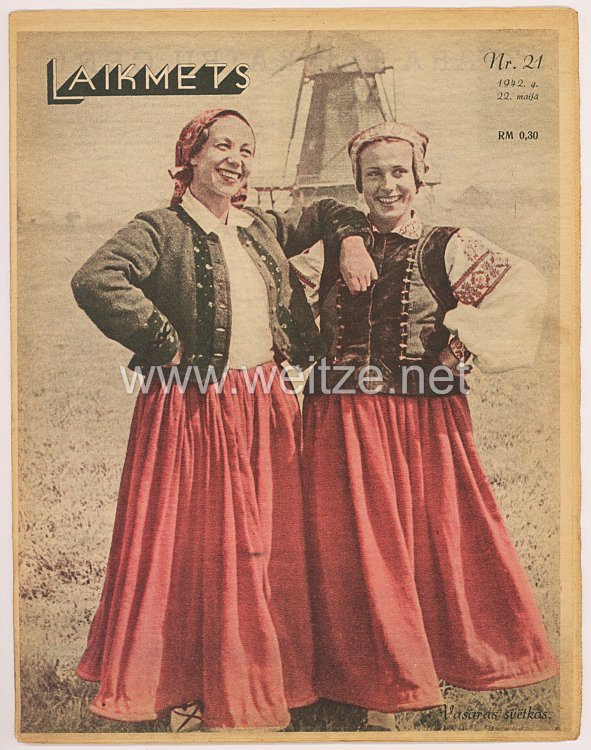
Third Reich / Estonia - Magazine "Laikmets" - Volume 1942 No. 21

Deutsche Verlags- und Druckerei-Ges. im Ostland m.b.H. Riga, condition 2-.
377289
35,00

Third Reich / Estonia - Magazine "Laikmets" - Volume 1942 No. 21

The Magazine "Laikmets" and the German Occupation Press in Estonia 1942

This issue of the magazine "Laikmets" (German: "The Epoch" or "The Times") from 1942, Number 21, represents significant testimony to German occupation policy in the Baltic region during World War II. Published by the German Publishing and Printing Company in the Ostland Ltd. (Deutsche Verlags- und Druckerei-Gesellschaft im Ostland m.b.H.) based in Riga, this publication exemplifies the systematic control of information by the German occupation forces in the occupied eastern territories.

Historical Context of the German Occupation of Estonia

Following the German attack on the Soviet Union as part of Operation Barbarossa on June 22, 1941, Estonia was conquered by the Wehrmacht within a few weeks. The Soviet occupation, which had existed since 1940, ended in the summer of 1941. The German administration established the Reichskommissariat Ostland, which encompassed the Baltic states of Estonia, Latvia, and Lithuania, as well as parts of Belarus. Hinrich Lohse was appointed as Reich Commissioner, with headquarters in Riga, the capital of Latvia.

The German Publishing and Printing Company in the Ostland

The German Publishing and Printing Company in the Ostland Ltd. was an institution controlled by the German occupation administration, responsible for publishing newspapers, magazines, and propaganda material in the occupied territories. This organization played a central role in implementing National Socialist information policy and propaganda in the Baltic region. From its headquarters in Riga, it coordinated the publication of various periodicals in different languages, including German, Estonian, Latvian, and Lithuanian.

The Magazine "Laikmets"

"Laikmets" was a magazine published in the Estonian language, targeting the local population. Such publications served multiple purposes: they were meant to legitimize German occupation policy, inform the population about administrative orders, spread anti-communist and anti-Soviet propaganda, and simultaneously convey an image of the "new order" under German rule. The contents were strictly controlled and censored by German authorities.

Press Policy in the Occupied Ostland

The National Socialist regime regarded media control as an essential instrument for dominating occupied territories. In the Reichskommissariat Ostland, a complex system of press control was established, supervised by the Reich Ministry for Public Enlightenment and Propaganda under Joseph Goebbels. Local newspapers and magazines had to adhere to strict guidelines and could only publish content approved by the occupation authorities.

The Estonian population found itself in a complex situation: after the Soviet occupation and the associated repressions, including the mass deportations of 1941, many Estonians initially viewed the Germans as liberators. However, this initial hope was disappointed by brutal German occupation policy, economic exploitation, and increasing recruitment for military purposes.

The Year 1942 in the Baltic Region

The year 1942, when this issue appeared, was a decisive phase of the German occupation. The initial phase of military conquest was complete, and civil administration was being consolidated. Simultaneously, the exploitation of economic resources and the recruitment of labor for the German Reich intensified. The systematic persecution and murder of the Jewish population was already in full swing, with most Estonian Jews having been murdered by the end of 1941.

Significance as a Historical Document

Magazines such as "Laikmets" are today important sources for historians researching German occupation policy, propaganda strategies, and everyday life under occupation. They document what information was made accessible to the population, how the German administration attempted to influence public opinion, and how cultural and political control was exercised. The condition of these publications – in this case rated as "2-," indicating good to very good preservation – makes them particularly valuable for historical research.

Collector Value and Ethical Considerations

Documents from the period of German occupation of the Baltic region are sought after by collectors but also raise ethical questions. While they undeniably have historical significance and are important for research and education, they must be viewed in the context of the crimes of National Socialism. Their collection and preservation should always be connected with the goal of historical education rather than glorification.

Conclusion

This issue of "Laikmets" from 1942 represents more than just a periodical; it is a window into the mechanisms of occupation, propaganda, and daily life in German-occupied Estonia. Such artifacts serve as crucial reminders of this dark chapter in Baltic history and contribute to our understanding of how totalitarian regimes sought to control information and shape public consciousness during wartime.