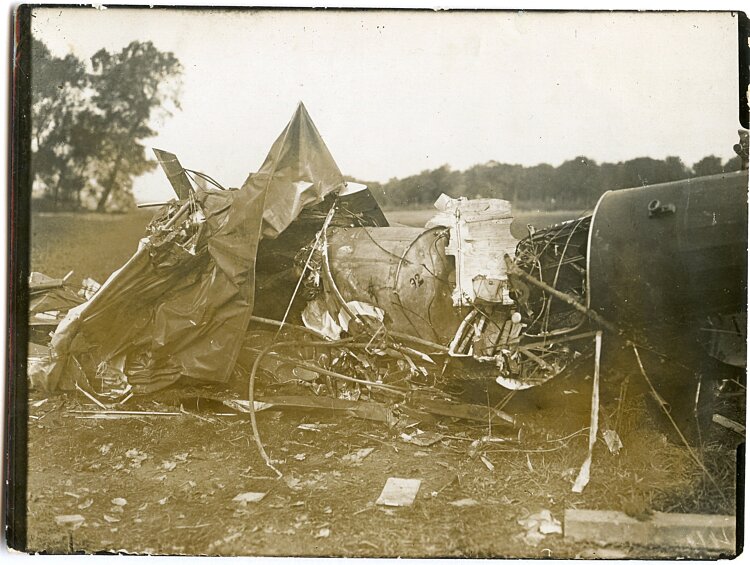
Photograph Aviation World War I: A Shot Down Enemy Aircraft

Postcard size, small tear, condition 2-
178889
8,00

Photograph Aviation World War I: A Shot Down Enemy Aircraft

This photographic document from the First World War showing a shot-down enemy aircraft represents an important aspect of military photography and propaganda documentation during humanity's first industrialized war (1914-1918). Such postcard-sized photographs were significant both for military reconnaissance purposes and for troop morale and the home front.

Aerial warfare evolved during the First World War from an experimental novelty to a decisive military factor. At the war's outbreak in 1914, the belligerent nations possessed relatively primitive aircraft used mainly for reconnaissance missions. However, by 1915, the first dogfights developed, and pilots such as Oswald Boelcke, Max Immelmann, and later Manfred von Richthofen became celebrated war heroes.

Photographs of shot-down enemy aircraft served several important functions: First, they provided proof of aerial victories, as confirmation of kills was often difficult. Air forces of all nations developed strict verification systems where eyewitness accounts, photographs, and recovery of wreckage served as evidence. Second, such images were used for intelligence purposes to study enemy aircraft types, construction features, and technical developments.

The production of photographs in postcard size was widespread during World War I. These formats (typically 9 x 14 cm or similar dimensions) were practical for archiving, mailing, and personal collecting. Soldiers frequently purchased or received such photographs as souvenirs and sent them to their families at home. Military photographers, often specially trained war correspondents, accompanied troops and documented important events.

The German Air Force of the First World War, organized under the Fliegertruppe (Flying Corps) of the German Army and the Marine-Fliegerabteilung (Naval Air Service), developed into one of the most formidable air forces of the conflict. German aircraft manufacturers such as Fokker, Albatros, Pfalz, and Rumpler produced various aircraft types, from reconnaissance planes to specialized fighters. Their opponents, mainly French (SPAD, Nieuport), British (Sopwith, Bristol, Royal Aircraft Factory), and later American aircraft, engaged in fierce aerial combat over the Western Front.

Documentation of aerial victories was part of military reporting and propaganda. Successful fighter pilots were styled as national heroes, their successes meticulously counted and published. The German system of “Jagdstaffeln” (hunting squadrons or Jastas), introduced in 1916, organized fighter pilots into specialized units. The most famous was Jagdstaffel 11 under Manfred von Richthofen, later expanded to Jagdgeschwader I.

The technical condition of the described photograph with a small tear and condition rating of 2- (according to common collector scales, where 1 is mint and 6 is heavily damaged) is typical for documents of this era. Over a century of storage has left its marks, yet the photograph remains valuable as historical testimony.

Such photographs today offer important insights into the material culture of World War I and the ways the war was documented, remembered, and represented. They are part of a larger corpus of war photography that documents the brutality and technological innovation of this devastating conflict. For collectors and historians, they represent authentic witnesses to a time when aerial warfare took its first, bloody steps and changed warfare forever.

These images also reflect the rapid technological advancement that characterized the war years. Aircraft design evolved dramatically between 1914 and 1918, with speeds, armament, and capabilities increasing exponentially. The documentation of destroyed enemy aircraft helped military strategists understand both successes and vulnerabilities of various designs, contributing to the constant cycle of innovation that defined the aerial arms race of the period.