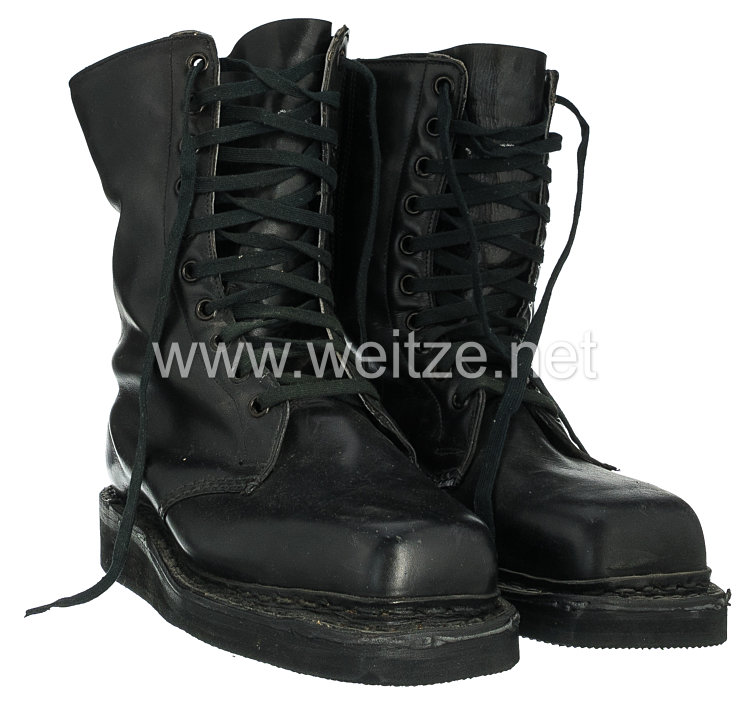
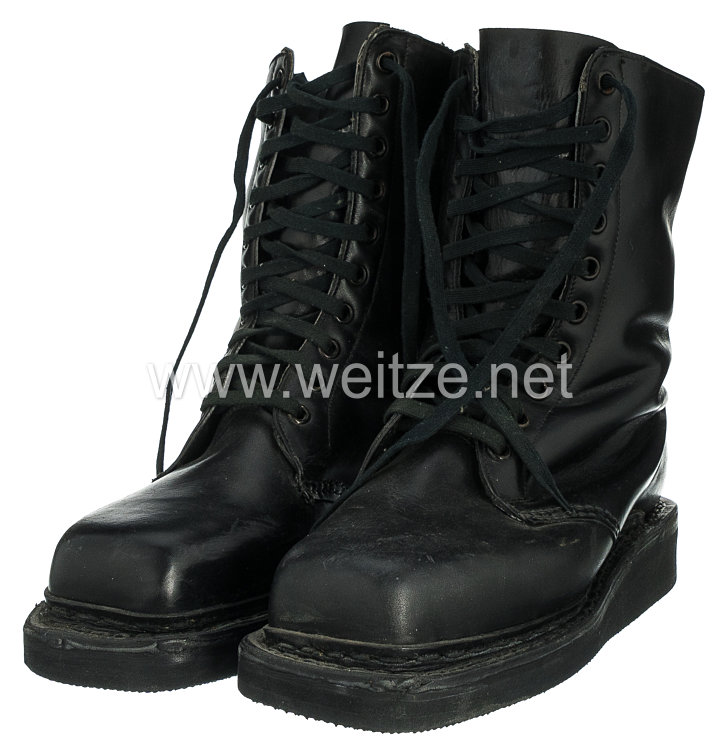
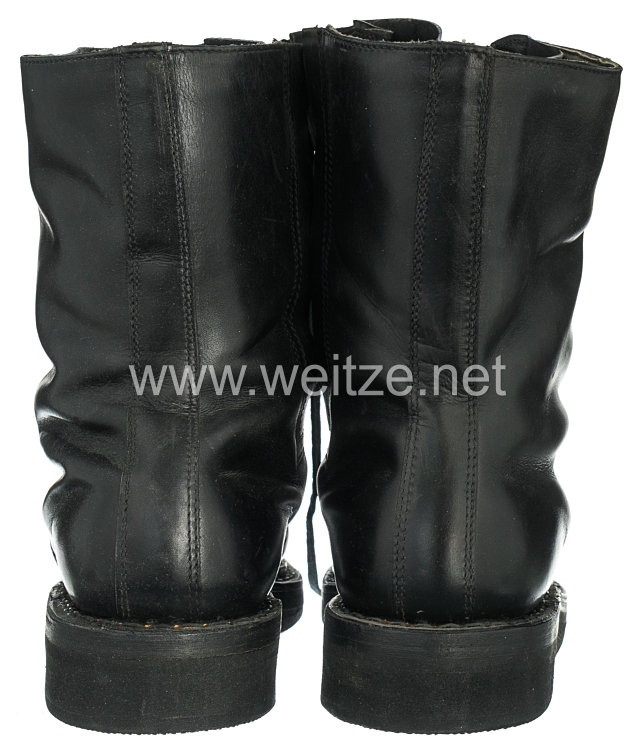
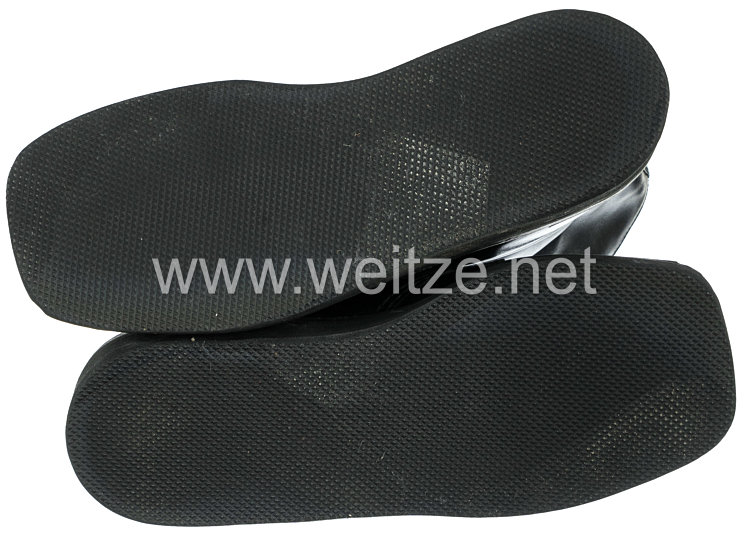
German Democratic Republic (GDR) National People's Army (NVA) Pair of Air Force Flight Boots
The flight boots of the Air Force of the National People's Army (NVA) of the German Democratic Republic represent a characteristic piece of equipment from East German military aviation during the Cold War. These specialized boots were worn by pilots, aircrew, and technical personnel of the Air Forces/Air Defense (LSK/LV), which existed as an independent service branch of the NVA from 1956 until German reunification in 1990.
The National People's Army was officially established on January 18, 1956, and formed the backbone of the GDR's military defense within the framework of the Warsaw Pact. The Air Forces developed into a modern service branch organized according to Soviet models, equipped with MiG fighter aircraft, transport planes, and helicopters. Uniforms and equipment followed Soviet standards while exhibiting characteristic GDR-specific features.
These flight boots made of smooth black leather represent the typical construction of flight personnel footwear from the 1970s and 1980s. The side zipper was a practical feature that enabled quick donning and removal – an important characteristic for aircrew who needed to be mission-ready quickly during emergencies or scramble alerts. The internal lining provided comfort during long missions and offered protection in various weather conditions.
The stamping inside the boots is typical of NVA equipment items and usually contained information about the manufacturer, production year, and size designation. Such stamps enabled traceability and quality control within the GDR's military procurement system. The shoe size 37.5 indicates a relatively small wearer, which was not unusual as the NVA Air Forces also employed female personnel, particularly in technical and administrative functions.
The production of military equipment in the GDR was carried out by publicly owned enterprises (VEB), which operated according to centrally established norms and specifications. The quality of workmanship and material selection followed military regulations aimed at durability and functionality. Leather was a preferred material for military boots as it was robust, breathable, and very durable with proper care.
The height of 21 centimeters corresponds to an ankle boot that provided sufficient support and protection without restricting freedom of movement. This design was particularly suitable for flight personnel who had to work in cramped cockpits while requiring safe footwear during emergency ejections or on the airfield. The sole length of 26 centimeters and the overall construction demonstrate the ergonomic orientation of this specialized military equipment.
The NVA Air Forces reached their peak strength in the 1980s with approximately 36,000 soldiers and possessed modern Soviet aircraft such as the MiG-21, MiG-23, and Su-22. Training followed Soviet methods, often with the support of Soviet advisors. The uniforms and equipment of the Air Forces differed in details from those of the Ground Forces, with the characteristic stone-gray uniform of the aviation forces being a distinctive feature.
After German reunification on October 3, 1990, the NVA was dissolved and partially integrated into the Bundeswehr. Most equipment was either scrapped, sold, or transferred to museum collections. Original NVA equipment items such as these flight boots are now sought-after collector's items that make an important contribution to understanding German military history during the division.
The condition of these boots (Condition 2) indicates well-preserved, worn examples that show the typical signs of use for military equipment. Such objects are not only of historical interest but also document the everyday reality of members of the NVA Air Forces. They serve as reminders of the 34-year history of the GDR armed forces and their role in the bipolar system of the Cold War, when Germany formed the front line between NATO and the Warsaw Pact.