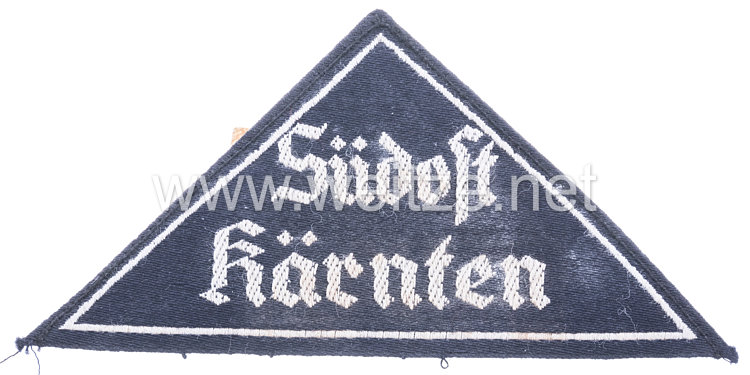
Bund Deutscher Mädel (BDM) District Triangle "Südost Kärnten"
The Bund Deutscher Mädel (BDM) District Triangle “Südost Kärnten” represents a significant artifact from the National Socialist youth organization for girls and young women in the German Reich. The Bund Deutscher Mädel was founded in 1930 as the female branch of the Hitler Youth (HJ) and developed after the seizure of power in 1933 into the only state-recognized girls' organization in the Nazi state.
The district triangles (Gebietsdreiecke) served as regional identifiers within the hierarchically structured BDM organization. They were worn on the uniform and enabled immediate identification of membership in a specific geographical administrative area. The territorial organization of the BDM largely followed the structure of the NSDAP Gaue and the HJ districts.
This triangle bears the designation “Südost Kärnten” (Southeast Carinthia), indicating geographical assignment to the Austrian region of Carinthia. After the Anschluss of Austria in March 1938, the entire Austrian territory was incorporated into the German Reich. Carinthia was organized as an independent Reichsgau, and existing Austrian youth organizations were dissolved and transferred into the structures of the Hitler Youth and BDM.
The implementation of BDM structures in the formerly Austrian territories occurred systematically and rapidly. By the end of 1938, the organizational foundations were established, and Austrian girls were incorporated into the BDM in large numbers. The regional subdivision in Carinthia took into account the geographical and administrative peculiarities of the Alpine region.
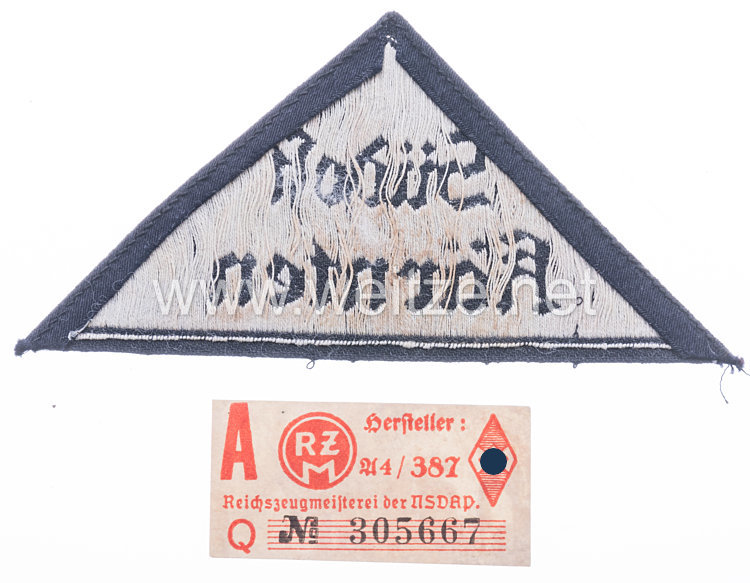
The RZM paper label accompanying this object is of particular historical significance. The Reichszeugmeisterei (RZM) was founded in 1929 as the central procurement agency of the NSDAP and from 1934 controlled the manufacture and distribution of all uniforms, insignia, and equipment of NS organizations. Every officially approved item had to be obtained through the RZM and bore corresponding markings. The presence of an original RZM label confirms the authenticity and official origin of the item.
Uniforming in the BDM followed strict regulations. Girls aged 10 to 14 belonged to the Jungmädelbund (JM), while those aged 14 to 18 were organized in the actual BDM. The uniform typically consisted of a dark blue skirt, white blouse, black neckerchief with leather knot, and dark jacket. District triangles were worn on the left upper arm and showed regional origin through their specific inscription.
The unworn condition of this specimen is remarkable and suggests that it was either never issued or held as reserve stock. After 1945, such items were frequently destroyed or hidden, making completely preserved examples with original labels rare today.
The historical classification of such objects requires critical examination of the BDM's role in the National Socialist system. The organization served the ideological indoctrination of young women and prepared them for their designated role in NS society. The BDM conveyed the National Socialist worldview, promoted physical fitness, and trained members in domestic activities. By 1939, approximately 3.5 million girls were organized in the BDM, and through the compulsory youth service from 1939, membership became virtually obligatory.
For military-historical and ethnological research, such uniform pieces are important sources for understanding the everyday history of National Socialism. They document the comprehensive organization of society, the appropriation of youth, and the administrative penetration into the most remote regions of the Reich.
The district triangle from Southeast Carinthia stands as an example of the systematic registration and uniforming of youth in the National Socialist sphere of power and serves as a reminder of a dark chapter in German and Austrian history that must be preserved for warning and scholarly examination.