Russia Pair of Epaulettes for Enlisted Men of the 2nd Leib-Ulanen-Regiment

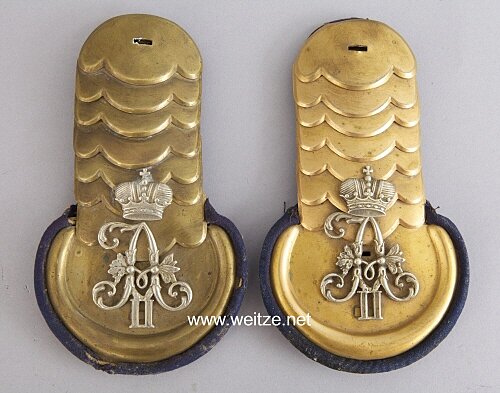
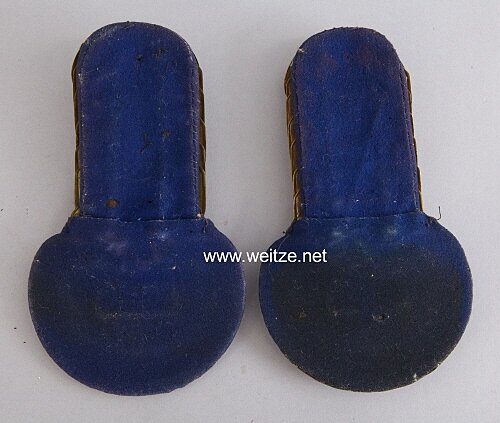
circa 1900. Heavy pattern. The epaulettes made of brass scales with large nickel silver monogram crown “A II”, the cloth backing in dark blue. Worn, condition 2.
186388
1.200,00

Russia Pair of Epaulettes for Enlisted Men of the 2nd Leib-Ulanen-Regiment

These epaulettes for enlisted men of the 2nd Life Uhlan Regiment represent a significant example of Russian military uniforms from the Tsarist era, circa 1900. These shoulder pieces embody not only the military splendor of the late Russian Empire but also the complex dynastic connections between European royal houses.

The 2nd Life Uhlan Regiment was one of the most prestigious cavalry units of the Russian army. The term “Life” (Leib) designated a special proximity to the Tsar and the Imperial House, which conferred an elevated status upon these regiments. The Uhlans themselves were light cavalry troops of Polish origin, distinguished by their characteristic uniforms featuring the distinctive czapka (Polish lance cap).

The technical execution of these epaulettes demonstrates the typical quality of Russian military accoutrements of the period. The brass scales are manufactured in heavy-duty construction, indicating high-quality production. Brass was chosen as a material because it produced a gold-like luster while being considerably more economical and durable. The individual scales were sewn onto a dark blue cloth backing, with the blue color traditionally associated with cavalry units.

The central element comprises a large monogram with crown “A II” made of nickel silver. This monogram refers to Emperor Alexander II (1818-1881), who reigned from 1855 until his assassination in 1881. Alexander II is known as the “Liberator Tsar” who abolished serfdom in Russia in 1861 and implemented far-reaching reforms. The continued use of his monogram after his death was a form of honor and tradition maintenance that was customary in the Russian army.

The use of nickel silver for the monogram is technically noteworthy. Nickel silver, an alloy of copper, nickel, and zinc, produced a silver-like luster without the cost of genuine silver. This material combination – golden-shimmering brass scales with silver-colored monogram – corresponded to Russian uniform regulations and created a visually impressive contrast.

Epaulettes of this type were worn on both shoulders of the uniform and served multiple purposes. Primarily, they were rank insignia, with the design for enlisted men distinctly different from those of officers. Enlisted men's epaulettes were typically simpler in design, while officers' epaulettes often featured fringes and more elaborate ornamentation. Simultaneously, epaulettes had a practical protective function for the shoulder area against saber strikes.

The period around 1900 marked a transitional phase in Russian military history. Under Tsar Nicholas II, who ascended the throne in 1894, the army increasingly modernized but retained its splendid dress uniforms. The magnificent uniforms of various regiments were intended not only to fulfill military function but also to demonstrate the power and tradition of the Tsarist Empire.

The 2nd Life Uhlan Regiment was organized according to Prussian models, reflecting the close military relations between Russia and Prussia-Germany. Russian Uhlan regiments were formed after the model of Polish light cavalry of the 18th century and retained many traditional elements even as warfare modernized.

The condition of these epaulettes – classified as “Condition 2” – indicates actual wear from use. This gives them additional historical value, as they were worn by a soldier in active service. The patina and signs of wear tell of the military reality of the late Tsarist Empire.

In the years before World War I and the Russian Revolution of 1917, such uniform pieces represented a world that would soon perish. The splendid cavalry tradition with its elaborate uniforms would yield to modern warfare realities. After the Revolution, such Tsarist insignia were often destroyed or taken abroad, making surviving examples important historical testimonies today.

These epaulettes are thus more than mere uniform pieces – they are material witnesses to the military culture of the Russian Empire, dynastic traditions, and the craftsmanship quality of military equipment before the collapse of Europe's old order.