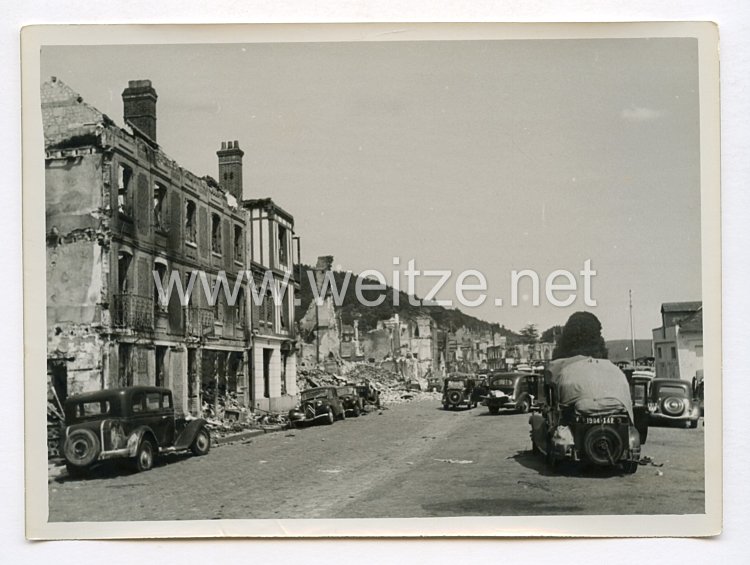
Press Photograph, Occupation of France 1940:
This press photograph from 1940 documents one of the most significant military events of World War II: the occupation of France by the German Wehrmacht. Measuring approximately 13 x 18 cm, it corresponds to the standard format for press photography of that era, produced by official war correspondents and intended for distribution in newspapers, magazines, and propaganda materials.
The Battle of France began on May 10, 1940, with the German attack on the neutral states of Belgium, the Netherlands, and Luxembourg, as well as France. Under the codename “Case Yellow” (Fall Gelb), German armored units broke through the supposedly impassable Ardennes forest, thereby circumventing the heavily fortified Maginot Line. This strategic masterpiece, primarily planned by generals such as Heinz Guderian and Erich von Manstein, led to the encirclement of Allied troops at Dunkirk and the rapid collapse of French defenses.
On June 14, 1940, German troops marched into Paris, and on June 22, the Armistice of Compiègne was signed in the Forest of Compiègne in the same railway carriage where the World War I armistice had been signed in 1918. France was divided into an occupied zone in the north and along the Atlantic coast, and the unoccupied Zone libre under the Vichy government led by Marshal Philippe Pétain.
War reporting played a central role in National Socialist propaganda during World War II. The Reich Ministry of Public Enlightenment and Propaganda under Joseph Goebbels strictly controlled all media products. War correspondents – both photographers and journalists – were organized into Propaganda Companies (Propagandakompanien or PK) and wore uniforms, though they were not directly under military command.
These press photographs were produced according to strict guidelines. They were meant to demonstrate the military superiority of the Wehrmacht, boost morale on the home front, and convey the image of a “clean war.” The images underwent rigorous censorship by the Wehrmacht Propaganda Department and the Propaganda Ministry before being approved for publication.
The 13 x 18 cm format was a standard size for press photos of this period. These prints were usually developed on baryta paper and often bore stamps, captions, or censorship marks on the reverse. Many carried the notation of the Scherl Picture Service, the German News Bureau (Deutsches Nachrichtenbüro or DNB), or other official picture agencies. The photographs were distributed to newspapers at home and abroad, to newsreels, and for exhibitions.
The occupation of France was celebrated as the greatest triumph of German warfare. For National Socialist propaganda, this was a central event that supposedly proved the superiority of the German military and National Socialist ideology. Photographs of troops marching past the Eiffel Tower, of Adolf Hitler during his tour of Paris on June 23, 1940, or of victory parades became iconic images of this period.
From today's historical perspective, such press photographs are important primary sources for researching World War II. They document not only military events but also the methods and intentions of National Socialist propaganda. At the same time, they must be viewed critically, as they are manipulated and staged representations of reality. The condition rating of 2 (according to standard collector grading) indicates a well-preserved specimen with possibly minor signs of wear.
Collectors and researchers today value such documents as historical testimonies, with the scientific and educational value being paramount. They help to understand the mechanisms of war propaganda and to reconstruct historical events in their context.