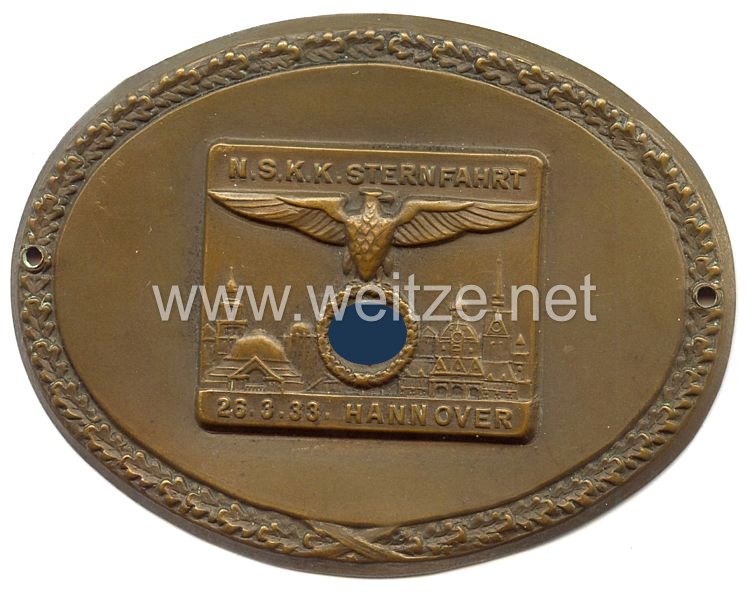
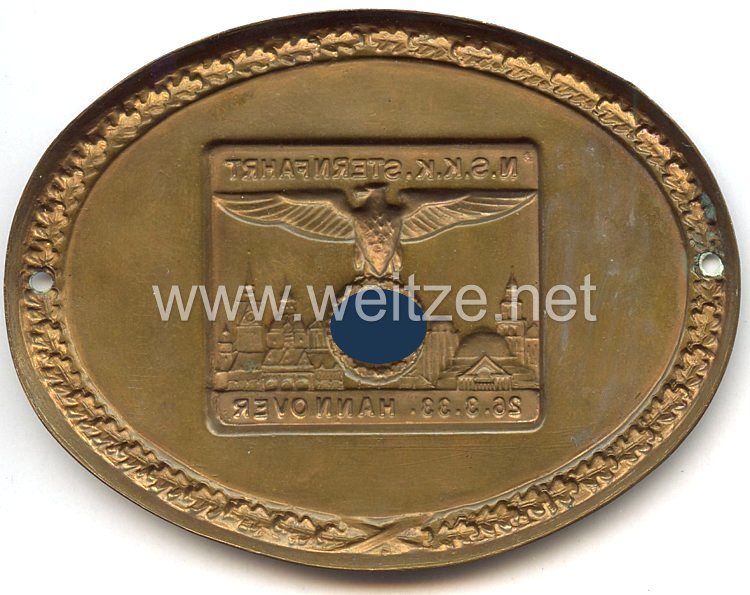
NSKK - Non-Wearable Participant Plaque - "NSKK Sternfahrt 26.3.1933 Hannover"

Non-ferrous metal, hollow embossed and toned, 60 x 80 mm, with 2 drill holes, Condition 2.
337388
300,00

NSKK - Non-Wearable Participant Plaque - "NSKK Sternfahrt 26.3.1933 Hannover"

This non-wearable participant plaque documents a significant event in the early history of the National Socialist Motor Corps (NSKK). It commemorates the NSKK Star Drive that took place on March 26, 1933 in Hanover, just weeks after the National Socialist seizure of power in January 1933.

The NSKK was founded in April 1930 as a division of the NSDAP and evolved from the Motor-SA established in 1929. The organization's purpose was to provide motorized propaganda and transportation services for the party. After the seizure of power in 1933, the NSKK experienced rapid expansion and received increasingly paramilitary functions, particularly in providing motor vehicle training to young Germans.

A Sternfahrt (star drive) was a special form of automotive demonstration in which vehicle columns converged on a common destination from different directions. This type of event had both propagandistic and organizational significance. It demonstrated the mobility, discipline, and strength of the Nazi movement while simultaneously serving as a mass event to activate and bind supporters.

The star drive to Hanover in March 1933 took place during a politically explosive phase. The Reichstag election of March 5, 1933 had not given the NSDAP an absolute majority, but with 43.9 percent of votes provided a strong position. On March 23, 1933, just three days before the Hanover star drive, the Reichstag passed the fateful Enabling Act. In this context, mass events like the NSKK star drive served to demonstrate power and intimidate political opponents.

The present plaque is made of hollow-embossed and toned non-ferrous metal, a typical manufacturing process for non-wearable badges of this period. Measuring 60 x 80 mm, it is a relatively large-format commemorative piece. The two holes indicate that the plaque was intended for permanent mounting, presumably on a wall or in a frame. Unlike wearable badges equipped with pins or fastening devices, such non-wearable plaques served as permanent mementos for participants.

The NSKK organized its events according to military patterns. Participants in such star drives were usually members of the organization who traveled with their private vehicles or NSKK vehicles. The events typically included parades, speeches by leading functionaries, and demonstrative drives through the city. They were carefully choreographed and served the movement's public self-representation.

The issuance of participant plaques was a widespread practice among Nazi organizations. They fulfilled several functions: they documented participation in important events, strengthened the sense of belonging among members, and served as collectibles that manifested personal connection to the movement. For participants, such plaques were coveted mementos that documented their commitment and loyalty.

Hanover as a venue held special significance. The city was an important center in northern Germany and had strategic importance for the Nazi movement in this region. After the seizure of power, the National Socialists intensified their activities in all German cities to consolidate their rule and penetrate society.

The NSKK itself developed after 1933 into a large organization with hundreds of thousands of members. It assumed tasks in motor vehicle training, traffic education, and during the war also military transportation duties. The organization was hierarchically structured and followed the Führer principle that characterized all Nazi organizations.

Today, such plaques are important historical documents that illustrate the propaganda and organizational practices of National Socialism. They provide insight into the event culture, the movement's self-representation, and the mechanisms of mass mobilization. For historical research, they offer valuable insights into the everyday history of the Nazi regime and the functioning of its mass organizations.

r