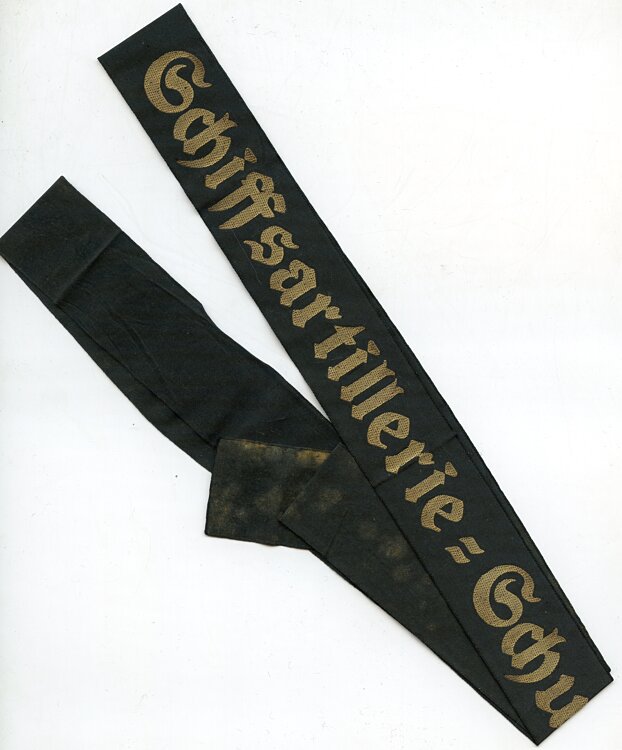
Cap Tally "Schiffsartillerie=Schule"
Cap Tally of the Naval Artillery School of the Imperial German Navy
This cap tally with metal thread weaving represents a characteristic piece of equipment from the Imperial German Navy and exemplifies the maritime training tradition of the late 19th and early 20th centuries. Such cap tallies served not only the practical purpose of identifying membership in a specific unit, but were also an important element of maritime identity and esprit de corps.
The Schiffsartillerie-Schule (Naval Artillery School) was a central training facility of the Imperial Navy, responsible for the professional instruction of officers and enlisted men in naval artillery. With the increasing mechanization of warships and the development of ever more powerful gun systems, systematic training in the operation, maintenance, and tactical application of naval artillery became an essential necessity for fleet readiness.
The history of German naval artillery training is closely linked to the rapid expansion of the fleet under Kaiser Wilhelm II and the then State Secretary of the Imperial Naval Office, Alfred von Tirpitz. The fleet buildup initiated by Tirpitz from the 1890s onward made professional and standardized training indispensable. The Naval Artillery School trained crews for the modern battleships, cruisers, and other warships that were equipped with increasingly complex weapons systems.
The cap tally itself was part of the uniform of the enlisted men and petty officers of the Imperial Navy. It was worn on the sailor's cap and indicated through its inscription membership in a particular ship or institution. The metal thread woven version, as presented here, was characterized by special durability and a representative character. The metal thread gave the band a certain luster and emphasized the importance of the respective unit.
The design of such cap tallies followed clear regulations of the naval clothing ordinance. Typically, they were in dark colors, usually black, and bore the name of the unit in gold or silver lettering. The design corresponded to the general standards of Prussian-German military tradition, which placed great value on uniformity and clear recognition.
The Naval Artillery School was traditionally located in Sonderburg on the island of Als (today Denmark) and later at other locations. Both theoretical and practical knowledge were taught here. The training included ballistics, fire control procedures, technical maintenance of guns, and tactical exercises. With the introduction of modern fire control systems and rangefinders, training became increasingly demanding and scientific.
Wearing a cap tally of the Naval Artillery School was for members a sign of their specialization and professional competence. Unlike regular ship crews, who wore the name of their respective warship, the tallies of training institutions indicated the special function of these establishments. After successful completion of training, the sailors and petty officers were transferred to fleet ships and then wore the cap tally of their new unit.
The metal thread weaving technique required craftsmanship and was more elaborate to produce than simple textile bands. The metal threads were integrated into the weaving process, creating a durable and simultaneously representative execution. This quality was particularly important for official occasions and parade uniforms.
After the end of World War I in 1918 and the dissolution of the Imperial Navy, many of these cap tallies found their way into private collections. They became sought-after mementos and historical documents of a bygone era. Today they are important testimonies of German naval history and military training tradition.
For collectors and historians, such cap tallies offer valuable insights into the organizational structure and training systems of the historic German Navy. They document not only the existence of certain institutions, but also tell of the people who wore these uniform parts and whose lives were shaped by maritime service. The present specimen in worn condition attests to its authentic use and makes it an immediate witness to German naval history.