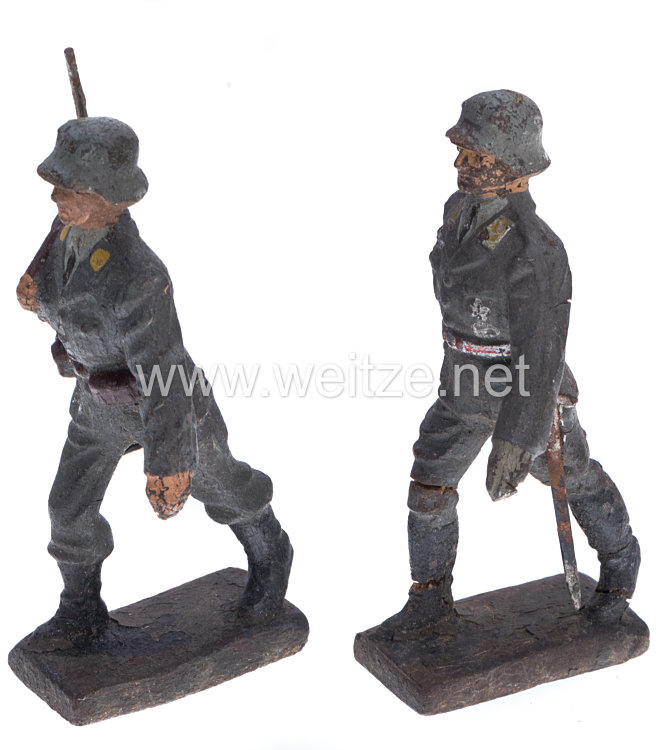
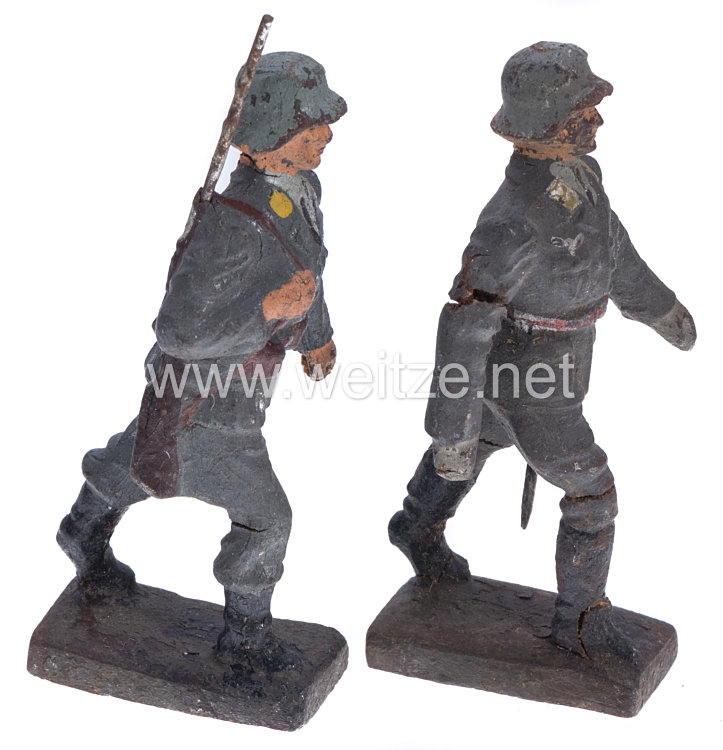
Lineol - Luftwaffe Aviation Officer and Soldier with Steel Helmet Marching
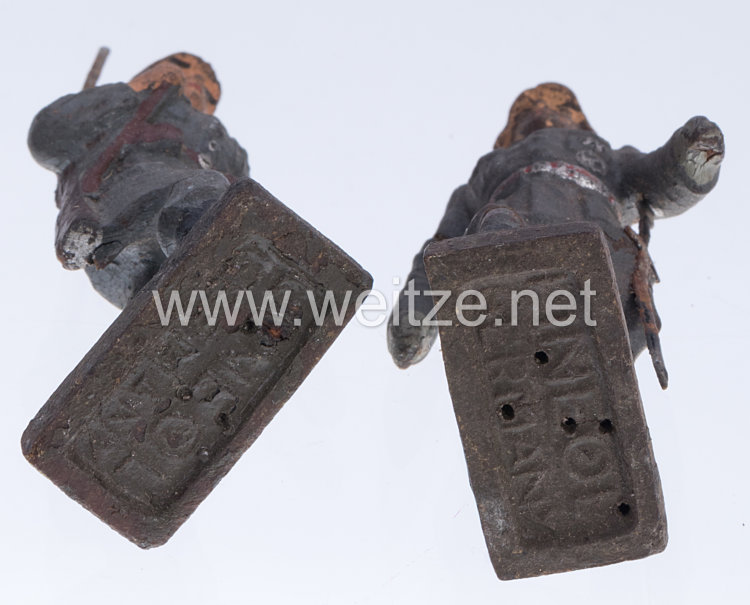
The present Lineol figures represent members of the Luftwaffe, specifically the flying corps, from the period of the Third Reich (1933-1945). These toy figures, measuring 7.5 cm in height, belong to the so-called composition figures manufactured by the Lineol company in Germany and are now highly sought-after collectibles in the field of historical military toys.
The Lineol Hausser company group became one of the leading manufacturers of toy soldiers in Germany during the 1930s. Unlike traditional lead soldiers, Lineol produced their figures from a special composition mass, an elastoplastic material based on casein, kaolin, glue, and other additives. This material was more robust than lead, allowed for detailed modeling, and was safer for children.
The depicted figures show an officer and a soldier of the Luftwaffe in marching formation. The Luftwaffe was officially founded on February 26, 1935, after Adolf Hitler publicly announced the rearmament and existence of this military branch. Under the leadership of Reichsmarschall Hermann Göring, the Luftwaffe developed into a significant branch of the Wehrmacht.
The steel helmet worn by the figures is a characteristic feature of German soldiers of this era. The Model M35, introduced in 1935, replaced the steel helmets from World War I and featured improved protective properties. The Luftwaffe used special variants of the steel helmet adapted to the needs of flying personnel, while ground staff wore the standard Wehrmacht helmet.
The Luftwaffe's uniforms were characteristically blue-gray colored, distinguishing them from the field-gray uniforms of the Army and the dark blue of the Navy. Rank insignia were worn on shoulder boards and collar patches. Officers were distinguished by gold or silver braiding, epaulettes, and special headgear.
Lineol produced these figures during the height of German rearmament and National Socialism. The toy figures served not only for entertainment but also for the militarization of youth and the promotion of military values. Children were to be introduced playfully to military structures and various military branches. The detailed representation of uniforms, equipment, and military formations reflected the social reality of the time.
The quality and attention to detail of Lineol figures was remarkable. The figures were manufactured in several work steps: first, the mass was cast in metal molds, then hand-painted. The artists paid attention to correct uniform colors, rank insignia, and equipment details. This makes the figures today not only collectibles but also valuable historical documents.
After World War II, the production of military toys was initially prohibited by the Allies. The Lineol company ceased production, and many molds were destroyed. In the post-war period, the revived toy industry focused on civilian themes. This makes original Lineol figures from before 1945 rare and sought-after collector's items.
The indicated condition 2/2- corresponds to the common grading scale for collector models, where condition 1 means mint condition. This rating indicates very well-preserved pieces, possibly with minimal signs of use, which is remarkable for objects of this age. The preservation of color, details, and the composition mass over decades is an important factor for collector value.
Today, such figures are valued by militaria collectors, toy historians, and museums. They document not only the history of toy manufacturing but also military history, uniform studies, and the social conditions of the 1930s and 1940s in Germany.