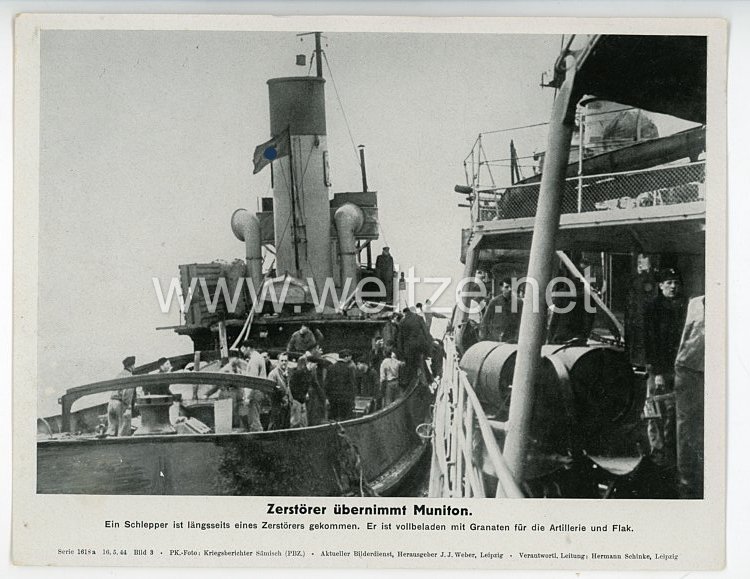
Third Reich - Printed Press Photo “Destroyer Takes on Ammunition” May 16, 1944
This printed press photograph from the Third Reich titled “Destroyer Takes on Ammunition” dated May 16, 1944 represents a significant document of National Socialist press propaganda during the final phase of World War II. Published by Aktueller Bilderdienst, one of the central press photo agencies of the Nazi regime, this photograph documents both the military reality and the propagandistic portrayal of the German Kriegsmarine in the spring of 1944.
The Aktueller Bilderdienst was one of the most important photo agencies of the Nazi state, supplying German and international media with carefully selected and censored photographs. Image production was subject to strict control by the Reich Ministry of Public Enlightenment and Propaganda under Joseph Goebbels. Every published image had to conform to propagandistic guidelines and could not show negative aspects of the military situation.
In May 1944, the German Kriegsmarine found itself in an increasingly precarious situation. Allied forces were preparing for the Normandy invasion, which would take place a few weeks later on June 6, 1944. The German Navy had already suffered severe losses, both through direct combat and due to increasing Allied air superiority. Destroyers played a critical role in the German fleet structure, being deployed for convoy escort, anti-submarine warfare, and coastal operations.
The German destroyer fleet in 1944 consisted mainly of various types, including the 1934, 1936, and 1936A-class destroyers. These ships were equipped with 12.7 cm or 15 cm guns as well as torpedo tubes and required regular ammunition resupply. Supplying warships with ammunition was a complex logistical challenge, especially under conditions of increasing Allied air and sea superiority.
The fact that this photograph shows ammunition transfer is significant for several reasons. First, it demonstrates the continuation of German naval operations despite the deteriorating strategic situation. Second, it was meant to signal to the German population and abroad that the Wehrmacht remained combat-ready and well-supplied. The choice of subject – a destroyer taking on ammunition – was intended to convey strength, readiness, and normal military routine.
The format of 23.5 x 18.5 cm corresponds to the standard sizes for press photographs of this era. The absence of printing on the reverse is noteworthy, as many press photos from Aktueller Bilderdienst bore stamps, captions, or censorship marks on the back. This could indicate that this is an archive copy or a print template.
In the context of wartime propaganda in 1944, naval propaganda held a special position. After the catastrophic losses in the Battle of the Atlantic and the substantial withdrawal of surface forces to Norwegian and German ports, it was important for the Propaganda Ministry to continue distributing images of active and operational warships. The Kriegsmarine under Grand Admiral Karl Dönitz attempted to maintain its role in German warfare despite overwhelming Allied superiority.
Press photographs like this were distributed to German newspapers and magazines, appeared in newsreels, and were used for exhibitions. They served to maintain morale on the home front and were meant to create the impression that Germany, despite military setbacks, still possessed effective armed forces.
From today's perspective, this press photograph is an important contemporary historical document that provides insight into the functioning of Nazi propaganda. It shows how even routine military operations such as ammunition supply were instrumentalized for propagandistic purposes. The preservation of such documents is of great importance for historical research, as they help understand the mechanisms of opinion formation and manipulation in the totalitarian state.
The condition grade 2 of the object indicates good to very good preservation, which is remarkable for a paper document over 80 years old. This allows detailed examination of print quality, photographic technique, and pictorial representation, all important aspects of the material culture of the Third Reich.