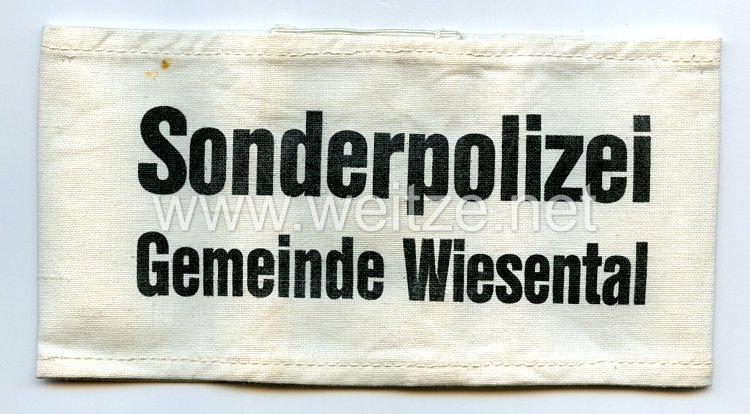
German Democratic Republic (GDR) Armband Special Police Municipality Wiesenthal
The Special Police armband from the municipality of Wiesenthal represents a fascinating testimony to the early security structures in the German Democratic Republic (GDR). This object documents a transitional phase in the development of the East German police apparatus after World War II.
Following the unconditional surrender of Nazi Germany in May 1945, German territory was divided into four occupation zones. In the Soviet Occupation Zone (SBZ), from which the GDR would later emerge, the construction of new administrative and security structures began immediately after the war. The Soviet Military Administration (SMAD) issued orders as early as June 1945 for the establishment of German police forces under Soviet supervision.
The Special Police (Sonderpolizei) formed a particular category within the developing police structure during this construction phase. While the regular People's Police (Volkspolizei or VP) was built up only gradually, various special units and auxiliary police forces existed at the municipal level. These local formations were often entrusted with specific tasks ranging from maintaining public order to guarding important facilities and supporting the enforcement of administrative orders.
The designation “Special Police” could have various meanings. In some municipalities, it referred to auxiliary police forces that supported the regular police, while in others it meant specialized units for specific areas of responsibility. Particularly in smaller communities like Wiesenthal, such formations were often necessary since the regular People's Police could not yet maintain a comprehensive presence throughout the territory in the first years after the war.
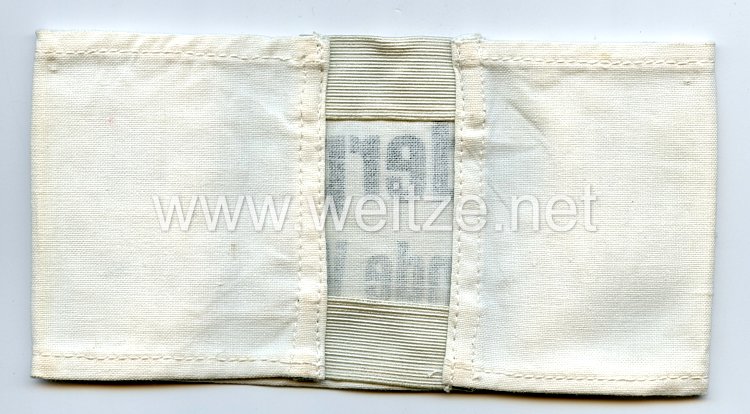
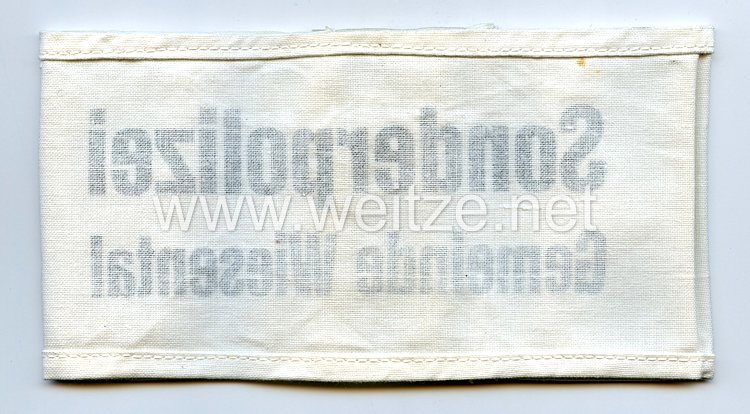
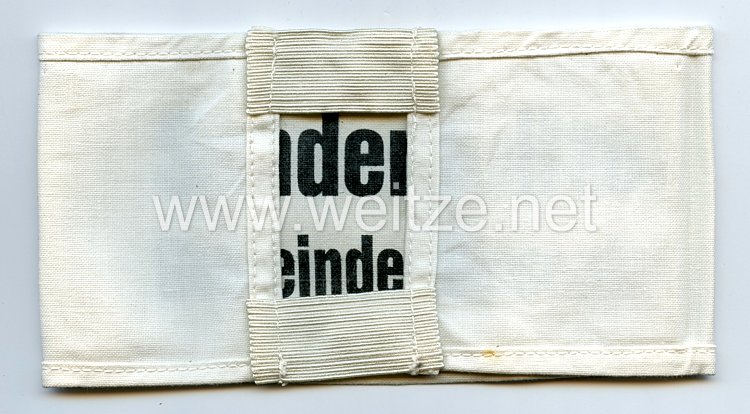
The present armband in early printed execution is of particular historical interest. In the immediate post-war years and early GDR period (approximately 1945-1952), armbands were frequently used as practical and cost-effective identification for various police and order forces. The printed execution suggests a certain degree of standardization but was still far from the later uniform equipment of GDR security organs.
The municipality of Wiesenthal (several places with this name existed in the SBZ/GDR, including in Saxony and Thuringia) represents the rural context in which such local security forces were particularly important. In the immediate post-war period, chaotic conditions prevailed: refugee flows, returning soldiers, supply shortages, and the transition to new administrative structures all required local order forces.
The development of GDR police structures went through several phases. From 1948 onward, the Barracked People's Police (KVP) was established, which later became the National People's Army. In 1952, a comprehensive administrative reform took place with the dissolution of the states and the establishment of districts. In this context, police structures were further centralized and standardized. Local special formations like the Special Police documented here gradually lost importance or were integrated into regular structures.
The GDR's Ministry of the Interior, founded in 1949, assumed central control of the People's Police. Parallel to this, the Ministry for State Security (MfS) developed from 1950 onward into the actual instrument of power for SED rule. Local police structures were gradually subordinated to these central organs.
Armbands as means of identification were used in the GDR throughout the state's entire existence, though increasingly standardized and regulated. Early examples like the one described here are often characterized by regional peculiarities, different manufacturing processes, and more individual design. They are therefore sought-after collector's items today that provide insight into the early phase of GDR security organs.
The preservation of such documents is significant for historical research, as they illustrate the often insufficiently documented development of local administrative and security structures in the early GDR. While central institutions like the MfS are well researched, many aspects of municipal security organs and their auxiliary forces remain to be examined in detail.
This armband thus represents not merely a piece of textile with printed identification, but rather a historical document that bears witness to the formative years of the East German state and its efforts to establish control and order at the grassroots level.