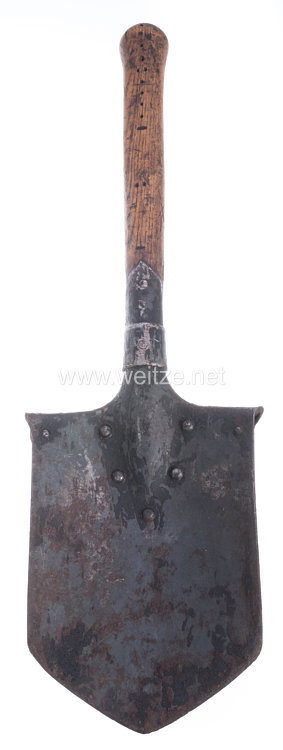
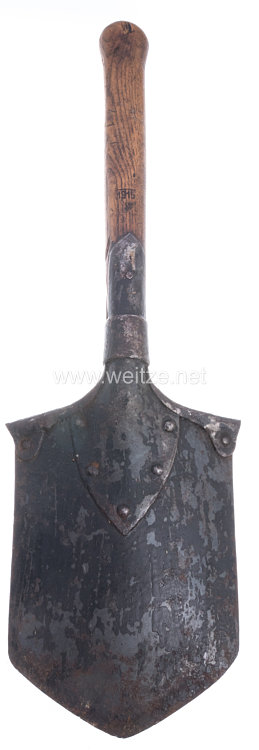
WWI Austro-Hungarian Infantry Entrenching Tool M 1910
The K.u.K. Infantry Spade M 1910: An Indispensable Tool of the First World War
The Infantry Spade Model 1910 of the Austro-Hungarian armed forces represents one of the most important pieces of personal equipment issued to the k.u.k. Army during the First World War. This particular specimen, manufactured by Bleckmann Mürzzuschlag in 1915, originates from a critical phase of the war when battles of attrition and trench warfare had dramatically increased the importance of entrenching tools.
The Bleckmann Company in Mürzzuschlag, Styria, was one of the most significant suppliers to the Austro-Hungarian Army. The company specialized in the production of metal goods and became an important armaments manufacturer during the war. The marking “Bleckmann Mürzzuschlag 1915” identifies not only the manufacturer but also the year of production, which is of considerable value to collectors and historians.
Technical Features and Design
The M 1910 spade is characterized by its distinctive construction: a short wooden handle and a pointed spade blade. This design was not accidental but the result of decades of military experience. The pointed blade enabled soldiers to dig effectively even in hard or rocky soil – a crucial capability in the mountainous regions of the Italian and Carpathian fronts.
The short handle was a compromise between functionality and portability. Infantrymen already had to carry a considerable burden of equipment, including rifle, ammunition, knapsack, and personal items. A shorter spade was easier to transport and could be conveniently attached to the knapsack or belt. The overall construction followed the k.u.k. Army regulations, which specified precise requirements for all equipment items.
Historical Context and Wartime Use
In 1915, when this spade was manufactured, the Austro-Hungarian Monarchy found itself in a desperate military situation. On the Eastern Front, k.u.k. troops were fighting against Russian armies, while fierce battles erupted on the newly opened Italian Front following Italy's entry into the war in May 1915. Trench warfare, which had begun on the Western Front in 1914, was now spreading to other theaters.
In this context, the spade transformed from a simple tool into a survival necessity. Soldiers spent months in trenches that constantly needed to be repaired, extended, and deepened. The spade served to dig trenches, dugouts, and latrines, to lay wire entanglements, and even as an improvised weapon in close combat.
Production and Logistics
The mass production of military equipment posed enormous challenges for the Dual Monarchy. The War Ministry had to procure millions of equipment items for an army that comprised approximately 3.35 million men in 1914 and grew to over 8 million during the war. Manufacturers like Bleckmann became key players in this war economy.
Quality control was strictly regulated. Each spade had to meet military specifications and was marked with manufacturer's stamps to ensure traceability. This systematic marking enables historians today to reconstruct production quantities, supply chains, and the industrial mobilization of the multi-ethnic empire.
Materials and Preservation
The spade consists of two main components: the wooden handle and the steel blade. The wood, typically beech or ash, was treated to withstand weather conditions. The steel blade was forged and hardened to ensure durability in harsh field conditions. After over a century, preserved specimens demonstrate the quality of contemporary craftsmanship.
Collector Value and Historical Significance
Today, authentic k.u.k. M 1910 spades are sought-after collector's items. They represent not only military history but also the industrial development of the late Habsburg Monarchy. Specimens with clear manufacturer's markings and dated stamps are particularly valuable as they enable precise historical attribution.
The M 1910 spade serves as a reminder of the millions of soldiers of the k.u.k. Army who fought and suffered under often extreme conditions. It is a silent witness to the industrialized warfare of the 20th century and the transformation of military equipment from traditional to modern forms. As an artifact, it connects us with a bygone era and serves as a reminder of the human costs of war.