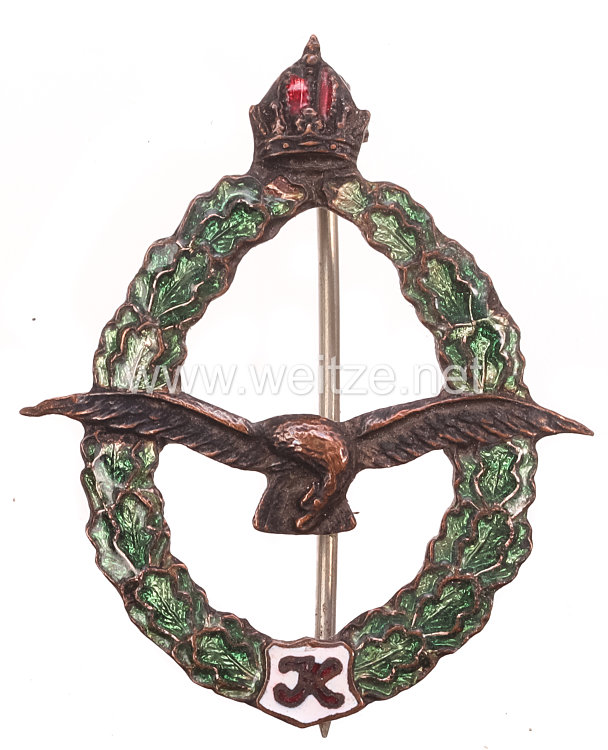
Austria-Hungary K.u.K. Monarchy World War I Field Pilot Badge 2nd Model 1916/17 Half-Miniature
The Austro-Hungarian Field Pilot's Badge ranks among the most significant military decorations of World War I and documents the dramatic development of military aviation between 1914 and 1918. This example in half-miniature format represents the second model of 1916/17 and is a fascinating testimony to the military honors of the declining Dual Monarchy.
The Imperial and Royal Air Force emerged from modest beginnings at the start of World War I. When Austria-Hungary entered the war in 1914, the empire possessed merely about 40 aircraft. However, military aviation rapidly developed into a decisive factor in modern warfare. As early as December 1913, an imperial resolution established the first Field Pilot's Badge, initially awarded only to military pilots who had successfully completed their training.
The first model of the Field Pilot's Badge displayed the crowned double eagle with the coat of arms of Emperor Franz Joseph I on its breast, surrounded by an enameled laurel wreath. With Franz Joseph's death on November 21, 1916, and the accession of his great-nephew Karl I, a modification of the badge became necessary. The present piece bears the characteristic coat of arms with the letter âKâ for Emperor Karl, clearly dating it to the period of 1916/17.
The half-miniature version represents a special variant, measuring approximately two-thirds the size of the regular badge. With a height of 32 mm (the standard size was about 48 mm), this form was intended for wearing on uniforms during less formal occasions or on civilian clothing. The manufacture from gilt tombac with finely enameled wreath demonstrates the high craftsmanship quality of these decorations. Tombac, an alloy of copper and zinc, was the preferred material for military decorations as it could be gilded effectively and provided a durable surface.
The award practice of the Field Pilot's Badge was strictly regulated. Initially, only trained aircraft pilots of the Imperial and Royal Aviation Troops who had successfully completed their theoretical and practical training were entitled to the badge. As the war progressed, the badge was also awarded to observers and other aircrew members who had proven themselves in combat operations. The award was made by the Imperial and Royal War Ministry upon recommendation from the respective command posts.
The Austro-Hungarian Air Force developed into a considerable military force during World War I. Despite industrial inferiority compared to the Western Powers, the Dual Monarchy managed to produce over 5,000 aircraft by war's end. Famous pilots such as Godwin Brumowski, the most successful Austro-Hungarian fighter pilot with 35 confirmed victories, or Julius Arigi wore this badge with pride.
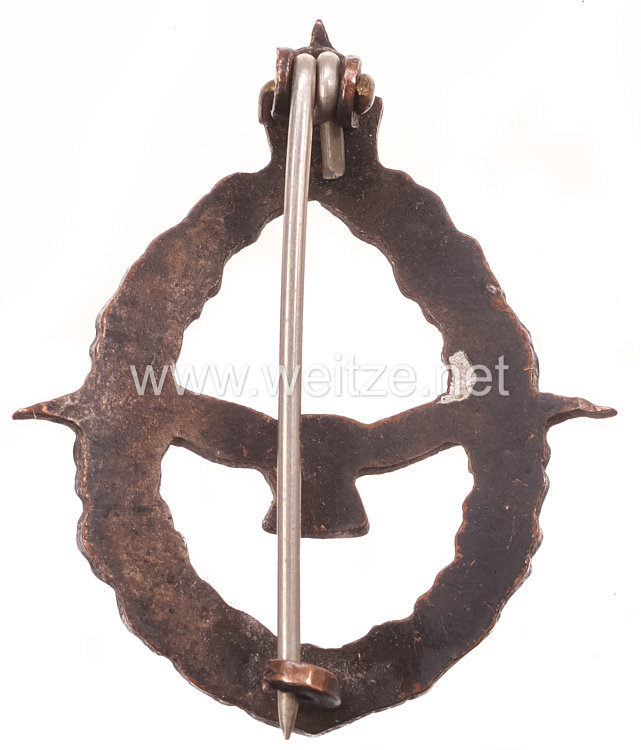
The technical execution of the second model differs from the first primarily through the modified coat of arms. The double eagle, symbol of Habsburg power for centuries, stands with outstretched wings upon an enameled laurel wreath symbolizing victory and military honor. The crown above the eagle represents imperial dignity. The reverse attachment via a pin enabled secure fastening to the uniform.
The provenance of this specimen from the Peter Groch collection, Berlin, emphasizes its museum quality. Groch was a renowned collector of military decorations whose collection was known for its quality and historical significance. The stated condition grade 2 (on the numismatic grading scale ranging from 1 for perfect to 6 for very poor) indicates a very well-preserved piece with only minimal signs of wear.
After the collapse of the Austro-Hungarian Monarchy in November 1918 and the dissolution of the Imperial and Royal Armed Forces, the Field Pilot's Badge became a historical relic of a bygone era. Today, these badges are sought-after collector's items that possess not only military-historical value but also document the high craftsmanship quality of Austrian medal art. They commemorate the brave men who fought in the skies above the battlefields of Europe and the final phase of the centuries-old Habsburg Monarchy.