Luftwaffe - Document Trio for a Later Colonel of Defense Economy Inspectorate VII in München
This trio of award documents chronicles the military career of a Luftwaffe officer who rose from Oberstleutnant (Lieutenant Colonel) to Oberst (Colonel) and served with the Wehrwirtschaftsinspektion VII in Munich (Economic Inspectorate VII). The three award certificates for service decorations of various classes offer a fascinating insight into the promotion and decoration system of the German Luftwaffe during the National Socialist period.
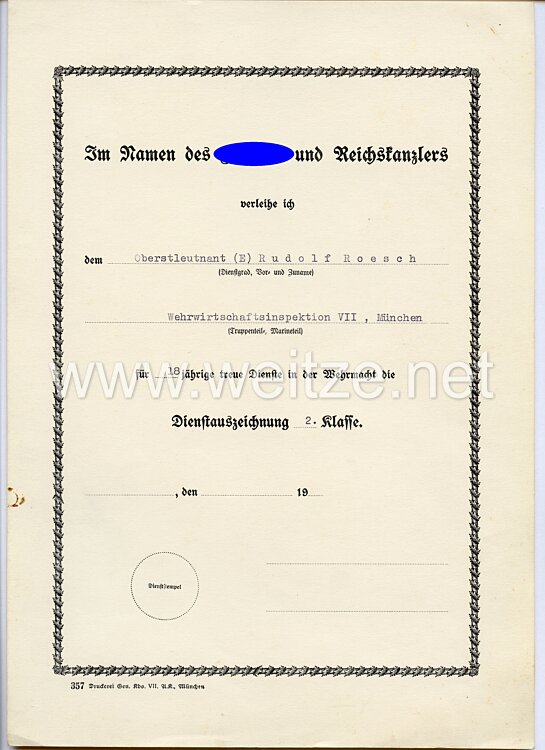
The Luftwaffe Long Service Awards were introduced by decree on March 16, 1936, replacing the previous Wehrmacht service awards for members of the Air Force. They were awarded in four classes: 4th Class for 4 years of service, 3rd Class for 12 years, 2nd Class for 18 years, and 1st Class for 25 years of service. These decorations were intended to honor loyalty and long service and were part of a comprehensive system for recognizing military merit.
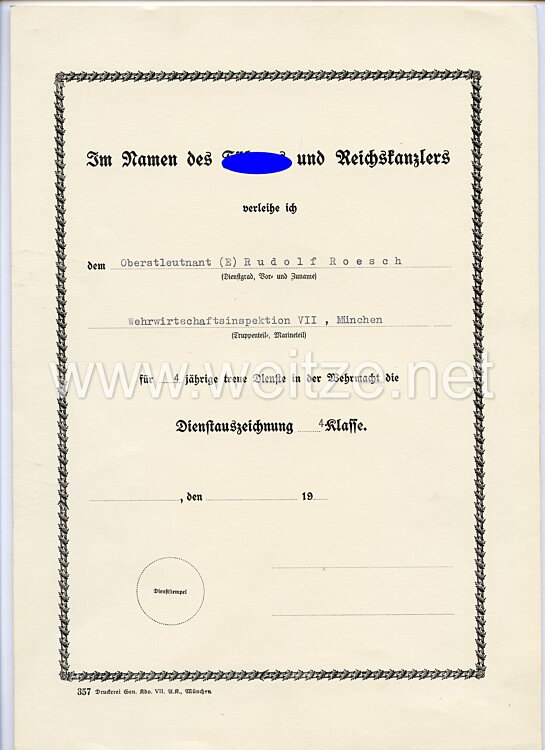
The present trio begins with the award certificate for the 4th Class Service Decoration to an Oberstleutnant with the addition “(E)”, indicating a Supplementary Officer (Ergänzungsoffizier). This category included officers who were not part of the active forces but served in reserve status or in special administrative functions. The fact that this certificate is not dated and stamped suggests it may have been issued during reorganization or as a replacement document.
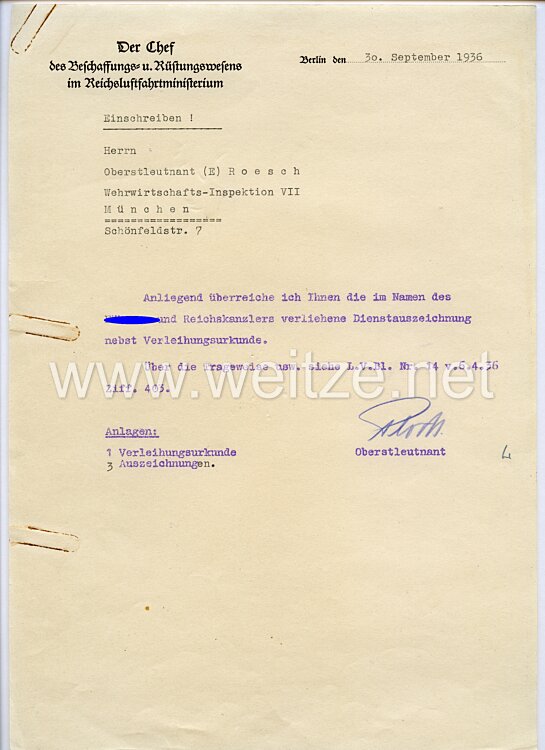
The transmittal letter dated September 30, 1936 comes from the Chief of Procurement and Armament in the Reich Air Ministry. This ministry, under the leadership of Hermann Göring, was the central authority for all Luftwaffe matters. The Procurement and Armament Department played a crucial role in building up the German air forces, which had to be rebuilt after World War I and the Treaty of Versailles. The official founding of the Luftwaffe was announced on March 1, 1935, and massive expansion followed in subsequent years.
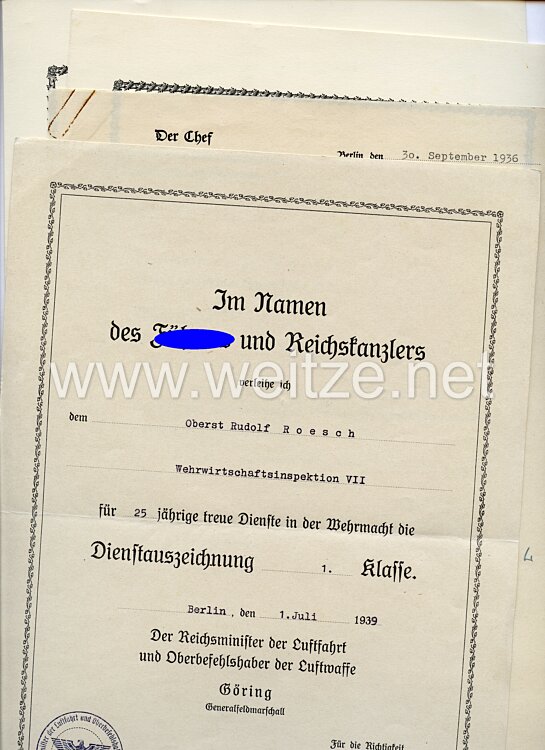
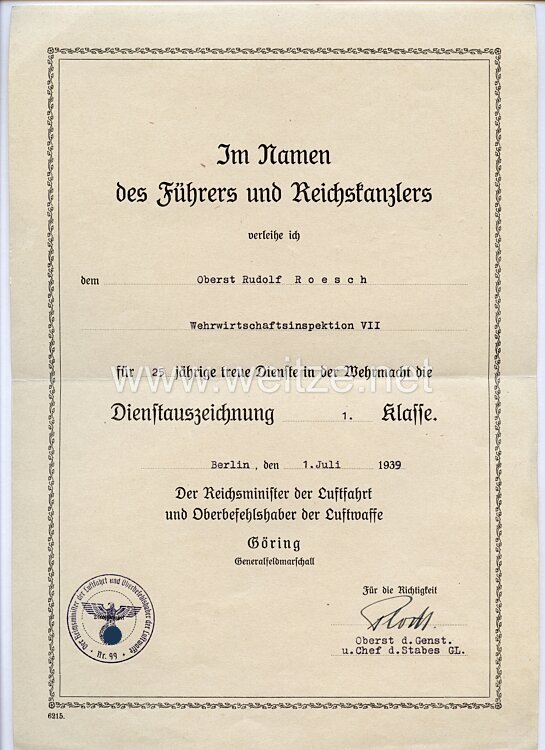
The award certificate for the 1st Class Service Decoration, issued on July 1, 1939 in Berlin, documents the peak of the officer's career. By this time, he had already achieved the rank of Colonel and could look back on at least 25 years of service. This means his military career likely began in the Reichswehr of the Weimar Republic, possibly in the early 1920s.
The Wehrwirtschaftsinspektion VII in Munich was part of a nationwide network of inspectorates responsible for economic mobilization and war preparation. These institutions, which corresponded to the military districts (Wehrkreise), coordinated cooperation between military and industry and were responsible for ensuring armament production. Wehrkreis VII encompassed Bavaria and had its headquarters in Munich, an important industrial and administrative center of the German Reich.
Service with a Wehrwirtschaftsinspektion was of great importance for war preparation. These officers were responsible for planning and supervising armament production, distributing raw materials, and coordinating between civilian economy and military needs. Especially in the Luftwaffe, which required an enormous industrial base for the production of aircraft, engines, and equipment, these functions were essential.
The period between 1936 and 1939, covered by these documents, was a phase of intense rearmament. The German Luftwaffe expanded dramatically, both in personnel and materiel. The number of aircraft and units multiplied, and Germany systematically prepared for a major war. The Wehrwirtschaftsinspektionen played a key role in transforming the German economy into a war economy.
The fate of many officers of the Wehrwirtschaftsinspektionen after 1945 varied greatly. While some were held accountable for their role in armament production, others were able to use their technical and administrative skills in the post-war period. Detailed documentation through such document trios enables historians today to trace individual career paths and better understand the structure of the National Socialist military apparatus.
These three documents are thus not only personal decorations of an individual officer but also important historical sources that provide information about the organization, hierarchy, and functioning of the German Luftwaffe in the period before and at the beginning of World War II.