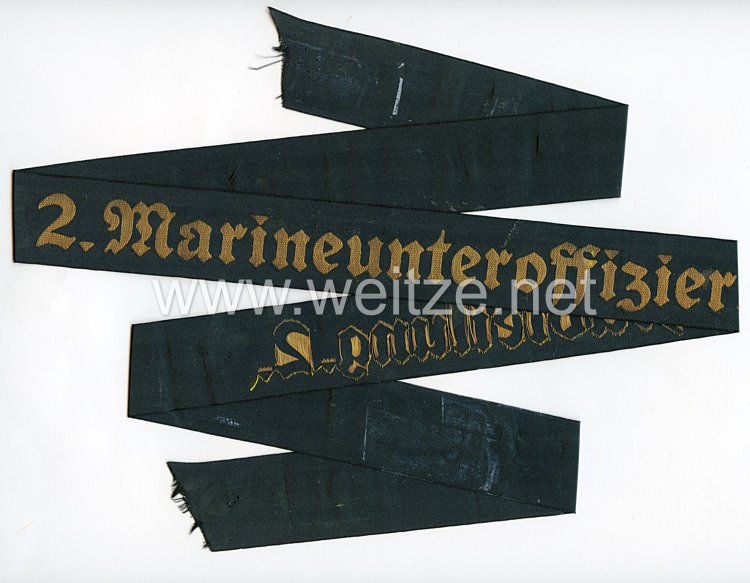
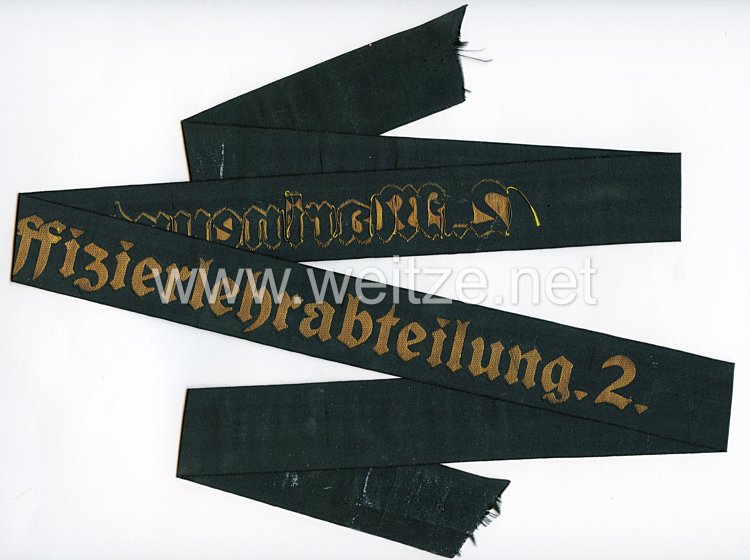
Kriegsmarine Cap Tally "2. Marineunteroffizierlehrabteilung 2."
The cap tally of the 2nd Marine NCO Training Department 2 represents an important aspect of the training structure of the German Kriegsmarine during World War II. These cap tallies, worn on the peaked caps of naval personnel, served not only as identification markers but also documented organizational affiliation within the complex structure of the German Navy.
The Marine NCO Training Departments (Marineunteroffizierlehrabteilungen) were specialized training units responsible for the education and professional development of non-commissioned officers in the Kriegsmarine. The NCO corps formed the backbone of the German Navy and required thorough technical and military training. These training departments were established during the rearmament phase of the Wehrmacht in the 1930s, when Germany massively expanded its naval forces contrary to the provisions of the Treaty of Versailles.
The metal thread woven execution of this cap tally corresponds to the high-quality manufacturing method used for official Kriegsmarine cap tallies. In this technique, golden or silver metal threads were woven into the black base fabric, making the lettering particularly prominent. The standard length of approximately 117 cm corresponded to the regular dimensions for Kriegsmarine cap tallies, which were sized to fit around the cap with the characteristic two flowing ribbons hanging at the back of the neck.
The organizational structure of the Kriegsmarine comprised numerous training facilities at various locations. The numbering “2nd Marine NCO Training Department 2” indicates a specific subdivision within the training system. Such units were typically stationed at major naval bases, such as Wilhelmshaven, Kiel, Stralsund, or Flensburg-Mürwik.
Training in the Marine NCO Training Departments included both theoretical instruction and practical exercises. NCOs were trained in navigation, weaponry, mechanical engineering, communications, and maritime tactics. The duration of training varied depending on specialization but could range from several months to a year. After successful completion, the NCOs were assigned to various fleet units, U-boat flotillas, or coastal fortifications.
The cap tally itself followed the precise regulations of the Kriegsmarine uniform code. The tradition of cap tallies in the German Navy dates back to the Imperial era. While enlisted ranks wore cap tallies with ship names or unit designations, the tallies of training units marked the temporary affiliation during the training period. The lettering was executed in the characteristic Antiqua script prescribed for Kriegsmarine cap tallies.
The present adhesive traces on the described specimen suggest that the tally may have been preserved for documentation or collection purposes. This was a common practice after the war, as many veterans and collectors preserved memorabilia.
The historical significance of such cap tallies lies in their function as authentic period documents. They enable the reconstruction of the organizational structure of the Kriegsmarine today and provide insight into the training system of one of the most modern naval forces of its time. For military historical research, they are valuable sources as they document specific units and help decipher the complex structure of the German Kriegsmarine.
After the end of World War II in 1945, the Kriegsmarine was dissolved, and with it disappeared the training facilities. The preserved cap tallies are today sought-after collector's items and important museum objects that document a specific aspect of German naval history.